The Social Seller & Social Buyer

Hi gang!

Let me know what you think of this project!

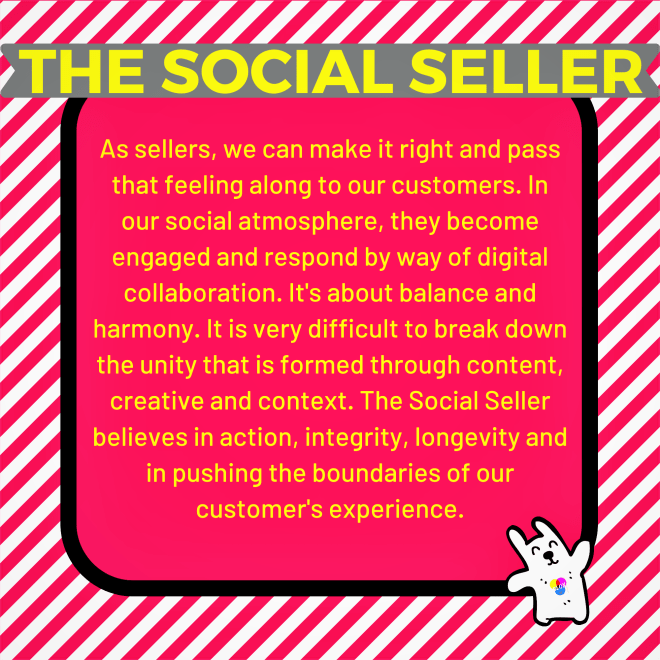
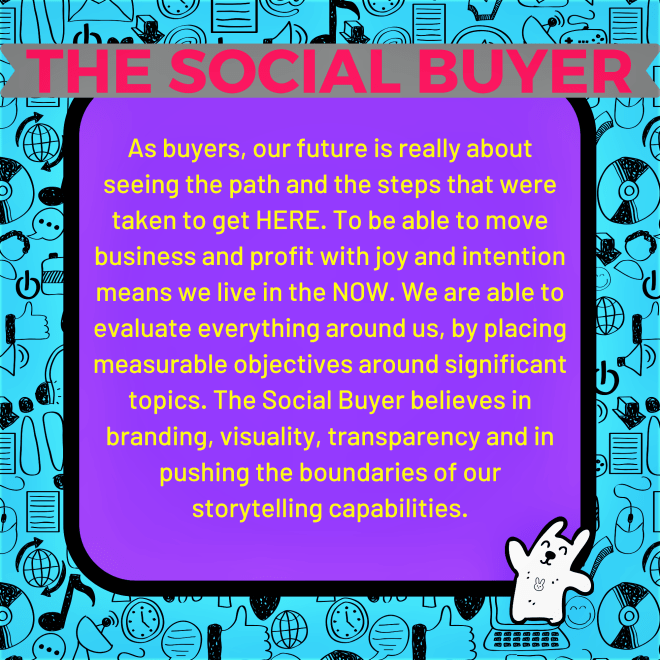
In my next few posts, I will showcase elements extracted from a direct mail proposal I created about brand strategy. The images below are a continuation of my Seller & Buyer persona study (also see image description in Previous Projects) and comment on the social aspect of selling and buying in the marketing industry.

Here is a pertinent excerpt from another relatable post Brand Names

For example, we (Sellers & Buyers) make the same, dedicated connections when observing a special life experience. Then, this can be observed through products and services. We recall brand names and in the long-term, we remember who you are for what you can bring to the table. Then, the name you have chosen to attach to your products and/or services will become synonymous and eventually engrained in time.

The original document was printed on glossy cardstock and sized like a 10″ vinyl record cover. They were presented in a stack, so that the viewer could lay them out on a table and take in a visual and sensory experience.

I placed a variation of the BLOX rabbit mascot in the bottom right hand corner of the images, the seller mascot wearing the creative BLOX logo and the buyer mascot wearing the technical BLOX logo. I’ve just recently defined this aspect of my brand and have much more to explore regarding it in the future.

Here’s an interesting article you should read – Why people focus on the right-hand side of a design taken from creativebloq.com.

9

10.png

Project Future – Can Something Become Practical in Theory?

Hey gang!

I am futuristic and that’s final. My mind lives in the future. Theoretically, I train envisioning that we can live in an entirely digital space. Practically, we live in this space doing regular things, but we also fend for ourselves using our brains. Oh, so this is life! Let’s put a couple of examples into perspective. Note: this post is starting to examine the concept of ‘internet of things’.

Abstract – thing / being / human / agreeance / motion

We live on a physical planet where issues like climate change are just beginning to surface. This a real and serious thing. A 16-year-old climate change activist from Sweden, Greta Thunberg is fighting with global politicians pleading, “How dare you!” Her statement is full of impatience. Does this quantify or qualify the time it has taken to have a crisis like climate change in focus? Now envision, in an utmost technologically advanced society, affecting the outcome of global issues via thought. Think about this – do Thunberg’s words permeate:

an action / integrity / longevity (experience) *creativity +strength

or

a brand / transparency / visuality (capability) *productivity -weakness

In certain applications that are already in place, we could debate the efficacy of an activist’s approach. However, would there be more power in advertising or marketing a cause if the objective considered certain design elements or art attributes? How do we implicate values like belief, trust and faith into a balanced and harmonious solution? And what would be the outcome of such an act? More opportunities? Less threats?

Think ads, television, movies, radio, books.

If those in charge of operating the goods either 1 – don’t fully comprehend new technologies due to incumbent roles and desires of maintaining diplomatic consensus or 2 – need to allocate funds to get everything in place, this does not mean they’re not participating in or understanding at all. And I’m talking highly established and evolved grey matter here! Executives of all sorts know, but the argument could be that we may potentially lack tacit knowledge and this is required to engage with younger generations or for that matter, older ones too. Throes of people that might already comprehend digitization (including all levels of being – thing, human etc.) are waiting for two things – a revolution and massive change. How is it going to pan out?

An example of Global Comprehension at work –

Do you remember when Facebook’s Mark Zuckerberg endured a 2-day congressional inquisition on the possibility that his company helped to fix Trump’s election campaign by intentionally (or unintentionally) releasing Facebook user data?

  • What was that all about?
  • How would you explain it to a Baby Boomer, Millennial or Digital Native?
  • How did this issue affect us in terms of technology?
  • How did this issue affect us in terms of marketing and advertising?
  • How did this issue affect us in relation to design?
  • Does it bear any importance?
  • How do we begin to explain these types of situations without being merely journalistic or too afraid to elaborate in a caption?
  • Should it matter and why?

We are honourably asking, what does Facebook incentivize and why? Personally, I think they are doing something amazing and are truly planning for our future.

In spite of everything, both Thunberg and Zuckerberg bear weight and responsibility representing modern dilemmas that many people don’t want to talk about. Or perhaps won’t or can’t.

Q: So, what are these dilemmas that require Global Comprehension?

A: Critical mass (Thunberg example) and artificial intelligence (Zuckerberg example)

Hypothetical Solution: recognizing power in unanimity (Thunberg example/things in agreeance) and leading with a ‘Productive Creative’ brain (Zuckerberg example/things in motion)

Note: the term Productive Creative is explored in Hustle & Float, a book by Rahaf Harfoush, a strategist, digital anthropologist, best-selling author and Executive Director of the Red Thread Institute of Digital Culture. She also teaches “Innovation & Emerging Business Models” at SciencesPo in Paris. This quote explains Productive Creative further –

But what happens when the product or service we are providing becomes more intangible in nature? The economy’s gradual shift to include more knowledge work meant that creativity was suddenly a highly desirable trait. That’s where the Productive Creatives came in: to stay relevant and profitable in a rapidly evolving economy, companies desperately needed problem solvers, strategic thinkers, and idea generators. This new type of work created a ripple within traditional workplaces, which now struggled to apply the same clear-cut approach to the creative class. Organizations had to adapt the decades-old systems that developed standardized organizational capabilities to ones that cultivated individual experts who could respond to market conditions with agility.

It would be time to show people – from all walks of life – what is actually going on. There is no need to be livid or paranoid or just plain complacent; if we just had Global Comprehension in place!

So let us say that today, we have the power, we have the goods, and we most definitely have the stage to set our differences aside and come up with new and inventive ways to approach our problems. So, the question becomes – can we altruistically and artificially fix problems like climate change? Could all the world’s brains come together and compute a solution that’s entirely technical (it could just be code of us walking around – engineering a practical application of semantics and proxemics really), but that would emote a creative shift in the planet’s thought processes, all things included? Without the desire to push our creative and technical limits, we will not progress. We will not move forward with fundamental ideas like artificial intelligence or critical mass.

If we can understand the essential framework of these new systems, future generations can develop and implement changes. Gen Y will test and research, then together, all generations can draw some very much needed transparent, accurate and responsible conclusions. The funny thing is, when the revolution (arguably renaissance even) is over and done with, what will be left? In other words, if there is no dilemma, did the dilemma even exist in the first place? This is my theory on Practicality – one planet, 1 human!

Uh-oh!

Today, let’s be practical (according to http://www.dictionary.com):

  • relating to practice or action
  • consisting of, involving, or resulting from practice or action
  • of, relating to, or concerned with ordinary activities, business, or work
  • adapted or designed for actual use; useful
  • engaged or experienced in actual practice or work
  • inclined toward or fitted for actual work or useful activities 

This is a timely discussion and we are all a part of it. How does this make you feel? Worried, scared, unusual? Would you be interested in exploring these ideas further if they were presented differently? As a note, I am always speaking to a mainstream audience. I think connections need to be made for each and every one of us, not only for those residing in an academic pool.

Great work, talk soon!


#impromptus

Hey everyone!

Hope your weekends were fun!

I’ve started a third campaign called #impromptus. It’s focus is to develop and deliver brief commentary on interesting research I’ve come across relating to art + digital marketing + social media.

My goal with this campaign is to disseminate any relevant literature, then to relate researchers’ messages to my own studies on ‘global comprehension’. I’m still enraptured by the idea of defining the digital condition of human life, so I will use my blog ChonaBLOX and my articles on LinkedIn as an educational platform to inspire my vision – exploring the right-brained application of artificial intelligence.

Most of us don’t have time to read through pages and pages of research and sometimes content becomes too complex, so I will use simpler, more modern language in my interpretations while linking back to the original idea at hand.

To get us started here’s a great quote about gratitude –

“I looked around and thought about my life. I felt grateful. I noticed every detail. That is the key to time travel. You can only move if you are actually in the moment. You have to be where you are to get where you need to go.” – Amy Poehler

Takeaway: one must perform self-talk to quantify positive life events. For example, you could say – in one month’s time, I completed an intensive course, I received 3 valuable certifications, I took less naps during the day and I ramped up my workout routine. A grateful outcome would be an instance where you could tell yourself positively – I can tell the difference! I did this within this time frame! And then, reiterate the reason WHY this is of value. It really is all in the details. The details of putting the work into practicing self-worth. Time travel is just another way to say, I can live in the past to qualify my present. Then, these actions together, can bring about my future. Our future is really about seeing the path and the steps that were taken to get HERE. And Amy is entirely correct, to be able to move (with joy or intention) means you live in the NOW, you are HERE and able to evaluate everything around you, by placing measurable objectives around significant topics. For example, you could say – that test was comprised of 53 questions, they were challenging as they presented theoretical and/or fundamental situations that required analysis which uses thinking and my brain. This is significant because one year ago, I didn’t even know what marketing was. I didn’t even know that you could run Facebook Ads. I didn’t even know that I had the ability to study or the capacity to learn complex subject matter. On my own. With barely any additional help. This subjectification (or my attitude/viewpoint) classifies (makes relevant or arranges) each and every action in (my) life and like the #impromptus post below comments, this is the continual motion, the framework, the mechanism that guides our work on social media platforms like Instagram. As creators, we can make it right and pass that feeling along to our audience. And they can respond or reply by way of digital collaboration. And this example of gratitude is tough. It is very difficult to break down unity through creative + messaging. I hope you can make that connection!

So without further ado, here’s my first #impromptus post – Gratitude Via Social Media

#impromptus graphic/template - gratitude via social media

I hope you like this new project, any feedback is more than welcome!

The power is in us to incite wonder and change!

Cheers!

5 Ways Social Media is Changing the Way We Communicate

Hey everyone! 

Let’s jump right into it. 

We all know things are different. We rarely use our phones to place calls anymore. Progressively, we are relying on different social media platforms to reach out – to friends, family, co-workers and customers. We can interact with more people at once. No need to place a phone call (unless you want to close a deal); we can send a snap using Snapchat, add tags to Instagram Stories or relay continuous messages via applications like Facebook Messenger. And think, we are doing this while doing the same thing with others. All at once. In synergy, together. Thing are really changing!

The following listicle written for Jelly Marketing, touches on this new ‘permanent impermanence’ or our ability to communicate in infinite ways via digital platforms, a.k.a. social media. Social media is here to stay. Read on to find out HOW social media maximizes communicative potential!

1 Creating New Sets of Social Skills

One of the most amazing ways communication has changed via social media, is in its integration of new sets of social skills or groups of attributes more focused on visual communication. The people we are interacting with are more inclined to be engaged, because they are constantly absorbing positive social imagery – videos, gifs, stickers, emojis and even colourful applications in the form of digital writing instruments like pencils and paintbrushes. Communication has become fun! It’s almost as if this function of elements has paved a way for our social skills to light up a space. Try using Canva to bring light to your brand, for example. In this space, our feelings and emotions are heightened, so as a result we are more likely to engage in this new way, time and time again. In our current adaptive environment, this may contribute toward new forms of success.

New York Behavioral Health emphasizes this idea stating –

“Our ability to process emotional cues is associated with personal, social and academic success (Knapp & Hall, 2010).”

2 Leading with Identity

Social media has provided us with ways to express ourselves, something that is more difficult to do in a short face-to-face encounter or during a mobile phone call. We can use all the different platforms to form our image & identity, then we can choose the ways we want to share this information with others. And the greatest thing about social media is that again, it is a 2-way communication channel, so we can interact with other individuals who have similar interests or attributes. This may increase our levels of self-image or esteem. Of course, there are many discussions that would argue against this, but the point of the matter is – it’s your identity and YOU can choose. We can start to pick apart our best features and develop them further using social media aspects like, a profile picture or Facebook cover photo. Even curating a group of boards showcasing who you are and what you like on Pinterest can help develop your identity!

Dr. Uğur Gündüz is an Associate Professor at Istanbul University for the Faculty of Communication and he wrote a research article published in 2017 for the Mediterranean Journal of Social Sciences on The Effect of Social Media on Identity Construction (www.degruyter.com).

Here is an excerpt relating to my idea of leading with identity –

Social media enables identity expression, exploration, and experimentation; something natural for the human experience. It is the agencies in real life, which provide a source of names for different sectors, that inspire the internet communities and the interactions they make within themselves.

3 Adaptive Learning

The ways that we communicate via social media are vast. It is not only a means to communicate with other people in new and creative ways or for establishing a specific digital identity. It is a structural tool that can be used to learn, teach and educate ourselves and others by employing incentive and authoritative techniques. Take for example, Instagram. Today’s Social Media Coordinators put together detailed strategies while skillfully composing content + format. We are learning to use the left side of our brain by applying grids, patterns, permutations and combinations. On the other end of things, we are training the right side of our brain by developing context and adding visuality to the mix.

The future of Generation Z will rely on social media to communicate findings and research relating to topics that are impacting the world. A couple of examples are the state of the science behind climate change or evaluating mental health based on technological consumption. According to a recent study, more and more teachers and professors are incorporating social media into their classrooms to engage students and support their educational development, whether online or in person (Ashford University).

4 Critical Mass

In marketing, critical mass is the idea that one, small movement in the form of an idea or expression can expand the sheer power and capacity of digital media. This can work in two ways, one – it helps users become aware of today’s most pertinent topics, current events, trends and critical intelligence that affect the way we communicate and do work. We don’t need to rely on a newspaper, we can obtain various points of view on the same topic from several different sources. Then, we can cross-postulate for our own purposes or to share with others across platforms like a blog or company e-newsletter. We can even use the least amount of words to create sustainable influence and significant reach (Twitter). Sharing information has never been so easy! We need to take advantage of critical mass in that sense. The second way is – contributing toward HOW businesses communicate. This impacts brand awareness, brand loyalty and even methods for prospecting and retaining clients. Sellers and buyers can flaunt their understanding of today’s fluctuating market (not just stocks and bonds stuff) without having to depend on outside sources, if they are connected to social media. It’s a two way street and we’re giving each other high fives!

Merriam-Webster points out that, “Once these elements reach the size that enables a company to operate efficiently, it is said that a company has reached its critical mass. Critical mass is the point at which a company becomes profitable.”

In this case, the elements are social platforms which provide new hubs of information that can make or break a company’s profitability. Social media has truly become a vital and crucial form of business development. Businesses cannot thrive without it. We communicate and work with it. Period.

Check out this article for more information – Social Media: The World’s Newest Source of Profit

5 Communicating Your Vision

In an era prior to social media, how did we figure out or map our goals? Probably with a vision board, a thought bubble written down on paper or by simply sitting down, daydreaming about what we could accomplish. This has changed so much today. Now, we can objectify our goals and visions using platforms like LinkedIn. Here, you have ample space in the About section to describe your ideas. It becomes a part of your LinkedIn profile, so other people, including employers, can see what you’re all about. But what’s even better is, you can use this section to produce timely updates relating to your journey. Others are watching and they can see the progression.

Instagram alone has become an indispensable tool for business owners. Through thoughtful curation and strategy, businesses can be portrayed in a respectable light that touches on what they offer, how they care about their customers, and in other words, what they do best. Think – campaigns that reflect a company’s core values, promotional posts that keep customers interested in products and services or spotlights on employees and company best practices, so customers can really know what they’re putting their money toward.

The hope for today is that we may collaboratively succeed using our most innovative tools (social media) and techniques (social media strategy), to communicate with others from all facets of life.

Jelly Marketing is an award-winning Digital Marketing & PR firm providing digital ads, social media, SEO, & public relations services to brands in Vancouver and the Fraser Valley. Their case studies explore various client objectives and the innovative + mainstream ways we can produce results by catering toward communicating vision. Have a look!

That’s it for today and remember everyone, always think of PRAC and are you living it today – Popularity, Relevance, Authority & Credibility.

The power is in us to incite wonder and change!

Talk soon!

What is Marketing?

Hey gang!

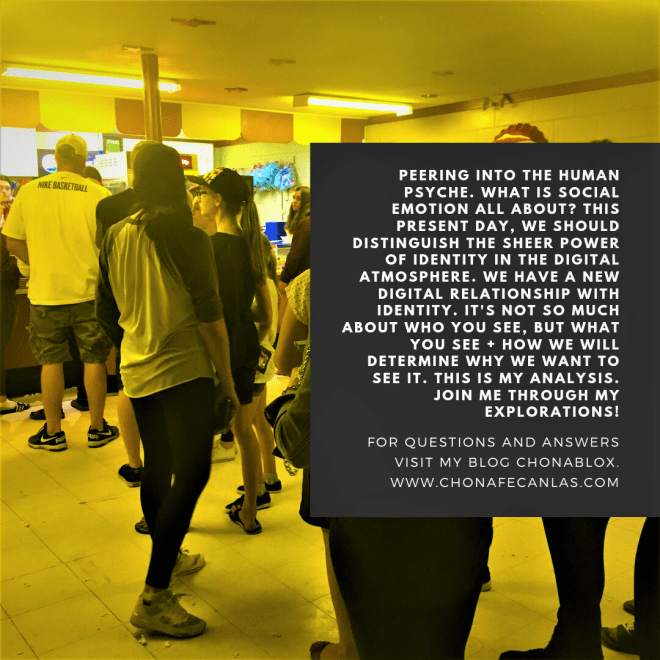
This content was developed prior to leaving VanWhistle Media. I wrote it in my small, orange notebook. I was thumbing through that today, putting some definitions together for my Definitions post. It’s amazing how you can return to something, months later and it has become more relevant than it was when it was originally written! The photo was taken at the Starlight Drive-In Theatre in Enderby, BC.

Social Emotion - Peering Into The Human Psyche

What do YOU think?

If you would like to see the Abstract for this post, shoot me an email anytime – info@chonafecanlas.com.

Cheers guys!

Launching #bloxbooks Sept. 17/19

Hey gang!

I’m starting a new regular topic called #bloxbooks.

It will showcase any recent books I’ve read and extracted elements that I believe are relevant to changing career paths or approaching life in a more creative + technical way.

My first book for this campaign is, Emergent Strategy by Adrienne Maree Brown.

Photo of book Emergent Strategy by Adrienne Maree Brown

The quote below is actually taken from the author’s blog. I find it ultra relevant as I search for the right company culture to work with.

Company culture is the personality of a company. It defines the environment in which employees work. Company culture includes a variety of elements, including work environment, company mission, value, ethics, expectations, and goals. – Definition from www.thebalancecareers.com

Brown’s post resonates with me, because it is primarily focused on trust and in my interpretation, what we should experience as Sellers & Buyers in the marketing, advertising and public relations industry.

Have a read and please let me know what you think!

trust the people who move towards you and already feel like home.

trust the people to let you rest.

trust the people to do everything better than you could have imagined.

trust the people and they become trustworthy.

trust that the people are doing their work to trust themselves.

trust that each breach of trust can deepen trust or clarify boundaries.

trust the people who revel in pleasure after hard work.

trust the people who let children teach/remind us how to emote, be still, and laugh.

trust the people who see and hold your heart.

trust the people who listen to the whales.

trust the people and you will become trustworthy.

trust the people and show them your love.

trust the people.

My favorite is: Trust the people who listen to the whales.

Psychology Today says, “Creativity comes through personal ecstatic experience, play, and a kind of osmosis: “Research conducted at the University of Kansas concludes that people from all walks of life show startling cognitive improvement — for instance, a 50 percent boost in creativity — after living for a few days steeped in nature.”

Do YOU believe in this? Why don’t we try?!

Organize a nature retreat for your team, or implement weekly yoga classes set outdoors. I remember when things got tough at my previous corporate job, I would schedule 5K runs at lunch to clear my brain and reset my mind to returning to a high performance environment (my job was that demanding).

I can usually say, if my body demands more exercise, it may be a sign of burnout, so it is imperative to carve out physical, mental and spiritual time to take care of yourself.

Do you feel this way when you’re overworked? Books can help, no?

The power is in us to incite wonder and change! 

Talk soon!

The Development of Trogg

Trogg a new potential character from Elevententeen

SEO

Hi everyone!

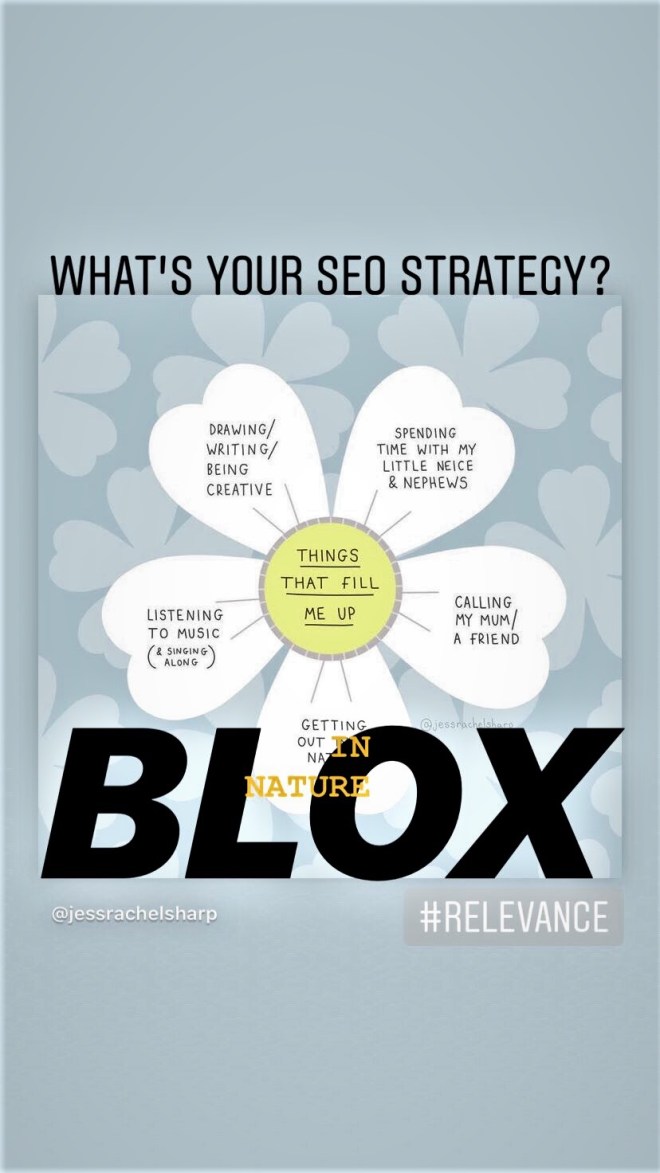
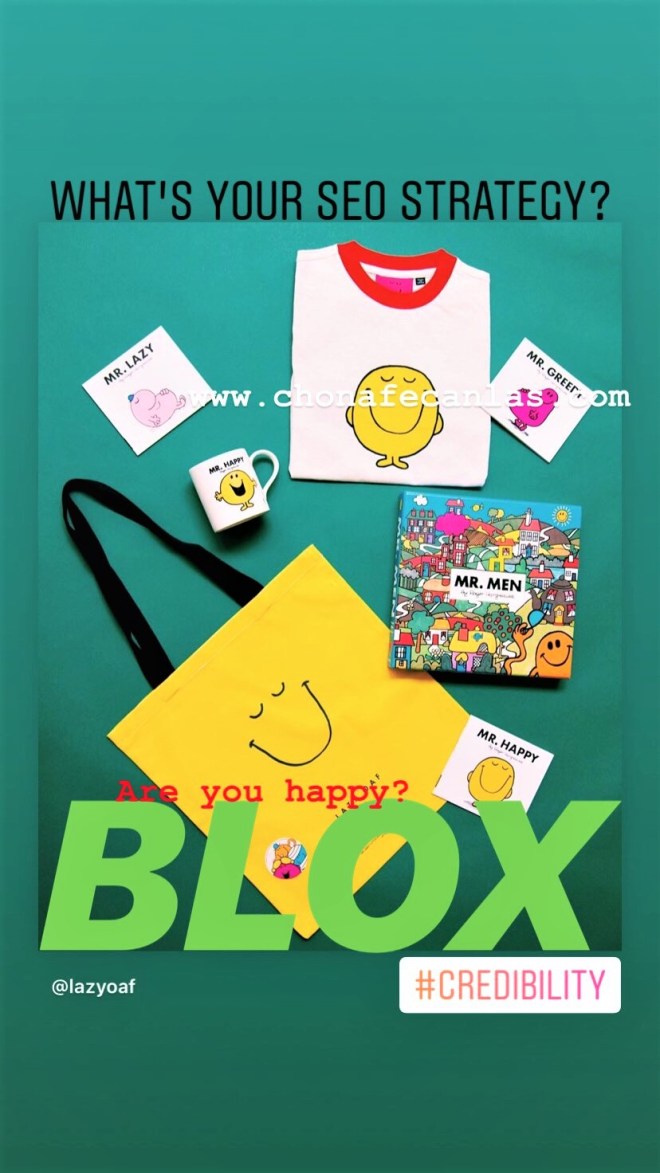
Just a short burst of info here. What are you drawn to? Do the colours play a significant role in your interpretation? What connections can you make with the chosen imagery attached to each hashtag?

A perfect brainstorming exercise for design newbies – make a list under each hashtag including transferable elements (actual aspects and items like a brand name or object) and attributes (descriptions and words) for each. Aim for 50 answers, then narrow down to your top 10 answers, then again to your top 3, then top 1. What conclusion can you draw from this experiment?

Always remember the acronym PRAC – Popularity, Relevance, Authority & Credibility. This will help you target your audience and ensure that your content is set up to improve your overall search engine rankings.

Yes, yes…SEO is a lot more complex than a simple acronym, but sometimes starting off with something more general helps to develop your digital marketing strategy or plan more succinctly down the road.

I will get into this topic (SEO) further in the  future!

8516971dc8824311b90739d6057393fc_Moment

3BC9F832-AADE-448A-A8C6-FBD0EEE0A5CE

FA7C92B5-50E1-40FE-A711-714E4251A799.jpg

B63AA3B1-EB38-4600-A85B-35C7CC4B6A72.jpg

5 Influential Marketing Personalities

Hi everyone! Without further ado…

We crowdsource (ideas). It’s our membership and contribution to the digital landscape. Wikipedia says –

Crowdsourcing is a sourcing model in which individuals or organizations obtain goods and services, including ideas and finances, from a large, relatively open and often rapidly-evolving group of internet users; it divides work between participants to achieve a cumulative result. The word crowdsourcing itself is a portmanteau of crowd and outsourcing, and was coined in 2005.[1][2][3][4] As a mode of sourcing, crowdsourcing existed prior to the digital age (i.e. “offline“).[5]

Crowdsourcing is a great way to develop content and topics for your target audience. I put together a listicle based on a few influential marketing personalities I admire. In my opinion, they provide some answers (to my design life) and a unique perspective. I hope  they can help you in any way, shape or form.

Also, here they are in a creative digital collage. Does it make you crave mangoes or money?

AA1581DC-2E9C-40B0-956F-8FBD3D35157C

1


Chris Do, Matthew Encina & the team at Blind

It started with advice from my brother. He goes, check out the vlog by The Futur. This happened right when I started at VanWhistle Media. I was looking for a way to feel inspired. These guys helped me identify high-end pricing techniques and I designed my website portfolio around a couple of videos they put out with creative director of Vrontikis Design Office, Petrula Vrontikis. I’m drawn to these guys for simple reasons – energy and passion.

2

Seth Godin

It started with an interview. Chris Do and Seth Godin, together, hashing out topics like, What is school for? Watch it on YouTube – Seth Godin—Make Something Everyday (Best Hour You’ll Spend Today). This was the first time I felt inspired to write continuously and I tried out (half of) his challenge by posting 50 blog posts, once a day. I didn’t quite make it to 50, but the point of the matter is, I identified with Godin’s creative process. He also coined the phrase Make Change Happen, a slogan I adopted for my artistic identity BLOX.

3

Barney the Business Guy

Just a straight-up, no fluff business guy, I follow Barney Cohen on Instagram. I can’t remember how our paths crossed, but he offers a refreshing, business-minded approach to life’s common obstacles. Coming from a corporate background, I identify with his mentality, clear reasoning and straightforward delivery. He has 50 years of experience in business, so his acumen is spot-on. You can check him out on Twitter as well.

4

Neil Patel

Shoot, I almost forgot! Neil is probably the most humourous, dramatic, yet to-the-point marketing entrepreneur I have come across to date. He helps me understand the importance of brand development and every time I come across his feed, I’m pretty sure we’re thinking the same thing. Quid pro quo at it’s finest, Neil can help you develop metrics that work and he will provide all the necessary reasonings behind it. On top of everything, he’s an excellent copywriter.

5

The Rock

To think mainstream is to truly understand the relationship between popularity and accessibility. The Rock shows us that fame can be your next door neighbour, unpretentious and welcoming. In the pursuit of greatness, his face and voice puts a sticker on my blank page. Everyone loves stickers. Not everything has to be complicated. Sometimes you are just a do-gooder with a gigantic heart. The Rock shares these emotions with me and his 154M followers.

What do you admire? Who inspires you to do better? Whether it be music or satirical retorts, we have something in common!


Consonance

IMG_2928

Hi everyone!

We do what we do! But without our mind getting in the way?

I sometimes find myself questioning my work. I ask myself – is it too ‘complicated’ for the ‘average’? Does it come off as ‘fluffy’ or ‘dense’? These words mean too many things, but we get used to one meaning, and that is not right.

And when our minds enter ‘the complex’, we should stop and perform self-talk. People avoid self-talk for fear that it gives others the impression that we’re ‘crazy’. I mean, my mouth moves when I’m thinking too hard! So what! Okay, it might just look ‘odd’. But nowadays, self-talk should be used as a positive, gentle form of therapy to get us back on track to believing in the idea of original intention. Google explores this concept readily, when it comes to understanding how people surf the internet. That being said, why is it today, that we feel an attachment to guilt, pity or shame when it comes to feeling a different way about something? Well, it could be ‘different’ things – an idea of interdependence, requirement or necessity.

When I came across the word consonance, I felt blessed and it quickly resonated with my current circumstance, because it challenges the notion of sleep (figure it out). Like take a break here and there, not everyone hates you, if anything shout it off the tallest rooftop – you are loved everywhere! Just go in with that attitude anyway, smile until it hurts. Find the humour in everything and go ‘nuts’, it’s not going to kill you to have fun! Here’s a bit on consonance as it relates to working and the whole job interview process thingamajigger.

Scott Olster, Ideas Editor at LinkedIn, wrote a brief article around “the idea of business trends, perspectives, and hot topics you need to know to work smarter”. He says –

Success can easily end up feeling hollow when it’s defined and measured by other people’s standards. For our work to have lasting personal value, author Laura Gassner Otting writes that we need to focus on developing what she refers to as consonance.

Laura is a writer for Harvard Business Review and she defines consonance as –

“Consonance is not just purpose writ large (and lofty). It’s your purpose, freely and clearly defined by you, and put into action through awareness of and alignment with your life’s plan. Consonance is when what you do matches who you are (or who you want to be).”

As I enter the interview zone, I will remember alignment with your life’s plans as another tip that will help me remember why this is taking so long. I’m dying here guys!

Hello. Thank you for the opportunity, now I have something to say…

Do you relate to this? What is the interview process like for you? Easy? Intense? How do you prepare?