Just a Moment for AI

Take a deep breath and think deeply. AI is becoming the structure of our world, no matter what shape or form that world takes. We are all witnessing it reshape how we think, create, decide, and execute. It’s enabling us to move faster, operate more efficiently, and, in some cases, reach a level of thoroughness that traditional processes struggle to match.

So, let’s start at square one. Why does the philosophical connection matter?

AI’s philosophical connection matters because it defines how we relate to technology – not just how we use it, but our relationship to it. It also challenges the assumption that intelligence is purely human. When a system can generate ideas, synthesize knowledge, and simulate reasoning, it pushes us to ask: What is original thought? Where does meaning actually come from? In that sense, AI becomes a kind of mirror – reflecting patterns, assumptions, and oversights, making our thinking more visible to a trained eye. But it’s not a perfect reflection. What it returns is shaped as much by the system as by us, which can create the illusion of truth when we’re really seeing a constructed projection. Used carelessly, that can blur our sense of authorship and originality. Used well, it can bring us closer to our new reality.

To elaborate.

AI may be blurring the boundary between information and discernment. While it can process, combine, and produce at scale, it lacks intentbelief, and accountability. It also doesn’t pass judgment, exhibit taste, or display empathy. These distinctions form what Blox calls your ‘Competitive Edge’. And note, these distinctions elevate us. They advance our critical thinking abilities. We move from being the primary producers of output to the editors of meaning – deciding what matters, what’s true, and what should be acted on. Most don’t see it this way, but AI gives us secret powers; it’s just a matter of recognizing them and using our self-awareness to do better work – on purpose.

And what about practicality?

In practice, AI reduces friction in how work gets done. It takes on the repetitive, time-consuming parts of work – research, synthesis, drafting, data processing – so people can focus on higher-value thinking. Instead of spending hours gathering and organizing information, you move more quickly to interpretation and decision-making – traits that might differ between man and machine.

And just to be direct about our positioning, we are on the side of humanness – because while AI compresses time, it’s still up to us to decide what that time is worth. Tasks that used to take days – thinking up social media content, writing a report, analyzing trends, building a presentation – can now be done in hours. That doesn’t just make humans faster; it changes how often we can iterate. More cycles, better outcomes. But wait, more work? We need to remember that those outcomes won’t magically explain themselves. That’s why some say AI improves collaboration. Now that we have more time to share, debate, waffle, and construct our ideas, they should carry more weight, and this, in turn, should augment our human capacity to learn.

So…

The distinction is hopefully becoming clear. Used as a shortcut, AI delivers increments. Used as a system, it compounds. Those who apply it sporadically, without understanding how to shape context or guide its output, will plateau. Those who integrate it into how they think and act critically will see exponential returns.

Better thinking. Sharper intuition. More willed execution.

Because when AI handles the production of information, what’s left is what matters most: how you interpret it, how you challenge it, and how you decide what to do with it. Thinking becomes less about generating answers and more about refining them. Intuition strengthens as you recognize patterns faster and question them more deeply. And execution improves because decisions are made with belief, empathy, judgment, accountability, taste, and intent, not just efficiency.

That’s the shift. To be in a mutually beneficial relationship with technology, not taking advantage of it, but giving and taking fairly, like how you would in a good marriage. Let’s look at how AI works with real people doing real life stuff.

Here’s example 1 of a marketing manager’s workflow to write a technical white paper:

Step 1 – Frame the topic and structure

Tools: ChatGPT, Perplexity AI, Claude

  • Pressure-test angles: “What are the most credible narratives in this space?”
  • Pull recent sources, reports, and citations
  • Build a structured outline (sections, arguments, flow)

Benefit: Faster clarity and stronger initial framing

Risk: Over-reliance on generic angles if not guided well, or applying critical thinking

Step 2 – Research synthesis

Tools: Perplexity AI, Elicit

  • Aggregate research papers, industry reports, and data
  • Summarize key findings and extract patterns
  • Cross-check sources manually for credibility

Benefit: Compresses hours of research into minutes

Risk: Missing nuance or misinterpreting source material

Step 3 – First draft development

Tools: ChatGPT

  • Feed structured outline + key points into ChatGPT
  • Generate rough sections (not final copy)
  • Focus on flow, completeness, and logical sequencing

Benefit: Eliminates blank page problem; accelerates momentum

Risk: Voice becomes flat or overly generalized

Step 4 – Refinement and editing

Tools: Grammarly, ChatGPT

  • Review for clarity, grammar, and tone
  • Tighten arguments, simplify language, or reframe sections
  • Manually inject brand voice, opinion, and specificity

Benefit: Higher clarity and readability with less effort

Risk: Over-polishing can remove distinctiveness

Step 5 – Final review and positioning

Tools: Human judgment, taste, and aligning intention (this is the differentiator)

  • Ensure claims are accurate and defensible
  • Align with brand narrative and strategic intent
  • Validate that insights are original enough to be valuable

Benefit: Maintains credibility and authority

Risk: If skipped, the content feels generic and interchangeable

Here’s example 2 of a visual artist’s workflow to understand and apply colour theory:

Step 1 – Research colour theory foundations

Tools: Perplexity AI, Elicit

  • Explore core principles (contrast, harmony, saturation, psychological impact)
  • Surface historical frameworks (Bauhaus, Itten, Albers)
  • Pull references from academic and art theory sources

Benefit: Rapid access to structured knowledge and historical context

Risk: Oversimplification of nuanced theory or missing deeper interpretation

Step 2- Study predecessors and movements

Tools: ChatGPT, Google Arts & Culture

  • Identify key artists and movements (Impressionism, De Stijl, Abstract Expressionism)
  • Analyze how colour was used intentionally across eras
  • Compare approaches (emotional vs. structural vs. symbolic use of colour)

Benefit: Faster pattern recognition across art history

Risk: Flattening distinct movements into generalized summaries

Step 3 – Translate theory into a postmodern application

Tools: ChatGPT

  • Prompt explorations like: “How would Josef Albers approach colour in a digital/postmodern context?”
  • Generate conceptual directions that blend structure with disruption
  • Explore contrast, irony, fragmentation, or reinterpretation of traditional palettes

Benefit: Expands conceptual range and reframes traditional ideas

Risk: Outputs can feel derivative without a strong artistic direction

Step 4 – Visual experimentation and iteration

Tools: Midjourney, Adobe Firefly

  • Generate visual studies based on colour prompts and themes
  • Test combinations, gradients, clashes, and unexpected palettes
  • Use outputs as references or starting points – not final work

Benefit: Rapid iteration and exploration of visual possibilities

Risk: Style homogenization or over-reliance on generated aesthetics

Step 5 – Refinement and artistic integration

Tools: Adobe Photoshop, Procreate

  • Reinterpret AI-generated ideas through your own process
  • Adjust colour relationships, composition, and texture manually
  • Anchor the work in your personal style and ensure it meets your goal

Benefit: Maintains authorship while leveraging AI for exploration

Risk: Losing originality if AI output is used too literally

I hope those examples were helpful.

Just so you know, this article came to light as I was creating a carousel for LinkedIn around three areas where AI is reshaping how work gets done. Let’s wrap up the article and review it here.

1 – Manual Thinking

AI shifts the burden from processing to interpretation. Studies show performance gains of roughly 10–25% in common knowledge tasks like writing, research, and coding when AI is used effectively. More importantly, it reallocates attention: instead of spending time gathering, structuring, and synthesizing information, we can move more quickly to judgment and decision-making, removing the shackles of demand and giving us a sense of freedom. This is where the real leverage sits. Yet many people and organizations are not there – only a small minority describe themselves as fully AI-integrated across workflows, suggesting the gap is not access or even application – it’s a reluctance to embrace what modernization requires.

2 – Creativity Block

When it comes to creativity, AI cannot replace it – it does, however, expand the surface area of possibility. AI is not here to generate the final output. It’s more about supporting iteration: reframing challenges, surfacing alternatives, and reducing the time to production. In practice, this means we can move through more ideas faster with less friction. The implication is subtle but important: creative blocks are no longer just about a lack of ideas, but about a lack of modern systems to support new and modern ideas. With tools like Midjourney and Canva, creators can go from idea to structured design to usable asset in shorter periods. Of course, this questions the entire notion of being creative – artists might want a long and difficult artistic process (I know this, because I have been a practicing artist). What that actually says about us is another topic.

3 – Adapting Systems

Let’s move forward and examine how AI shapes a legacy organization – directly aligning with our third core area: adapting systems. Many companies operate within a “modernization gap,” where fragmented tools, disconnected data, and inconsistent workflows quietly limit their ability to evolve. Across marketing, sales, and customer experience, nearly an entire workday each week is lost to these inefficiencies. Applied strategically, AI becomes that structure we talked about – integrating platforms, standardizing data, and enabling information to move seamlessly across functions. Without that alignment, complexity compounds. With it, AI becomes a coordinating force, helping us activate our Competitive Edge in personal and professional settings.

My final words.

What emerges across all three areas is a pattern. Note: this will be constantly debated. AI does not create capability in isolation – it amplifies the structure that already exists; it makes our existence within the structure more significant. This helps explain the current divide: while roughly three-quarters of us already use AI, many people and organizations do not fully appreciate its implications. The constraint is not technological maturity, but understanding AI’s impact, paired with our empathetic value, so we can leave a strong impression behind and continue moving ahead. And in that, shape the structure we’re all learning to operate within.

2-Way Communication

*Featured Image by Kasimir Severinovich Malevich | Black Cross (1923)

Hi everyone!

Here’s a rant I wrote when returning from a run a little while ago. Sometimes these ideas get stirred around during physical activity, perhaps a cocktail tumbled by adrenaline, cortisol and/or endorphins. Needless to say, it doesn’t take much energy for me to produce content, as I’ve said this time and time again. What takes energy – and time – is pairing down said content, so that it makes sense to my audience and can relate to my work as a whole. Have a read (some major thesis edits were made) and tell me this: how would we A/B test to further quantify/qualify this as an experiment?

 abstract – italic (R) : Visual Transparency & Communication, what makes AI right-brained, Insight / bold (L): platforms, IT, ME, WE, US, UP sales, Currency / underlined words have DUAL meaning (typically analog vs digital

2-way communication is what we’re dealing with today. It is no longer multiple channels (which I think is still the way most dominant marketers believe it to be), but 2 separate, individually performing platforms that interact with each other, either knowingly or not.

So, say there’s Platform A and Platform B. An example of this idea is when I sat down to use Markeko’s FB Blueprint Exam Study Guide YouTube video. As platform A, I intentionally participated in communication. Markeko was Platform B and he simply took my need and fulfilled it. Now, the way this works as a 2-way communication experience is what I take from him is fed back in his direction. He may not know this, or need it, however, the point of the ‘internet of things’, is this interaction in existence.

IT (internet of things) is a thing in the air, in our system, online that is being dispersed, received, re-dispersed and transmuted into other forms. These forms utilize adaptive learning or my exploration of AI as a right-brained system. IT will impact our economy and the poverty line, because we will be able to apply it to everything (Visual Transparency/Communication). WE can begin (as marketers, social media specialists, art/creative directors) to imbue all of our work with this element.

IT is not a new element. Marshall McLuhan’s explorations of ‘medium as the message’ were done in the late 50s. But our society has changed, and we have not figured out a way to apply his concept to our new technologies. IT has been explored by many (think movies, books), but we (apparently) have a small percentage of geniuses, intellectuals and educated individuals with high IQ+EQ+PQ (Global Comprehension), so we have an enormous remainder of people left out externally.

We are all internally capable, but the ‘alone ability’ to read or decipher content and context using right-brained AI in today’s digital circumstance deserves more recognition.

The amazing proposition (GC) is that, again, we as marketers and social media specialists have both the ability and avenue to distribute this new form of technology, as we are catering to clients, businesses large and small, that require some form of interpretation for their business needs. We are developing their projects, campaigns and overall the content of their identity with purposeful motivation. Therefore, behind the scenes, each project or campaign where we can apply the maximum effects of visuality (Visual Transparency/Communication) will cause massive changes in branding, marketing and sales applications. This holistic approach will impact the general stream of Insight (Insight Selling – right-brained) and paired with Solution Selling (left-brained), we are fully realizing AI and what it can do, for society, culture and most importantly …

Humankind.

This is my notion of XE (Currency). High-quality work that only a true and talented artist can create, combined with that person’s ability to make the most abstract concepts and ideas, will turn them into (Visual Transparency/Communication) money. I say money (interchangeable with Currency/Insight), because we know WHAT this is – customers, clients, target audiences are accustomed to a high-level customer experience.

According to my findings – this service is enjoyable. They want to deal with us. They want to see our results. The whole experience, for both the Seller & Buyer is productive.

And then, it just turns into a pay-it-forward type of system. Pay me, I will pay you back, well now, let’s pay them, and finally, why not just pay the whole existing world? I am scaling the most minute, Critical Mass to create a huge tidal wave effect. Again, this effect is imbued, may or may not be intentional, but the point is, it will snowball toward to right direction, UP.

This is the way I built it. More equality, happier business owners, more enticing and vibrant ads, campaigns that focus on world change and not simply on reach vs influence.

I would love to present this idea to the CEO of Microsoft and see what he would have to say. The most brilliant thing I have experienced, just in the last week, is while studying for the FB Blueprint exam (September 2019), I’ve begun to learn these new terms, almost 100% analytical and in turn I am funneling my right-brained ideas into beautiful left-sided friction. Highly needed as my conscience purports many individuals disagree with anything termed right-brained. So then, let’s get measuring!

The below is more abstract, but perhaps you want to read it –

The strength of application lies in between ability (to develop sound) and our ability to apply (these concepts) to solutions (sight) that would impact our interaction with customers. I often develop concepts in sets of 2. I believe DUALITY is a great way to present information (internally and externally), because it provides CHOICE (to see and/or hear). And everyone likes to choose what they think is BEST for them. This is where my Seller & Buyer persona study began – choosing a WAY to communicate, to tell a story, to sell/buy a TALENT, that’s IT/ME/WE/US/UP!

And so, can you see how we hear things together?

Recent Works – Direct Mail Proposal

Hey everyone!

Back into the swing of things.

This project may seem simple to you, but it challenges the idea of giving and receiving. In our digital space, we give constantly. And is the return of our efforts (ROE) measured through digital collaboration (DC) enough? Think: total impact of IQ + EQ + PQ or a new notion ascertaining digital quotient (DQ) / digital equilibrium (DE) / digital aspect ROI (DAROI). *I will explore these ideas in a future post.

When my mother received letters from her suitors (a common practice in her time), she did not write back. She kept each letter as if to say, I realize you are all interested, however I will hold in my heart, the one who is right. Is this action right? Is it just? We observe a similar practice in Japanese culture. The ritual is gift-giving (action), rather than the gift itself. Huffpost.com describes it in three steps – the reveal, the denial and the recognition. Or, revelation of intelligence + denying impact of emotionality + recognition of our role and place in digital space.

Using this interpretation, I could say that this project was aimed to reveal part of my identity/intelligence (I now question its visual and linguistic legitimacy in my current digital explorations), to reflect my denial of attaching emotion to the act of giving and receiving, and finally to sustain 2-way recognition/communication (between seller and buyer in this case) of the journey (action) itself – “For the Japanese, gratitude is a battle of endurance.”

We need to evaluate the tone and style of our expressions (gratitude being relevant today) as we delve further and further into a state of digital collaboration. We are impacted and at what point are we actually bringing more clarity to situations and circumstance? This is sort of the concept of ‘niceties’ and because I aim to maintain a certain level of accuracy in my work, details are important, but should my actions impose more or less scrutiny in regards to how my audience receives my message? This ties everything back to: total impact of IQ + EQ + PQ or a new notion ascertaining digital quotient (DQ) / digital equilibrium (DE) / digital aspect ROI (DAROI).

As you make your way through the below, try to remove feelings of assumption or judgement. Art is for everyone. Despite my specific approach, there’s a core selection from each demographic (Baby Boomer to Gen Z) that relates to my work in its simplest form, in other words – the visual and the language. For this project, I give it back to them!

Abstract – slash / roboto / elephant

This project started out with a photoshoot. I was dressed as Wenda (Where’s Waldo’s girlfriend) and my friend Allegra and I captured a series of images in and around Horseshoe Bay, British Columbia, Canada. There was lunch at Troll’s (fish and chips of course) and a brief introduction/chat with family business owner Ab Troll. Then, tea at another local establishment Flour Bakery and the final shot – me peering over … The Giant Hedge.

I developed the concept around a youthful, graffiti-inspired (old BLOX style) rendering of sweetness or the sweet spot/’magic’ that we often search for in our interactions with brands and art projects in general. My old style was always striking, vibrant and street culture inspired. Think – Keith Haring meets baby Andy Warhol.

The first portion centres around strategy, the next on my Social Seller & Social Buyer personas and finally, the Wenda portion (introducing myself within a specific context) finalizes the presentation. I printed the images on glossy card stock and hand-cut each one with a paper cutter. The final presentation resembled 7-inch vinyl singles and are displayed most effectively in a stack, layed out as placards on a table or mounted onto a wall with colourful binder clips (yellow, purple or stainless steel would work).

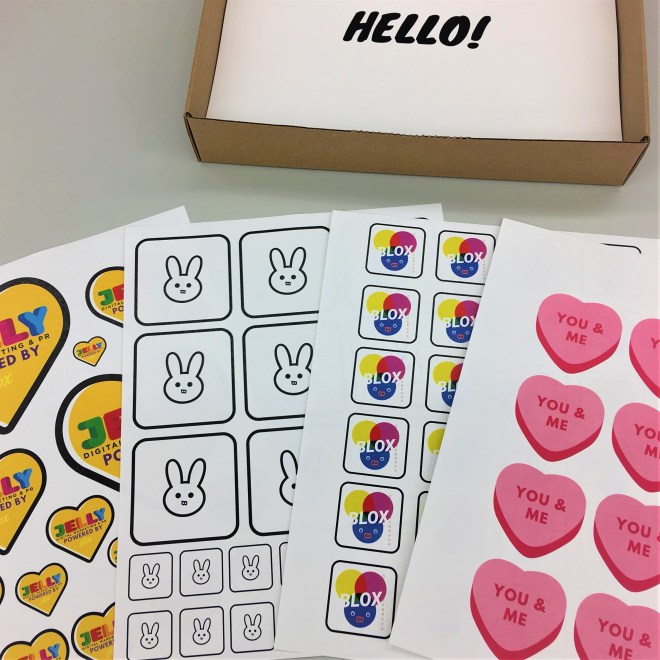
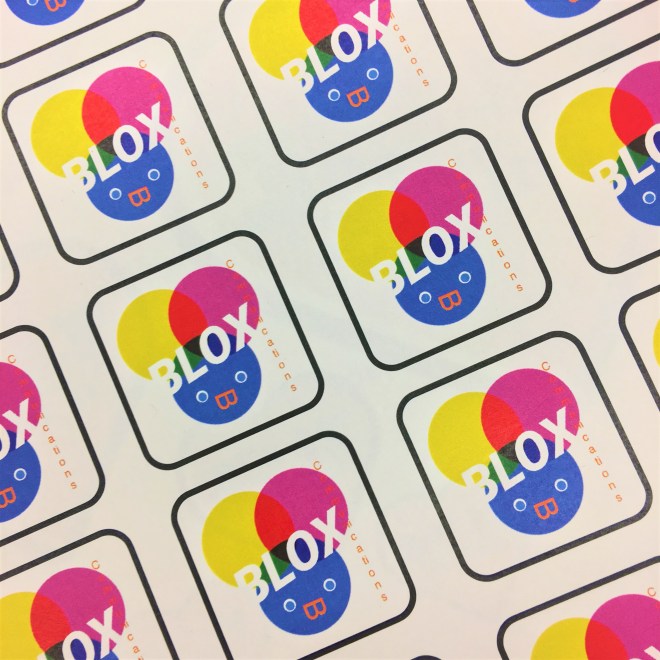
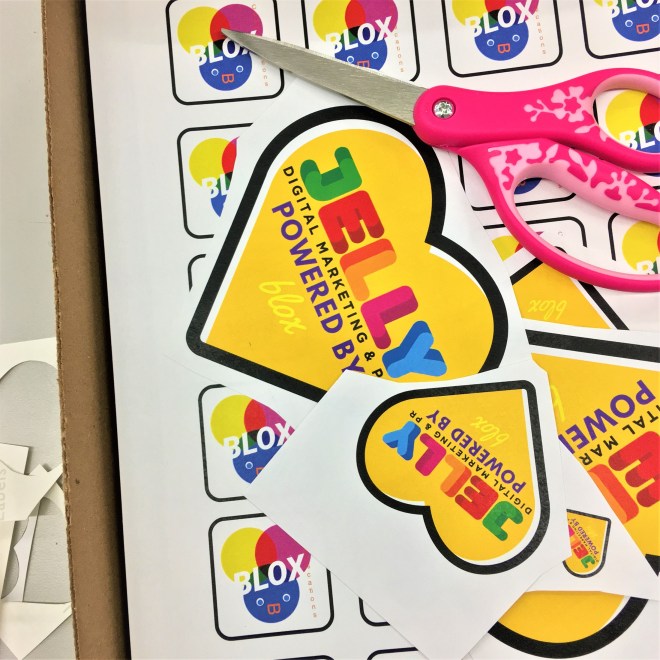
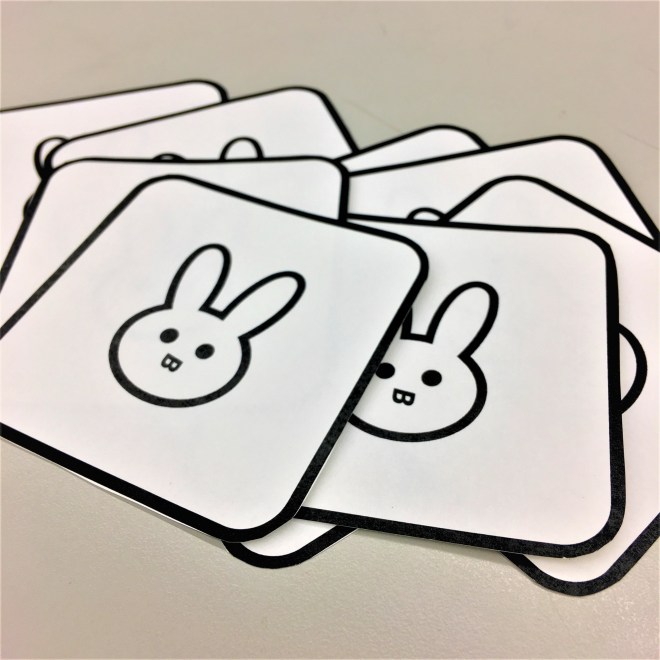
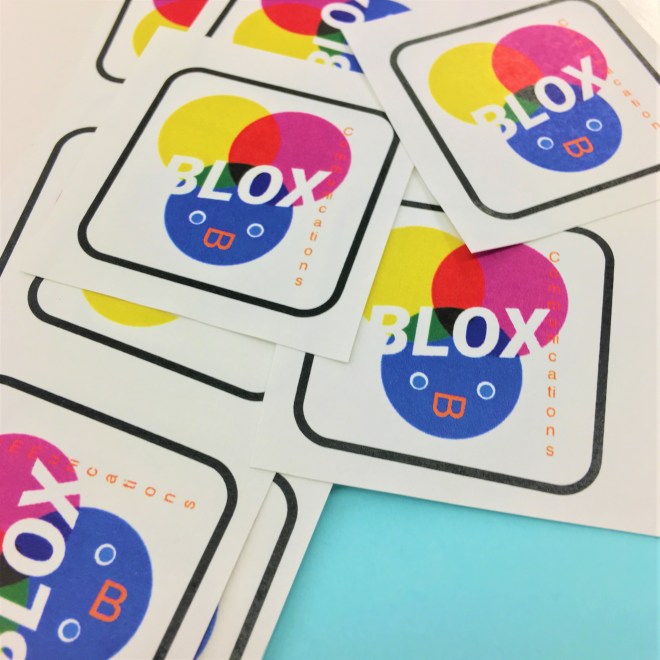
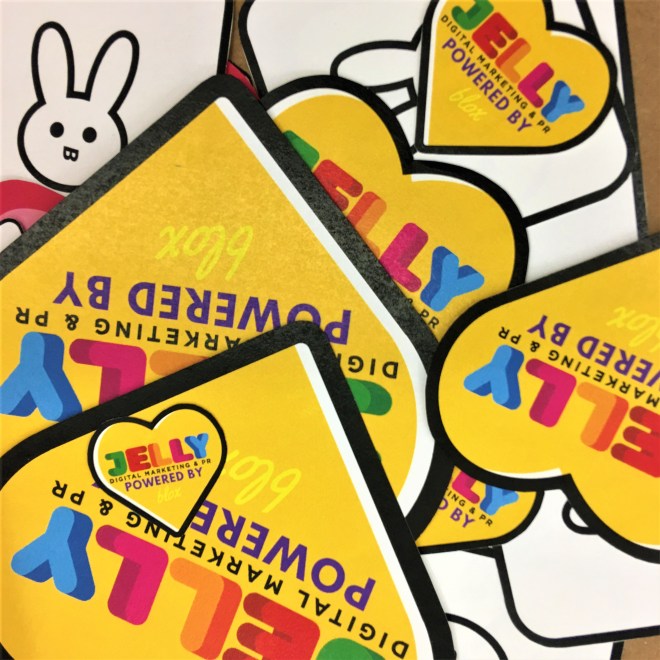
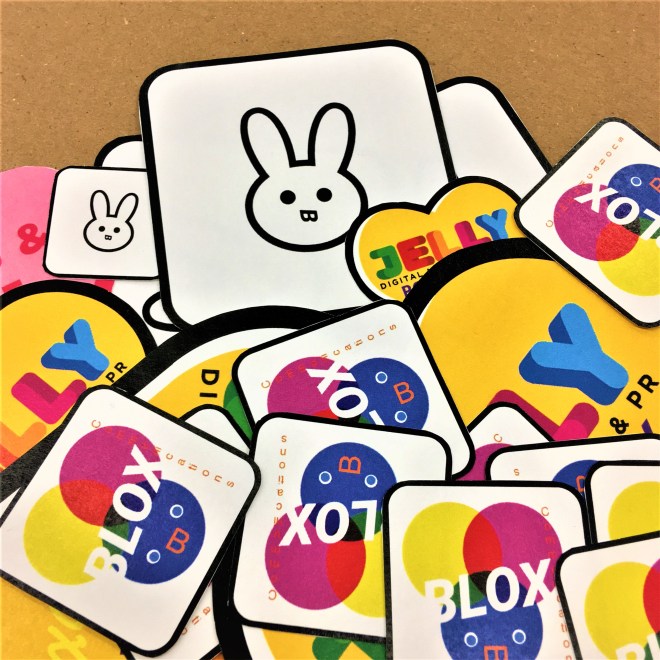
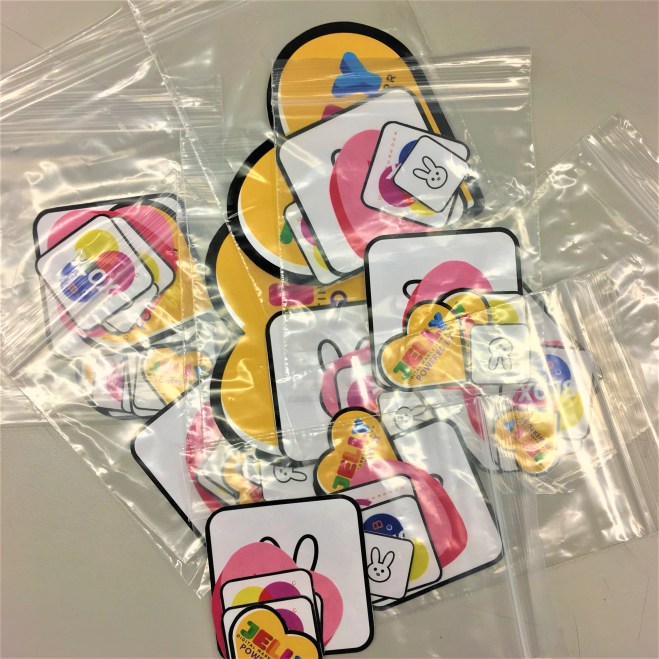
Along with my visual presentation, I designed a series of stickers that were printed on matte sticker paper and cut by hand. I then assembled the stickers, one by one, into individual, resealable plastic bags. Two of the images are BLOX identity concepts. The one with the primary color wheel represents right-brained or creative BLOX and the other with the black and white bunny mascot (and letter B branded roboto typeface mouth) represents left-brained or technical BLOX. The remainder stickers were simple and fun applications of imagery used in the presentation. To top the set off, I made a collaborative-style logo (powered by) for the agency I was presenting to.

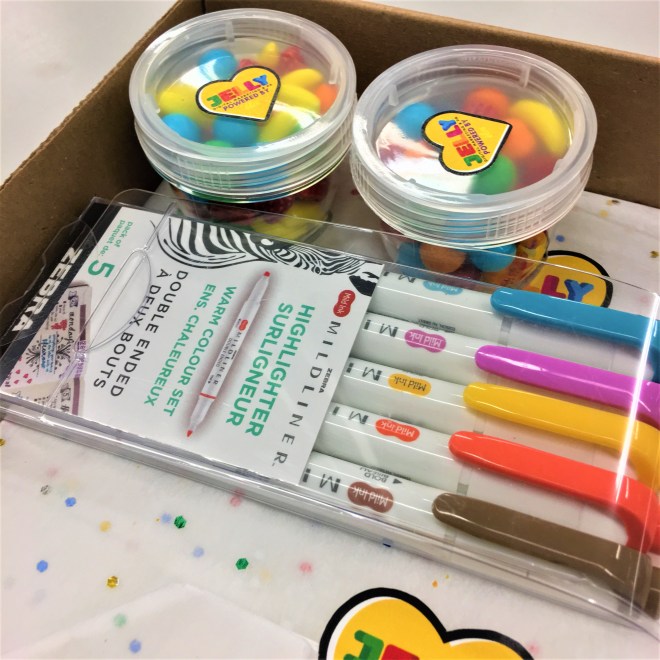
As a fun treat and tribute to the jam jar (featured in several of the images), I filled a couple of clear canisters with bright fruit candy (I once had a banana necklace) to match the colour theme and concept of sweetness. I also included a book containing 85 pages of work samples and creative/technical resources – collateral, white papers and articles. The book was bound using the specifications below:

8.5″ x 11″
Double Sided, Colour
Colour Laser, 98 Bright, 32-lb.
Binding – Wireless Binding – Black
Standard front cover
Pastel Yellow, 90-lb. Index
Standard back cover
Pastel Yellow, 90-lb. Index

*See more supporting documentation on my Instagram, Facebook or LinkedIn account.

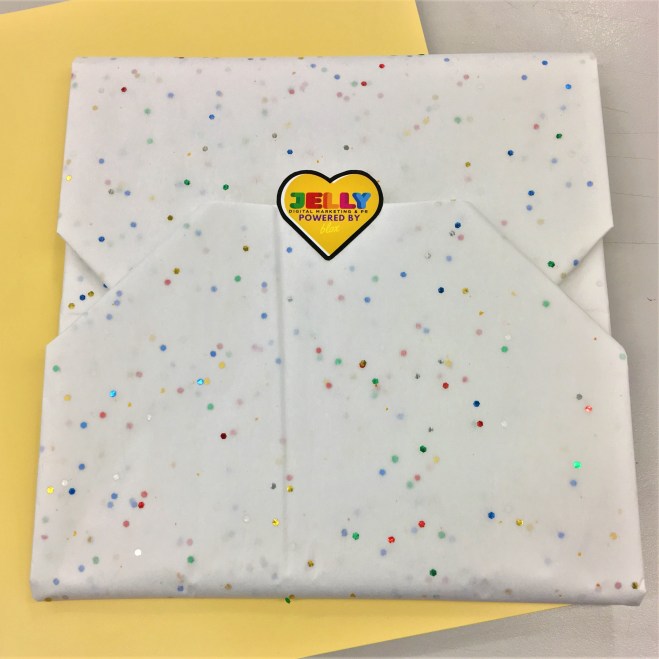
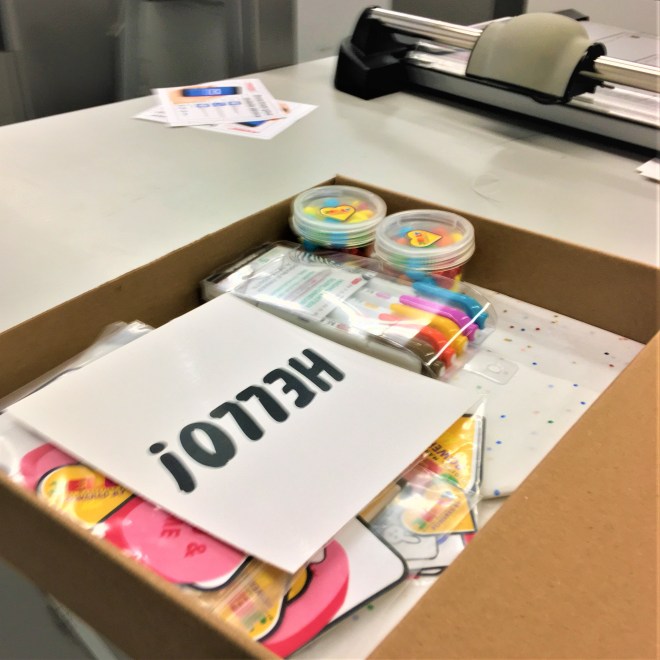
The final products were wrapped in colourful confetti  paper and fastened with two Jelly Marketing stickers. Everything was arranged bento-style in an unobtrusive Staples box with a package of fun pastel highlighters and a final ‘hello’ letter placed on top.

I am eternally dedicated to my work and process. This project was a homage to my academic background as a printmaker and street identity as a writer. When I was practicing regularly, the art forms themselves took shape. There was no plan, just creation. I would compare it to writing and reading classical music. I can’t really compare it to anything else. But my efforts today are different. They are positioned around understanding and fully utilizing the creative + technical aspects of my brain. So, now there is a need to plan and there is a need to create, but by having a specific outcome in mind.

At the end of it all, this has generated the foundation of A Brand Strategy. You will hear more about this in the coming year.

A few quick work goals for 2020 –

  • Find a job that I’m happy about
  • Develop Digital Presence business model
  • Develop A Brand Strategy

Next up: who’s down for white, black and corporate-friendly? Is it time to revisit my Digital Presence business model? Yes/No?

The question remains – To mail or not to mail? To give or not to give? To receive or not to receive? What matters most? Having or expecting? Waiting or forgetting? Are you a yes-man or a no-sayer? Check back guys!

Project Future – Can Something Become Practical in Theory?

Hey gang!

I am futuristic and that’s final. My mind lives in the future. Theoretically, I train envisioning that we can live in an entirely digital space. Practically, we live in this space doing regular things, but we also fend for ourselves using our brains. Oh, so this is life! Let’s put a couple of examples into perspective. Note: this post is starting to examine the concept of ‘internet of things’.

Abstract – thing / being / human / agreeance / motion

We live on a physical planet where issues like climate change are just beginning to surface. This a real and serious thing. A 16-year-old climate change activist from Sweden, Greta Thunberg is fighting with global politicians pleading, “How dare you!” Her statement is full of impatience. Does this quantify or qualify the time it has taken to have a crisis like climate change in focus? Now envision, in an utmost technologically advanced society, affecting the outcome of global issues via thought. Think about this – do Thunberg’s words permeate:

an action / integrity / longevity (experience) *creativity +strength

or

a brand / transparency / visuality (capability) *productivity -weakness

In certain applications that are already in place, we could debate the efficacy of an activist’s approach. However, would there be more power in advertising or marketing a cause if the objective considered certain design elements or art attributes? How do we implicate values like belief, trust and faith into a balanced and harmonious solution? And what would be the outcome of such an act? More opportunities? Less threats?

Think ads, television, movies, radio, books.

If those in charge of operating the goods either 1 – don’t fully comprehend new technologies due to incumbent roles and desires of maintaining diplomatic consensus or 2 – need to allocate funds to get everything in place, this does not mean they’re not participating in or understanding at all. And I’m talking highly established and evolved grey matter here! Executives of all sorts know, but the argument could be that we may potentially lack tacit knowledge and this is required to engage with younger generations or for that matter, older ones too. Throes of people that might already comprehend digitization (including all levels of being – thing, human etc.) are waiting for two things – a revolution and massive change. How is it going to pan out?

An example of Global Comprehension at work –

Do you remember when Facebook’s Mark Zuckerberg endured a 2-day congressional inquisition on the possibility that his company helped to fix Trump’s election campaign by intentionally (or unintentionally) releasing Facebook user data?

  • What was that all about?
  • How would you explain it to a Baby Boomer, Millennial or Digital Native?
  • How did this issue affect us in terms of technology?
  • How did this issue affect us in terms of marketing and advertising?
  • How did this issue affect us in relation to design?
  • Does it bear any importance?
  • How do we begin to explain these types of situations without being merely journalistic or too afraid to elaborate in a caption?
  • Should it matter and why?

We are honourably asking, what does Facebook incentivize and why? Personally, I think they are doing something amazing and are truly planning for our future.

In spite of everything, both Thunberg and Zuckerberg bear weight and responsibility representing modern dilemmas that many people don’t want to talk about. Or perhaps won’t or can’t.

Q: So, what are these dilemmas that require Global Comprehension?

A: Critical mass (Thunberg example) and artificial intelligence (Zuckerberg example)

Hypothetical Solution: recognizing power in unanimity (Thunberg example/things in agreeance) and leading with a ‘Productive Creative’ brain (Zuckerberg example/things in motion)

Note: the term Productive Creative is explored in Hustle & Float, a book by Rahaf Harfoush, a strategist, digital anthropologist, best-selling author and Executive Director of the Red Thread Institute of Digital Culture. She also teaches “Innovation & Emerging Business Models” at SciencesPo in Paris. This quote explains Productive Creative further –

But what happens when the product or service we are providing becomes more intangible in nature? The economy’s gradual shift to include more knowledge work meant that creativity was suddenly a highly desirable trait. That’s where the Productive Creatives came in: to stay relevant and profitable in a rapidly evolving economy, companies desperately needed problem solvers, strategic thinkers, and idea generators. This new type of work created a ripple within traditional workplaces, which now struggled to apply the same clear-cut approach to the creative class. Organizations had to adapt the decades-old systems that developed standardized organizational capabilities to ones that cultivated individual experts who could respond to market conditions with agility.

It would be time to show people – from all walks of life – what is actually going on. There is no need to be livid or paranoid or just plain complacent; if we just had Global Comprehension in place!

So let us say that today, we have the power, we have the goods, and we most definitely have the stage to set our differences aside and come up with new and inventive ways to approach our problems. So, the question becomes – can we altruistically and artificially fix problems like climate change? Could all the world’s brains come together and compute a solution that’s entirely technical (it could just be code of us walking around – engineering a practical application of semantics and proxemics really), but that would emote a creative shift in the planet’s thought processes, all things included? Without the desire to push our creative and technical limits, we will not progress. We will not move forward with fundamental ideas like artificial intelligence or critical mass.

If we can understand the essential framework of these new systems, future generations can develop and implement changes. Gen Y will test and research, then together, all generations can draw some very much needed transparent, accurate and responsible conclusions. The funny thing is, when the revolution (arguably renaissance even) is over and done with, what will be left? In other words, if there is no dilemma, did the dilemma even exist in the first place? This is my theory on Practicality – one planet, 1 human!

Uh-oh!

Today, let’s be practical (according to http://www.dictionary.com):

  • relating to practice or action
  • consisting of, involving, or resulting from practice or action
  • of, relating to, or concerned with ordinary activities, business, or work
  • adapted or designed for actual use; useful
  • engaged or experienced in actual practice or work
  • inclined toward or fitted for actual work or useful activities 

This is a timely discussion and we are all a part of it. How does this make you feel? Worried, scared, unusual? Would you be interested in exploring these ideas further if they were presented differently? As a note, I am always speaking to a mainstream audience. I think connections need to be made for each and every one of us, not only for those residing in an academic pool.

Great work, talk soon!