Take a deep breath and think deeply. AI is becoming the structure of our world, no matter what shape or form that world takes. We are all witnessing it reshape how we think, create, decide, and execute. It’s enabling us to move faster, operate more efficiently, and, in some cases, reach a level of thoroughness that traditional processes struggle to match.
So, let’s start at square one. Why does the philosophical connection matter?
AI’s philosophical connection matters because it defines how we relate to technology – not just how we use it, but our relationship to it. It also challenges the assumption that intelligence is purely human. When a system can generate ideas, synthesize knowledge, and simulate reasoning, it pushes us to ask: What is original thought? Where does meaning actually come from? In that sense, AI becomes a kind of mirror – reflecting patterns, assumptions, and oversights, making our thinking more visible to a trained eye. But it’s not a perfect reflection. What it returns is shaped as much by the system as by us, which can create the illusion of truth when we’re really seeing a constructed projection. Used carelessly, that can blur our sense of authorship and originality. Used well, it can bring us closer to our new reality.
To elaborate.
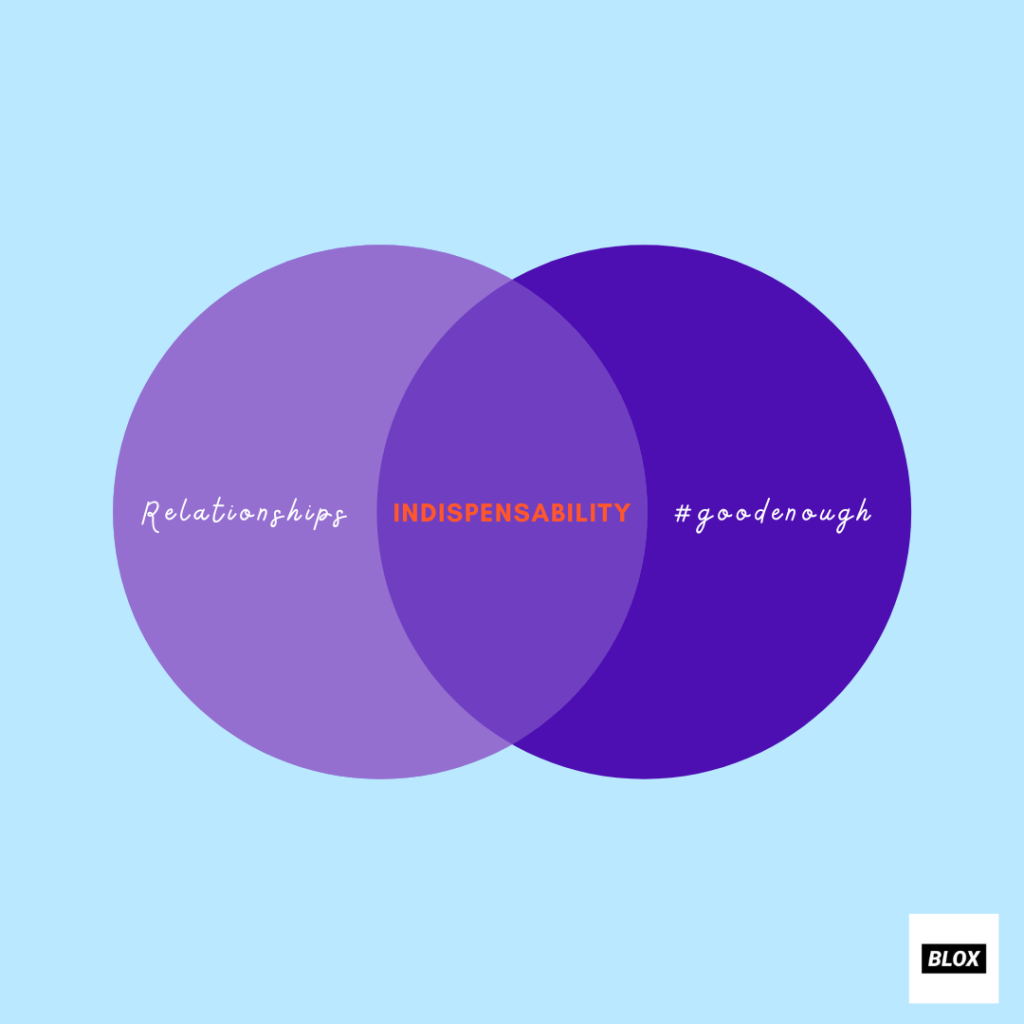
AI may be blurring the boundary between information and discernment. While it can process, combine, and produce at scale, it lacks intent, belief, and accountability. It also doesn’t pass judgment, exhibit taste, or display empathy. These distinctions form what Blox calls your ‘Competitive Edge’. And note, these distinctions elevate us. They advance our critical thinking abilities. We move from being the primary producers of output to the editors of meaning – deciding what matters, what’s true, and what should be acted on. Most don’t see it this way, but AI gives us secret powers; it’s just a matter of recognizing them and using our self-awareness to do better work – on purpose.
And what about practicality?
In practice, AI reduces friction in how work gets done. It takes on the repetitive, time-consuming parts of work – research, synthesis, drafting, data processing – so people can focus on higher-value thinking. Instead of spending hours gathering and organizing information, you move more quickly to interpretation and decision-making – traits that might differ between man and machine.
And just to be direct about our positioning, we are on the side of humanness – because while AI compresses time, it’s still up to us to decide what that time is worth. Tasks that used to take days – thinking up social media content, writing a report, analyzing trends, building a presentation – can now be done in hours. That doesn’t just make humans faster; it changes how often we can iterate. More cycles, better outcomes. But wait, more work? We need to remember that those outcomes won’t magically explain themselves. That’s why some say AI improves collaboration. Now that we have more time to share, debate, waffle, and construct our ideas, they should carry more weight, and this, in turn, should augment our human capacity to learn.
So…
The distinction is hopefully becoming clear. Used as a shortcut, AI delivers increments. Used as a system, it compounds. Those who apply it sporadically, without understanding how to shape context or guide its output, will plateau. Those who integrate it into how they think and act critically will see exponential returns.
Better thinking. Sharper intuition. More willed execution.
Because when AI handles the production of information, what’s left is what matters most: how you interpret it, how you challenge it, and how you decide what to do with it. Thinking becomes less about generating answers and more about refining them. Intuition strengthens as you recognize patterns faster and question them more deeply. And execution improves because decisions are made with belief, empathy, judgment, accountability, taste, and intent, not just efficiency.
That’s the shift. To be in a mutually beneficial relationship with technology, not taking advantage of it, but giving and taking fairly, like how you would in a good marriage. Let’s look at how AI works with real people doing real life stuff.
Here’s example 1 of a marketing manager’s workflow to write a technical white paper:
Step 1 – Frame the topic and structure
Tools: ChatGPT, Perplexity AI, Claude
- Pressure-test angles: “What are the most credible narratives in this space?”
- Pull recent sources, reports, and citations
- Build a structured outline (sections, arguments, flow)
Benefit: Faster clarity and stronger initial framing
Risk: Over-reliance on generic angles if not guided well, or applying critical thinking
Step 2 – Research synthesis
Tools: Perplexity AI, Elicit
- Aggregate research papers, industry reports, and data
- Summarize key findings and extract patterns
- Cross-check sources manually for credibility
Benefit: Compresses hours of research into minutes
Risk: Missing nuance or misinterpreting source material
Step 3 – First draft development
Tools: ChatGPT
- Feed structured outline + key points into ChatGPT
- Generate rough sections (not final copy)
- Focus on flow, completeness, and logical sequencing
Benefit: Eliminates blank page problem; accelerates momentum
Risk: Voice becomes flat or overly generalized
Step 4 – Refinement and editing
Tools: Grammarly, ChatGPT
- Review for clarity, grammar, and tone
- Tighten arguments, simplify language, or reframe sections
- Manually inject brand voice, opinion, and specificity
Benefit: Higher clarity and readability with less effort
Risk: Over-polishing can remove distinctiveness
Step 5 – Final review and positioning
Tools: Human judgment, taste, and aligning intention (this is the differentiator)
- Ensure claims are accurate and defensible
- Align with brand narrative and strategic intent
- Validate that insights are original enough to be valuable
Benefit: Maintains credibility and authority
Risk: If skipped, the content feels generic and interchangeable
Here’s example 2 of a visual artist’s workflow to understand and apply colour theory:
Step 1 – Research colour theory foundations
Tools: Perplexity AI, Elicit
- Explore core principles (contrast, harmony, saturation, psychological impact)
- Surface historical frameworks (Bauhaus, Itten, Albers)
- Pull references from academic and art theory sources
Benefit: Rapid access to structured knowledge and historical context
Risk: Oversimplification of nuanced theory or missing deeper interpretation
Step 2- Study predecessors and movements
Tools: ChatGPT, Google Arts & Culture
- Identify key artists and movements (Impressionism, De Stijl, Abstract Expressionism)
- Analyze how colour was used intentionally across eras
- Compare approaches (emotional vs. structural vs. symbolic use of colour)
Benefit: Faster pattern recognition across art history
Risk: Flattening distinct movements into generalized summaries
Step 3 – Translate theory into a postmodern application
Tools: ChatGPT
- Prompt explorations like: “How would Josef Albers approach colour in a digital/postmodern context?”
- Generate conceptual directions that blend structure with disruption
- Explore contrast, irony, fragmentation, or reinterpretation of traditional palettes
Benefit: Expands conceptual range and reframes traditional ideas
Risk: Outputs can feel derivative without a strong artistic direction
Step 4 – Visual experimentation and iteration
Tools: Midjourney, Adobe Firefly
- Generate visual studies based on colour prompts and themes
- Test combinations, gradients, clashes, and unexpected palettes
- Use outputs as references or starting points – not final work
Benefit: Rapid iteration and exploration of visual possibilities
Risk: Style homogenization or over-reliance on generated aesthetics
Step 5 – Refinement and artistic integration
Tools: Adobe Photoshop, Procreate
- Reinterpret AI-generated ideas through your own process
- Adjust colour relationships, composition, and texture manually
- Anchor the work in your personal style and ensure it meets your goal
Benefit: Maintains authorship while leveraging AI for exploration
Risk: Losing originality if AI output is used too literally
I hope those examples were helpful.
Just so you know, this article came to light as I was creating a carousel for LinkedIn around three areas where AI is reshaping how work gets done. Let’s wrap up the article and review it here.
1 – Manual Thinking
AI shifts the burden from processing to interpretation. Studies show performance gains of roughly 10–25% in common knowledge tasks like writing, research, and coding when AI is used effectively. More importantly, it reallocates attention: instead of spending time gathering, structuring, and synthesizing information, we can move more quickly to judgment and decision-making, removing the shackles of demand and giving us a sense of freedom. This is where the real leverage sits. Yet many people and organizations are not there – only a small minority describe themselves as fully AI-integrated across workflows, suggesting the gap is not access or even application – it’s a reluctance to embrace what modernization requires.
2 – Creativity Block
When it comes to creativity, AI cannot replace it – it does, however, expand the surface area of possibility. AI is not here to generate the final output. It’s more about supporting iteration: reframing challenges, surfacing alternatives, and reducing the time to production. In practice, this means we can move through more ideas faster with less friction. The implication is subtle but important: creative blocks are no longer just about a lack of ideas, but about a lack of modern systems to support new and modern ideas. With tools like Midjourney and Canva, creators can go from idea to structured design to usable asset in shorter periods. Of course, this questions the entire notion of being creative – artists might want a long and difficult artistic process (I know this, because I have been a practicing artist). What that actually says about us is another topic.
3 – Adapting Systems
Let’s move forward and examine how AI shapes a legacy organization – directly aligning with our third core area: adapting systems. Many companies operate within a “modernization gap,” where fragmented tools, disconnected data, and inconsistent workflows quietly limit their ability to evolve. Across marketing, sales, and customer experience, nearly an entire workday each week is lost to these inefficiencies. Applied strategically, AI becomes that structure we talked about – integrating platforms, standardizing data, and enabling information to move seamlessly across functions. Without that alignment, complexity compounds. With it, AI becomes a coordinating force, helping us activate our Competitive Edge in personal and professional settings.
My final words.
What emerges across all three areas is a pattern. Note: this will be constantly debated. AI does not create capability in isolation – it amplifies the structure that already exists; it makes our existence within the structure more significant. This helps explain the current divide: while roughly three-quarters of us already use AI, many people and organizations do not fully appreciate its implications. The constraint is not technological maturity, but understanding AI’s impact, paired with our empathetic value, so we can leave a strong impression behind and continue moving ahead. And in that, shape the structure we’re all learning to operate within.