Just a Moment for AI

Take a deep breath and think deeply. AI is becoming the structure of our world, no matter what shape or form that world takes. We are all witnessing it reshape how we think, create, decide, and execute. It’s enabling us to move faster, operate more efficiently, and, in some cases, reach a level of thoroughness that traditional processes struggle to match.

So, let’s start at square one. Why does the philosophical connection matter?

AI’s philosophical connection matters because it defines how we relate to technology – not just how we use it, but our relationship to it. It also challenges the assumption that intelligence is purely human. When a system can generate ideas, synthesize knowledge, and simulate reasoning, it pushes us to ask: What is original thought? Where does meaning actually come from? In that sense, AI becomes a kind of mirror – reflecting patterns, assumptions, and oversights, making our thinking more visible to a trained eye. But it’s not a perfect reflection. What it returns is shaped as much by the system as by us, which can create the illusion of truth when we’re really seeing a constructed projection. Used carelessly, that can blur our sense of authorship and originality. Used well, it can bring us closer to our new reality.

To elaborate.

AI may be blurring the boundary between information and discernment. While it can process, combine, and produce at scale, it lacks intentbelief, and accountability. It also doesn’t pass judgment, exhibit taste, or display empathy. These distinctions form what Blox calls your ‘Competitive Edge’. And note, these distinctions elevate us. They advance our critical thinking abilities. We move from being the primary producers of output to the editors of meaning – deciding what matters, what’s true, and what should be acted on. Most don’t see it this way, but AI gives us secret powers; it’s just a matter of recognizing them and using our self-awareness to do better work – on purpose.

And what about practicality?

In practice, AI reduces friction in how work gets done. It takes on the repetitive, time-consuming parts of work – research, synthesis, drafting, data processing – so people can focus on higher-value thinking. Instead of spending hours gathering and organizing information, you move more quickly to interpretation and decision-making – traits that might differ between man and machine.

And just to be direct about our positioning, we are on the side of humanness – because while AI compresses time, it’s still up to us to decide what that time is worth. Tasks that used to take days – thinking up social media content, writing a report, analyzing trends, building a presentation – can now be done in hours. That doesn’t just make humans faster; it changes how often we can iterate. More cycles, better outcomes. But wait, more work? We need to remember that those outcomes won’t magically explain themselves. That’s why some say AI improves collaboration. Now that we have more time to share, debate, waffle, and construct our ideas, they should carry more weight, and this, in turn, should augment our human capacity to learn.

So…

The distinction is hopefully becoming clear. Used as a shortcut, AI delivers increments. Used as a system, it compounds. Those who apply it sporadically, without understanding how to shape context or guide its output, will plateau. Those who integrate it into how they think and act critically will see exponential returns.

Better thinking. Sharper intuition. More willed execution.

Because when AI handles the production of information, what’s left is what matters most: how you interpret it, how you challenge it, and how you decide what to do with it. Thinking becomes less about generating answers and more about refining them. Intuition strengthens as you recognize patterns faster and question them more deeply. And execution improves because decisions are made with belief, empathy, judgment, accountability, taste, and intent, not just efficiency.

That’s the shift. To be in a mutually beneficial relationship with technology, not taking advantage of it, but giving and taking fairly, like how you would in a good marriage. Let’s look at how AI works with real people doing real life stuff.

Here’s example 1 of a marketing manager’s workflow to write a technical white paper:

Step 1 – Frame the topic and structure

Tools: ChatGPT, Perplexity AI, Claude

  • Pressure-test angles: “What are the most credible narratives in this space?”
  • Pull recent sources, reports, and citations
  • Build a structured outline (sections, arguments, flow)

Benefit: Faster clarity and stronger initial framing

Risk: Over-reliance on generic angles if not guided well, or applying critical thinking

Step 2 – Research synthesis

Tools: Perplexity AI, Elicit

  • Aggregate research papers, industry reports, and data
  • Summarize key findings and extract patterns
  • Cross-check sources manually for credibility

Benefit: Compresses hours of research into minutes

Risk: Missing nuance or misinterpreting source material

Step 3 – First draft development

Tools: ChatGPT

  • Feed structured outline + key points into ChatGPT
  • Generate rough sections (not final copy)
  • Focus on flow, completeness, and logical sequencing

Benefit: Eliminates blank page problem; accelerates momentum

Risk: Voice becomes flat or overly generalized

Step 4 – Refinement and editing

Tools: Grammarly, ChatGPT

  • Review for clarity, grammar, and tone
  • Tighten arguments, simplify language, or reframe sections
  • Manually inject brand voice, opinion, and specificity

Benefit: Higher clarity and readability with less effort

Risk: Over-polishing can remove distinctiveness

Step 5 – Final review and positioning

Tools: Human judgment, taste, and aligning intention (this is the differentiator)

  • Ensure claims are accurate and defensible
  • Align with brand narrative and strategic intent
  • Validate that insights are original enough to be valuable

Benefit: Maintains credibility and authority

Risk: If skipped, the content feels generic and interchangeable

Here’s example 2 of a visual artist’s workflow to understand and apply colour theory:

Step 1 – Research colour theory foundations

Tools: Perplexity AI, Elicit

  • Explore core principles (contrast, harmony, saturation, psychological impact)
  • Surface historical frameworks (Bauhaus, Itten, Albers)
  • Pull references from academic and art theory sources

Benefit: Rapid access to structured knowledge and historical context

Risk: Oversimplification of nuanced theory or missing deeper interpretation

Step 2- Study predecessors and movements

Tools: ChatGPT, Google Arts & Culture

  • Identify key artists and movements (Impressionism, De Stijl, Abstract Expressionism)
  • Analyze how colour was used intentionally across eras
  • Compare approaches (emotional vs. structural vs. symbolic use of colour)

Benefit: Faster pattern recognition across art history

Risk: Flattening distinct movements into generalized summaries

Step 3 – Translate theory into a postmodern application

Tools: ChatGPT

  • Prompt explorations like: “How would Josef Albers approach colour in a digital/postmodern context?”
  • Generate conceptual directions that blend structure with disruption
  • Explore contrast, irony, fragmentation, or reinterpretation of traditional palettes

Benefit: Expands conceptual range and reframes traditional ideas

Risk: Outputs can feel derivative without a strong artistic direction

Step 4 – Visual experimentation and iteration

Tools: Midjourney, Adobe Firefly

  • Generate visual studies based on colour prompts and themes
  • Test combinations, gradients, clashes, and unexpected palettes
  • Use outputs as references or starting points – not final work

Benefit: Rapid iteration and exploration of visual possibilities

Risk: Style homogenization or over-reliance on generated aesthetics

Step 5 – Refinement and artistic integration

Tools: Adobe Photoshop, Procreate

  • Reinterpret AI-generated ideas through your own process
  • Adjust colour relationships, composition, and texture manually
  • Anchor the work in your personal style and ensure it meets your goal

Benefit: Maintains authorship while leveraging AI for exploration

Risk: Losing originality if AI output is used too literally

I hope those examples were helpful.

Just so you know, this article came to light as I was creating a carousel for LinkedIn around three areas where AI is reshaping how work gets done. Let’s wrap up the article and review it here.

1 – Manual Thinking

AI shifts the burden from processing to interpretation. Studies show performance gains of roughly 10–25% in common knowledge tasks like writing, research, and coding when AI is used effectively. More importantly, it reallocates attention: instead of spending time gathering, structuring, and synthesizing information, we can move more quickly to judgment and decision-making, removing the shackles of demand and giving us a sense of freedom. This is where the real leverage sits. Yet many people and organizations are not there – only a small minority describe themselves as fully AI-integrated across workflows, suggesting the gap is not access or even application – it’s a reluctance to embrace what modernization requires.

2 – Creativity Block

When it comes to creativity, AI cannot replace it – it does, however, expand the surface area of possibility. AI is not here to generate the final output. It’s more about supporting iteration: reframing challenges, surfacing alternatives, and reducing the time to production. In practice, this means we can move through more ideas faster with less friction. The implication is subtle but important: creative blocks are no longer just about a lack of ideas, but about a lack of modern systems to support new and modern ideas. With tools like Midjourney and Canva, creators can go from idea to structured design to usable asset in shorter periods. Of course, this questions the entire notion of being creative – artists might want a long and difficult artistic process (I know this, because I have been a practicing artist). What that actually says about us is another topic.

3 – Adapting Systems

Let’s move forward and examine how AI shapes a legacy organization – directly aligning with our third core area: adapting systems. Many companies operate within a “modernization gap,” where fragmented tools, disconnected data, and inconsistent workflows quietly limit their ability to evolve. Across marketing, sales, and customer experience, nearly an entire workday each week is lost to these inefficiencies. Applied strategically, AI becomes that structure we talked about – integrating platforms, standardizing data, and enabling information to move seamlessly across functions. Without that alignment, complexity compounds. With it, AI becomes a coordinating force, helping us activate our Competitive Edge in personal and professional settings.

My final words.

What emerges across all three areas is a pattern. Note: this will be constantly debated. AI does not create capability in isolation – it amplifies the structure that already exists; it makes our existence within the structure more significant. This helps explain the current divide: while roughly three-quarters of us already use AI, many people and organizations do not fully appreciate its implications. The constraint is not technological maturity, but understanding AI’s impact, paired with our empathetic value, so we can leave a strong impression behind and continue moving ahead. And in that, shape the structure we’re all learning to operate within.

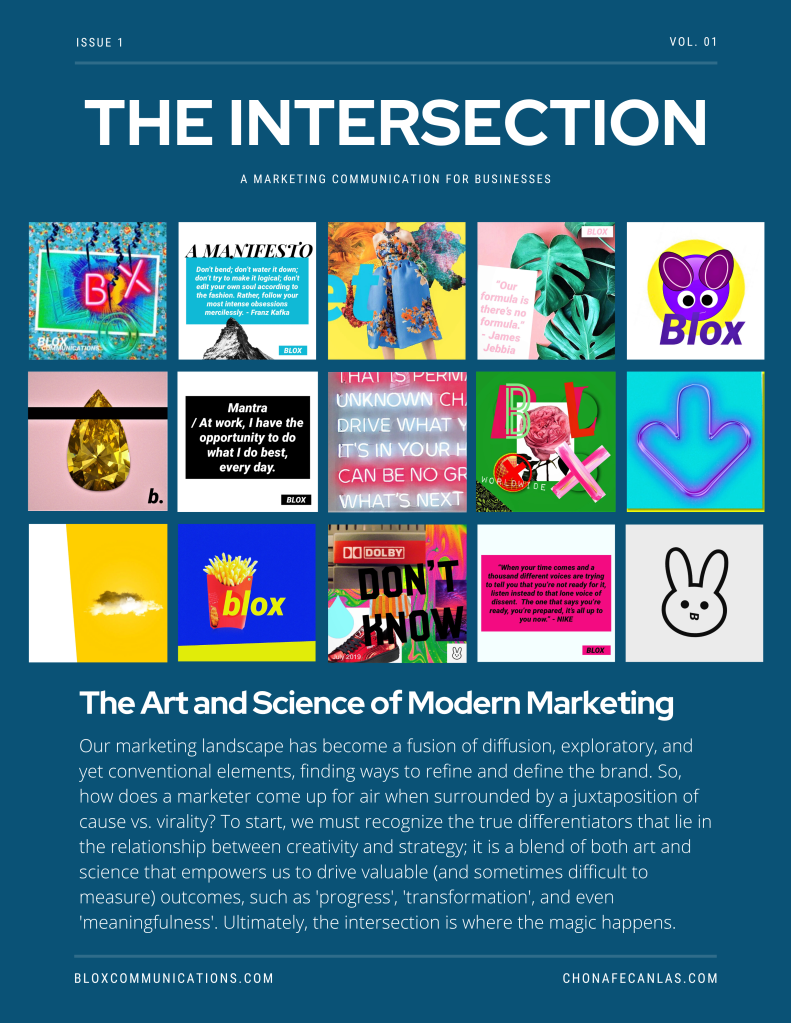
First Issue of The Intersection

I’ve made some refinements to the original issue, which I previously posted as a plug for a podcast idea (see the updated written version below). If you’re wondering, yes, I still want to start a marketing podcast. I’m still exploring ideas on how to execute all of this. Likely, it will be a monthly contribution, again, following relevant topics around ‘A Marketing Communication for Businesses’.

This serves as inspiration and is also creative fuel for my passion project—Blox. Communications, a marketing consultancy and a project I’m building alongside my professional career as a Marketing Manager. It’s a service-based platform designed to support mid-sized businesses across sectors, including but not limited to manufacturing, distribution, and tech, with bold (a.k.a. creative), strategy-driven marketing solutions that connect, differentiate, and drive results.

If you have a project in mind that sparks your interest or if you’re struggling to find direction for your marketing department, let’s discuss and create a plan tailored to your needs!

The website is being developed, but so far you can take a look here.

And if you’re curious, it has been a long time since I’ve posted. Life has been uber busy, and while I know that is the lamest excuse, believe me, I remain dedicated and committed to my art, writing, and design! Posts to come – promise!

For now, enjoy reading The Intersection, and as always, I am open to hearing your feedback or suggestions. Talk soon.

Never Miss Twice

Marketers plan. And planning takes work. But the involved behaviours and habits around planning take the cake. For me, establishing these behaviours and habits involve practice (continually trying to figure out the best outcome), a never-ending cycle of trial and error, and ultimately, gridlocked, unnerving will and determination.

In the process, we can lose sight of our destination. But to get there, we first must understand the journey. That path may not always be clear, but if the correct approach is adopted and adhered to, it will make things easier! James Clear talks about a rule that relates to this – never missing twice:

“The first mistake is never the one that ruins you. It is the spiral of repeated mistakes that follows. Missing once is an accident. Missing twice is the start of a new habit.”

Never missing twice is as sensible a rule as it can get. It acknowledges that to achieve personal or professional excellence, we should hold high standards and a high compliance rate. The importance is to allow for some human failure, to be reasonable, and self-compassionate to hold yourself accountable. But never miss twice. Plan for your success. Get back on track after the first misstep. Keep moving forward, learning, growing, and, most of all, welcome change, as it’s often the precursor for attaining better results.

Relentless Beauty – Directing Art in Life

Hi everyone!

This post is being published a couple of weeks late. It sides like a dialogue or script between my negative and positive conscience. It also questions the personality of reality and the role of work impacting everyday life. Have a read and let me know what you think!

1

I am you.

We are masterpieces at work.

A masterpiece is considered to be a work of outstanding artistry, skill, or workmanship. I am building something great in my brain, that might take 5-10 years to materialize, but for today…it is a matter of steps.

  1. TED Talk
  2. Meet some important CEOs (Microsoft, Facebook etc.)
  3. Have an annual income>$100,000.00

Step 1 – The Wait

This past year has been a period of unparalleled accomplishment and perseverance.

  1. Being able to write well – technically (analyses) and creatively (rationale)
  2. Upping my graphic design capabilities (still supporting MART)
  3. Identifying the BLOX brand (logos for example)

Step 2 – Past Reconciliation

Bell Bird / I walked away from my desk knowing it was over. And every time I returned, I resumed my role, but thought to myself quietly and strategically: 1 – you don’t allow me to be artistic or creative in a way that would generate an income; 2 – despite all my hard work and dedication, you haven’t allowed me to move forward or upward; and 3 – down to the date I left, you gave me the belief that I could achieve something bigger, better and huge.

Step 3 – Hiding

When I say there’s a solution, here’s why. My partner is the most realistic human being that has ever existed! He tells me; I should listen. Now, I’m trying to understand, again (in this moment of gratitude), WHY I have the NEED to reveal a few big secrets, but I won’t. I think it’s going to take a long while, you guys might as well grab some food.

Step 4 – Revelation

Chona: I am not realistic.

Daisy: I am the least realistic human being that has ever existed!

Chona Fe: I am so utterly unrealistic that I presume the world in a digital fashion and to me, it all makes sense.

Seventeen: And my unrealisticness bears unbreakable confidence and this leads me to believe that people already understand it, that other people exist in a digital fashion as well and that it is all working.

Steps, I said. Steps.

Step 5 – Fighting Back

Blox Bunny / Back at my desk, I am thinking again: when I left my former job, there was something inside of me that longed to escape. I was previously trapped in the mind of a realistic person! This does not satisfy me! I want it back! I belong in there. So, I started writing this blog and finally, I have a platform to voice my concerns, however all I want to do is write and that leads to my battle with time.

2

Young at heart.

Old in thought.

Step 6 – In the Past

It feels like more things have been given to me and I have spent a whole lot of time trying to decipher those things regularly. The pursuit seems futile. Is it? I experience true happiness when I am free to create, to express myself as I will. Just being is so strong.

Step 7 – Entrance

Chona begins to write feverishly on a notepad: the questions become – how does the audience receive these creations? But that is not a real question. The real question is, does it matter how they receive it? Wrong again. Once I release a creation into someone’s hands, or brain for that matter, is that it? Is that all that matters?

No, no, no!

Step 8 – The Return

We need to feel a reason to proceed with creating.

Step 9 – The End

I will get there, promise. And when all else fails, I did it for love and the beauty surrounding it.

3

A very dear friend of mine, Yenukwa Kombian, is the co-owner and facilitator of King of Hearts (a collective of men helping men). He shared a few quotes with me when I was feeling down and they really helped –

About struggling as an artist/entrepreneur

…being an artist/entrepreneur, grinding it out and never being recognized for your hard work. It talks a lot about giving up, letting go and even going into a dark hole that you feel stuck in. The line ‘Lose My Air’ is directly correlated with anxiety, and depression. Feeling overwhelmed and stuck in life. I think it’s so easy nowadays to compare ourselves to everyone around us, and that can be crippling. The one thing I have learned through all of this, is that everyone is on their own path, their own chapter of life and it’s extremely unfair to compare yourself to everyone around you. – Brandon Linkewich

About hustling aligning

Destroy the idea that you have to be constantly working or grinding in order to be successful. Embrace the concept that rest, recovery, and reflection are essential parts of the progress toward a successful and ultimately happy life.

About feeling behind in life

You’re not behind in life. There’s no schedule or timetable that we all must follow. It’s all made up. Wherever you are right now is exactly where you need to be. Seven billion people can’t do everything in exactly the same scheduled order. We are all different with a variety of needs and goals. Some get married early, some get married late, while others don’t get married at all. What is early? What is late? Compared with whom? Compared with what? Some want children, others don’t. Some want a career; others enjoy taking care of a house and children. Your life is not on anyone else’s schedule. Don’t beat yourself up for where you are right now. It’s YOUR timeline, not anyone else’s, and nothing is off schedule. – Emily Maroutian

And so, it should be said…

Has anything changed since last year? Are you more ahead of the game? Do I understand being HERE and NOW? Is there something standing in my way? Is it constructed or real? What is real anyway?

Revealing my true identity…

Instead of defining it as creating, writing, being artistic, it must be redefined as working. This mantra says it best – At work, I have the opportunity to do what I do best, every day. That’s it. That’s all that matters!

I think somewhere on this blog I talk about losing my identity, then regaining it. It just isn’t as easy as that. As an artist, you can create a wonderful masterpiece and use it to build yourself up. But when you are done, you have to start all over again and this is a problem. It’s a similar thing building a social media presence. You can really use what’s out there to help support your vision or you can get lost in the confusion of trying to fit in (or out) with a trillion other ‘things’, plus being an open book for everyone one to read. The role of work is to harness these conditions. To take the experience and quantify or qualify it. To have a goal and to accomplish it, then to move on to the next task. Bell provided me with this motion, it just lacked the artistic/creative portion. This past year I have learned how to objectify my work and I am ready to apply these skills.

4

Please bring your trays to a tray return station. We’ll take care of the sorting, recycling and trash. To lower our environmental impact, nearly 90% of waste in the IKEA stores is sent for recycling or used for energy production. And we’re working hard to get to 100%.

IKEA’s founder Ingvar Kamprad thought along these lines, “To do business with a clear conscience is an attitude that pays. We have to find more time for ourselves and to regain respect for the environment in which we live.”

I agree and what if the sign instead read –

Please bring your brains to a brain return station. We’ll take care of the sorting, recycling and trash. To lower our environmental impact, nearly 90% of waste in the BLOX stores is sent for recycling or used for energy production. And we’re working hard to get to 100%.

The idea that the brain requires an actual vacation – with pay – connotes the modern (we’ve been modern for much too long) notion of a retreat. The IKEA restaurant works just great.

Conclusion – Digital Detox Works

Leave your devices at the door and have a seat with us in our cafe, er…restaurant. You really have to plow deep to comprehend your body visiting versus your mind walking in. That is how I think. Typically the thoughts are in motion, in my head and do not leave it. Case in point, there’s power in environment, yet I am denied, time and time again.

Hyper Conclusion – The Drive of Your Mind

It is incessant. Must be more positive. Must be HERE and NOW. Must trust, believe, have faith and most importantly, love.

It causes turbulence. Must convert to renewable energy. Big breakfasts. Netflix. Naps. Running.

1 day left until Halloween!

Yay!