Just a Moment for AI

Take a deep breath and think deeply. AI is becoming the structure of our world, no matter what shape or form that world takes. We are all witnessing it reshape how we think, create, decide, and execute. It’s enabling us to move faster, operate more efficiently, and, in some cases, reach a level of thoroughness that traditional processes struggle to match.

So, let’s start at square one. Why does the philosophical connection matter?

AI’s philosophical connection matters because it defines how we relate to technology – not just how we use it, but our relationship to it. It also challenges the assumption that intelligence is purely human. When a system can generate ideas, synthesize knowledge, and simulate reasoning, it pushes us to ask: What is original thought? Where does meaning actually come from? In that sense, AI becomes a kind of mirror – reflecting patterns, assumptions, and oversights, making our thinking more visible to a trained eye. But it’s not a perfect reflection. What it returns is shaped as much by the system as by us, which can create the illusion of truth when we’re really seeing a constructed projection. Used carelessly, that can blur our sense of authorship and originality. Used well, it can bring us closer to our new reality.

To elaborate.

AI may be blurring the boundary between information and discernment. While it can process, combine, and produce at scale, it lacks intentbelief, and accountability. It also doesn’t pass judgment, exhibit taste, or display empathy. These distinctions form what Blox calls your ‘Competitive Edge’. And note, these distinctions elevate us. They advance our critical thinking abilities. We move from being the primary producers of output to the editors of meaning – deciding what matters, what’s true, and what should be acted on. Most don’t see it this way, but AI gives us secret powers; it’s just a matter of recognizing them and using our self-awareness to do better work – on purpose.

And what about practicality?

In practice, AI reduces friction in how work gets done. It takes on the repetitive, time-consuming parts of work – research, synthesis, drafting, data processing – so people can focus on higher-value thinking. Instead of spending hours gathering and organizing information, you move more quickly to interpretation and decision-making – traits that might differ between man and machine.

And just to be direct about our positioning, we are on the side of humanness – because while AI compresses time, it’s still up to us to decide what that time is worth. Tasks that used to take days – thinking up social media content, writing a report, analyzing trends, building a presentation – can now be done in hours. That doesn’t just make humans faster; it changes how often we can iterate. More cycles, better outcomes. But wait, more work? We need to remember that those outcomes won’t magically explain themselves. That’s why some say AI improves collaboration. Now that we have more time to share, debate, waffle, and construct our ideas, they should carry more weight, and this, in turn, should augment our human capacity to learn.

So…

The distinction is hopefully becoming clear. Used as a shortcut, AI delivers increments. Used as a system, it compounds. Those who apply it sporadically, without understanding how to shape context or guide its output, will plateau. Those who integrate it into how they think and act critically will see exponential returns.

Better thinking. Sharper intuition. More willed execution.

Because when AI handles the production of information, what’s left is what matters most: how you interpret it, how you challenge it, and how you decide what to do with it. Thinking becomes less about generating answers and more about refining them. Intuition strengthens as you recognize patterns faster and question them more deeply. And execution improves because decisions are made with belief, empathy, judgment, accountability, taste, and intent, not just efficiency.

That’s the shift. To be in a mutually beneficial relationship with technology, not taking advantage of it, but giving and taking fairly, like how you would in a good marriage. Let’s look at how AI works with real people doing real life stuff.

Here’s example 1 of a marketing manager’s workflow to write a technical white paper:

Step 1 – Frame the topic and structure

Tools: ChatGPT, Perplexity AI, Claude

  • Pressure-test angles: “What are the most credible narratives in this space?”
  • Pull recent sources, reports, and citations
  • Build a structured outline (sections, arguments, flow)

Benefit: Faster clarity and stronger initial framing

Risk: Over-reliance on generic angles if not guided well, or applying critical thinking

Step 2 – Research synthesis

Tools: Perplexity AI, Elicit

  • Aggregate research papers, industry reports, and data
  • Summarize key findings and extract patterns
  • Cross-check sources manually for credibility

Benefit: Compresses hours of research into minutes

Risk: Missing nuance or misinterpreting source material

Step 3 – First draft development

Tools: ChatGPT

  • Feed structured outline + key points into ChatGPT
  • Generate rough sections (not final copy)
  • Focus on flow, completeness, and logical sequencing

Benefit: Eliminates blank page problem; accelerates momentum

Risk: Voice becomes flat or overly generalized

Step 4 – Refinement and editing

Tools: Grammarly, ChatGPT

  • Review for clarity, grammar, and tone
  • Tighten arguments, simplify language, or reframe sections
  • Manually inject brand voice, opinion, and specificity

Benefit: Higher clarity and readability with less effort

Risk: Over-polishing can remove distinctiveness

Step 5 – Final review and positioning

Tools: Human judgment, taste, and aligning intention (this is the differentiator)

  • Ensure claims are accurate and defensible
  • Align with brand narrative and strategic intent
  • Validate that insights are original enough to be valuable

Benefit: Maintains credibility and authority

Risk: If skipped, the content feels generic and interchangeable

Here’s example 2 of a visual artist’s workflow to understand and apply colour theory:

Step 1 – Research colour theory foundations

Tools: Perplexity AI, Elicit

  • Explore core principles (contrast, harmony, saturation, psychological impact)
  • Surface historical frameworks (Bauhaus, Itten, Albers)
  • Pull references from academic and art theory sources

Benefit: Rapid access to structured knowledge and historical context

Risk: Oversimplification of nuanced theory or missing deeper interpretation

Step 2- Study predecessors and movements

Tools: ChatGPT, Google Arts & Culture

  • Identify key artists and movements (Impressionism, De Stijl, Abstract Expressionism)
  • Analyze how colour was used intentionally across eras
  • Compare approaches (emotional vs. structural vs. symbolic use of colour)

Benefit: Faster pattern recognition across art history

Risk: Flattening distinct movements into generalized summaries

Step 3 – Translate theory into a postmodern application

Tools: ChatGPT

  • Prompt explorations like: “How would Josef Albers approach colour in a digital/postmodern context?”
  • Generate conceptual directions that blend structure with disruption
  • Explore contrast, irony, fragmentation, or reinterpretation of traditional palettes

Benefit: Expands conceptual range and reframes traditional ideas

Risk: Outputs can feel derivative without a strong artistic direction

Step 4 – Visual experimentation and iteration

Tools: Midjourney, Adobe Firefly

  • Generate visual studies based on colour prompts and themes
  • Test combinations, gradients, clashes, and unexpected palettes
  • Use outputs as references or starting points – not final work

Benefit: Rapid iteration and exploration of visual possibilities

Risk: Style homogenization or over-reliance on generated aesthetics

Step 5 – Refinement and artistic integration

Tools: Adobe Photoshop, Procreate

  • Reinterpret AI-generated ideas through your own process
  • Adjust colour relationships, composition, and texture manually
  • Anchor the work in your personal style and ensure it meets your goal

Benefit: Maintains authorship while leveraging AI for exploration

Risk: Losing originality if AI output is used too literally

I hope those examples were helpful.

Just so you know, this article came to light as I was creating a carousel for LinkedIn around three areas where AI is reshaping how work gets done. Let’s wrap up the article and review it here.

1 – Manual Thinking

AI shifts the burden from processing to interpretation. Studies show performance gains of roughly 10–25% in common knowledge tasks like writing, research, and coding when AI is used effectively. More importantly, it reallocates attention: instead of spending time gathering, structuring, and synthesizing information, we can move more quickly to judgment and decision-making, removing the shackles of demand and giving us a sense of freedom. This is where the real leverage sits. Yet many people and organizations are not there – only a small minority describe themselves as fully AI-integrated across workflows, suggesting the gap is not access or even application – it’s a reluctance to embrace what modernization requires.

2 – Creativity Block

When it comes to creativity, AI cannot replace it – it does, however, expand the surface area of possibility. AI is not here to generate the final output. It’s more about supporting iteration: reframing challenges, surfacing alternatives, and reducing the time to production. In practice, this means we can move through more ideas faster with less friction. The implication is subtle but important: creative blocks are no longer just about a lack of ideas, but about a lack of modern systems to support new and modern ideas. With tools like Midjourney and Canva, creators can go from idea to structured design to usable asset in shorter periods. Of course, this questions the entire notion of being creative – artists might want a long and difficult artistic process (I know this, because I have been a practicing artist). What that actually says about us is another topic.

3 – Adapting Systems

Let’s move forward and examine how AI shapes a legacy organization – directly aligning with our third core area: adapting systems. Many companies operate within a “modernization gap,” where fragmented tools, disconnected data, and inconsistent workflows quietly limit their ability to evolve. Across marketing, sales, and customer experience, nearly an entire workday each week is lost to these inefficiencies. Applied strategically, AI becomes that structure we talked about – integrating platforms, standardizing data, and enabling information to move seamlessly across functions. Without that alignment, complexity compounds. With it, AI becomes a coordinating force, helping us activate our Competitive Edge in personal and professional settings.

My final words.

What emerges across all three areas is a pattern. Note: this will be constantly debated. AI does not create capability in isolation – it amplifies the structure that already exists; it makes our existence within the structure more significant. This helps explain the current divide: while roughly three-quarters of us already use AI, many people and organizations do not fully appreciate its implications. The constraint is not technological maturity, but understanding AI’s impact, paired with our empathetic value, so we can leave a strong impression behind and continue moving ahead. And in that, shape the structure we’re all learning to operate within.

Corporate Identity

Here are some social media videos showcasing the #corpcorp vibe.

We all know that these days, videos garner much more engagement than static images and visuals. That’s because they emit a sort of energy, which transmits directly to the viewer, influencing their experience with the content and helping them to make decisions that impact the brand’s ability to connect, sway, and sell.

In my opinion, a good short video pays special attention to the interaction between sound and movement – this in itself moves your audience along, can build anticipation, as well as excitement. Realistically, you have about 3 seconds to make an impression, so it’s critical to ensure the beginning of your video starts off with a bang.

I’m looking forward to creating more content like this! What’s your take on video creation to support brand identity?

Hello, 2025!

When the magic happens,
You’re making change happen.

Identity stamped to perfection.

Understanding:

style,
thinking,
love,
goals and aspirations.

There are always ways to re-imagine.

Be who you are.
Strive to be better.

*This is a new day, a new era. My new personal brand stamp marks each letter as if to say, “Hi there!” We need to have a conversation about creativity and art and art and creativity and that relationship specifically.

Welcome, 2025. You are going to be amazing.

Lessons from Art to Marketing

Creativity—an elusive concept for all.

Hard to identify and more challenging to explain.

Cambridge Dictionary describes it as:

imagination
vision
inventiveness
ingenuity

and

originality

Artists and marketers know.

Creativity is necessary. It may not have always been that way, but today, it matters immensely.

Whether you’re an artist painting on a canvas (Are your colours ‘original’? Do they spark emotions we are starting to understand?) or a marketer crafting campaigns (Is your work pivotal? Does it imbue change?)—creativity is the spark that turns ordinary moments into extraordinary breakthroughs.

It’s the difference between refining and redefining.

It is a flash of brilliance.

A slow-burning fire built on curiosity and persistence.

The truth is that creativity thrives at the intersection of structure and imagination.

It’s where the messy “what ifs” meet the grounded “how-tos.” And at this junction lies the power to unlock potential within teams, organizations, and leaders. Oh, and of course, within yourself.

So, creativity isn’t just about expression; it’s about connection—linking ideas, people, and strategies in ways that inspire growth and, more importantly, progress.

It’s about being part of a larger community where each participant has recognized their unique capabilities. We have taken an intellectual oath that includes emotion and experience to persist and sway. To churn ambition into reality, to light the fire beneath, spark bold ideas and fuel new mindsets.

Lean into these queries the next time you feel stuck or uninspired. Funnily enough, doubt can take you there.

The magic happens.

The Innovator’s Dilemma

🚀 Embrace Innovation + Disruption = A Lesson for Every Marketer

I downloaded a new app called Headway. It’s a great way to learn about new books, and I recommend it to anyone. Here are some of my learnings over the weekend.

Topic: The Innovator’s Dilemma (By Clayton Christensen)

The main idea is that creating a new market poses less risk than entering an established market. It is also more rewarding. Nonetheless, small new markets can barely satisfy the required growth requirements of larger businesses.

In other words, businesses may overlook game-changing opportunities because their model is primarily to maintain the status quo. 🛳️ To lead the pack, marketers must be forward-thinking, disruption-leaning changemakers.

Here are a couple of definitions to start –

Innovation: In marketing, this is the fusion of creativity and strategy. Innovation is our ability to craft compelling narratives and experiences that captivate audiences, redefine brands, and transcend conventional boundaries.

Disruption: Closely connected to the above, disruption in marketing is the radical departure from norms, leveraging innovative approaches to challenge conventions and reshape audience/buyer behaviour on a larger scale.

So, what’s the takeaway for us marketers? Here are a few key points to keep in mind:

🔍 Stay vigilant: Keep your eyes peeled for emerging trends and technologies, even if your first inclination is to tell yourself it’s too small or too niche of an idea. Do you want to cross over strategy between industries? Why not see how it fits? Run some experiments to test the waters – but before you launch anything, earn buy-in from your team. Your role will be to convince them with supporting data.

💡 Think like a startup: Embrace agility and experimentation. Don’t get too comfortable with your current strategies. See the value for your audience. How does that influence business outcomes? And if there is a misalignment, you might focus too much on activities and output. Your strategy must respond to change, not be static or a quest for perfection.

🗣️ Listen to your audience/buyers, but watch the market too: While meeting current needs is significant, don’t ignore opportunities outside your existing customer base. Seek out different and diverse points of view. Your creative director friend? He might have some powerful assertions worth exploring. Always carry paper and a pen as it provides immediate focus and stimulation – good stuff for your head.

Be proactive: Don’t wait for disruption to hit you—seek ways to innovate and stay ahead of the curve. And you can do it by yourself! Self-learning can help learners become more autonomous, organized, self-disciplined, and able to communicate. Just remember – cross-collaboration over silos and hierarchies.

What are your thoughts on innovation and disruption in marketing?

Inception Marketing

In a world where businesses fight for attention, inception marketing can cut the noise. This unconventional technique aims to implant desire into your buyer’s mind, subconsciously intriguing them to make decisions.

But how would you approach this?

As per due course, identifying and understanding your target audience is fundamental. Perhaps serendipitously, knowing who your ‘people’ are is riff with classification – demographic, psychographic, and so on. But how do you distinguish character? Dreams? Accomplishments?

Wear their shoes!

Imagine what it’s like to be a member of your target audience. Consider their daily routines, challenges, aspirations, and sources of joy. Empathize with their experiences, and you can gain valuable insights into what motivates them and how your product or service can address their needs.

I’m not saying it’s going to be easy work. It will take time, bottomless curiosity, and creativity to craft compelling buyer personas that will make a difference in your pursuit of growth. You might even have to look the opposite way. Envision your competitor knocking at your door. How would you understand them? What questions would you ask? Then, alas, you can ask the grand question – what message and associations do you want to embed in your target audience’s psyche?

Your answers should create a deep, emotional connection and tap into their subconscious desires, beliefs, and aspirations.

Remember, storytelling is the key.

Evoke sentiment and eagerness and delve into universal themes that address the human experience.

And sometimes broad is better. Subtle and indirect. The goal is to make a long-lasting impact, build brand affinity, and, most importantly, influence their attitude toward your brand in the long term.

What are your thoughts on this marketing tactic?

The 9-Point Channel Strategy

Marketing in an Age of Complexity

Marketing is an environment defined by complexity and constant change.

For example, AI has automated and streamlined processes such as social media management and content creation. Similarly, over the past five years, the world of SEO has shifted away from simply keyword tactics to a more holistic approach involving the rigorous understanding of user intent and experience.

A recent McKinsey study found that 77% of CMOs believe their role has increased in complexity over the past five years, while other research consistently highlights the importance of integrated, customer-centric approaches for increased growth and revenue.

Amidst this frenzy of marketing metamorphosis, we can now say that leaders need more than campaigns. They need systems. They need ways to leverage digital ecosystems while maintaining a hyper-vigilant approach to customer needs and overall growth. That’s where the 9-Point Channel Strategy comes in.

Delving, Developing, and Deducing

This complexity was not theoretical for me – it showed up daily during my Longboard days, when I was part of a small yet mighty team.

A few months into my role, I began to dream about creating a strategy that could answer some of the challenges our team was experiencing – a lack of organization due to poor project management skills, limited human resources to handle social media and email marketing tasks, and most importantly, misalignment and miscommunication with leadership, as well as missed opportunities to collaborate with cross-functional departments.

I wrote a business case and presented it to the CEO.

In my study, I explored all the potential projects and campaigns we could launch if only we were more organized and had more structure to our efforts. It was also the catalyst for doubling our team’s size. After a quick presentation of my findings, my request was quickly approved. I finally had the go-ahead to develop the strategy that had been rattling about in my brain.

A Holistic View

The lack of a holistic view is one significant challenge that spurred the need to develop the 9-Point Channel Strategy.

In holistic marketing, departments and the strategy work together to accomplish shared goals and support an overarching purpose. A holistic stance paired with a transparent purpose is pivotal to scaling efforts and driving incremental volume and revenue.

It allows you to step back and review your work, gaining a deeper and clearer understanding of how inputs influence outcomes. With this perspective, you’ll be better prepared to make thoughtful, proactive decisions. Once you develop a holistic view, you can begin shaping content and messaging that resonates across physical, emotional, social, and even spiritual dimensions. At its core, this unification can lead to outcomes that stand out and make a lasting impact.

The 9-Point Strategy

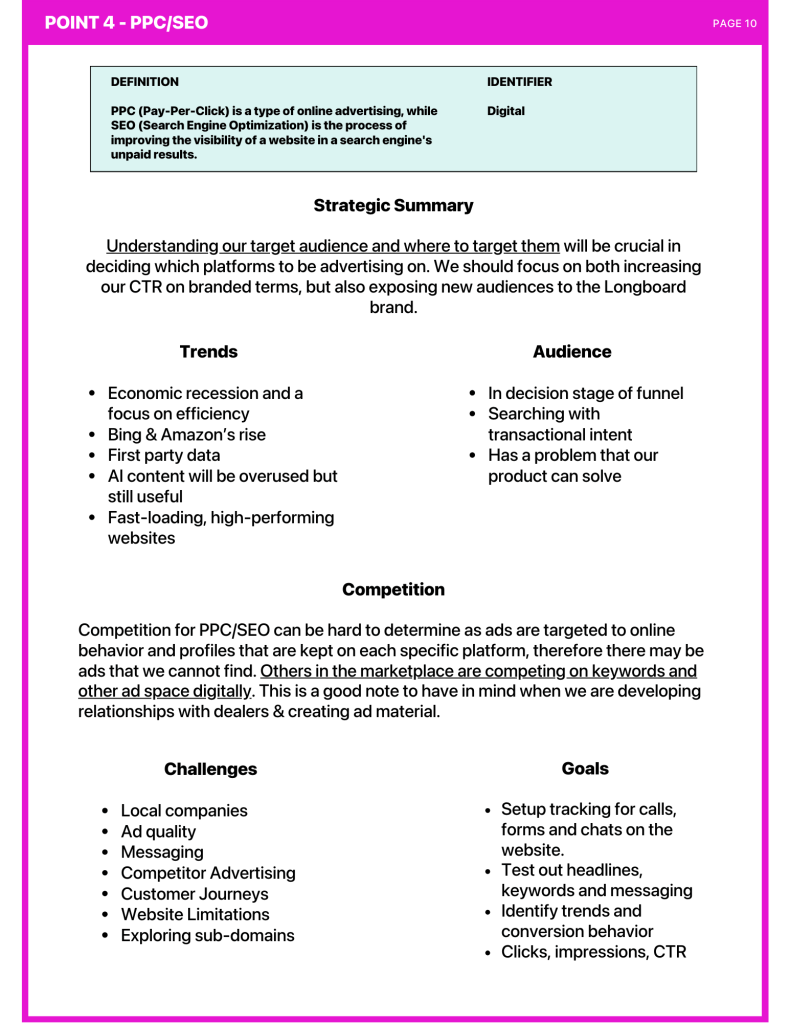
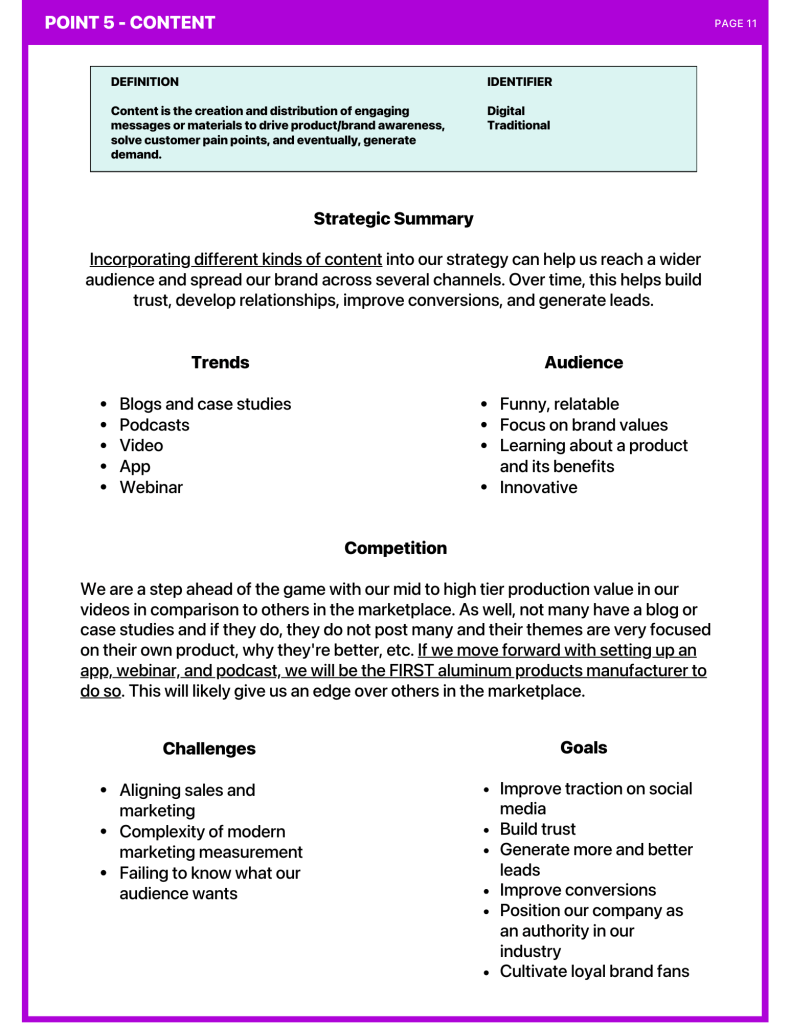
The 9-Point Channel Strategy is an integrated approach to channel marketing where the primary goal is to understand your market segments and audience so you can deliver campaigns and projects that will produce results, all while driving your mission and vision forward.

By organizing each channel according to activity and assigning roles and responsibilities to the team (RACI chart), you can plan your delivery and create an inspiring experience that results in alignment between identity, delivery, and experience. This framework provides marketing teams with a structured, repeatable approach to align business goals, customer engagement, and brand growth across traditional and digital channels.

The 9-Point Channel Strategy model resembles a rotary phone because every channel (digit) must be dialled deliberately, in a sequence, and through a central hub (budget + analytics) to connect the organization to its customer outcomes (the call).

Why Structure Matters in Marketing

Most marketing teams suffer from one of two extremes: ad hoc creativity with little consistency, or rigid planning that fails to adapt to market shifts. Neither delivers sustainable growth.

The 9-Point Channel Strategy strikes a balance.

At its core, it emphasizes organization, planning, and resource allocation. These are not administrative details; they are the foundations of scaling. A Harvard Business Review study found that companies that link project management discipline with strategy execution are 70% more likely to outperform their peers.

By organizing around nine integrated channels – SEO/PPC, Content, Swag & Signage, Communications and Relationship Management, Tradeshows & Events, PR & Media, Website & Apps, Email Marketing, and Social Media – companies create a roadmap that both grounds their brand and gives teams the agility to respond to change.

From Brand Awareness to Measurable Revenue

Marketing is not just about visibility. Done right, it drives the business. Done wrong, it can degrade the brand and dislodge the customer journey.

So, it’s vital to understand how each channel works singularly and in groups (Channel Groups). Research by Nielsen shows that brands with strong integrated campaigns achieve 31% more effectiveness than those using single-channel approaches.

The 9-Point Channel Strategy is designed to move organizations along this path. It improves:

  • Brand Awareness: By consistently activating channels that reinforce identity and voice.
  • Customer Engagement: Through storytelling, dialogue, and relationship management across touchpoints.
  • Sales Impact: By aligning marketing activity with measurable outcomes such as lead quality, conversion rates, and pipeline growth.

For example, when I applied this framework in past roles, companies saw up to 600% growth in engagement and $25M in new business pipeline opportunities.

It’s critical to understand that this doesn’t just happen out of sheer application – it’s the targeted execution that matters most. It’s like a causeway. You can allocate resources to support your teams, all while understanding your business needs more accurately.

Furthermore, the 9-Point Channel Strategy guides the creation of marketing and sales materials, the development of strategic regional campaigns, and the collection of valuable data using the software and tools you have in place. By investing more time into understanding the potential of your market and the journey your clients take, you can influence product development, boost brand recognition, and more.

You will also improve your breadth of knowledge and meet changing client requirements more quickly and effectively. Client satisfaction will rise, as will your future revenue and profitability. Your reputation will grow as you raise awareness for your company and industry.

The Agile Imperative

No framework survives long if it can’t adapt. The 9-Point Channel Strategy incorporates principles from the Agile Marketing Manifesto, which emphasizes experimentation, cross-functional collaboration, and responsiveness to change.

Five rules serve as guiding pillars:

  1. Focus on client value and business outcomes over activity and outputs.
  2. Deliver value early and often, rather than waiting for perfection.
  3. Learn through experiments and data, rather than opinions and conventions.
  4. Collaborate across functions, not just within silos or hierarchy.
  5. Respond to change by following a static plan.

This isn’t just philosophy. According to AgileSherpas, 42% of marketers now practice some form of Agile marketing, and those teams are twice as likely to report success as their non-Agile counterparts.

To put agility into practice, leaders need guiding principles that balance flexibility with discipline.

Principles for Execution

To embed agility within structure, leaders must:

  • Align closely with internal and external stakeholders through transparency and trust.
  • Encourage diverse perspectives to fuel creativity and innovation.
  • Operate at a sustainable pace, balancing urgency with long-term growth.
  • Empower small, cross-functional teams who are motivated and trusted.
  • Continuously refine brand and channel fundamentals—because agility alone is not enough.

The best marketing programs are not built on one-off bursts of inspiration but on disciplined iteration. As Reid Hoffman, LinkedIn co-founder, once put it: “If you are not embarrassed by the first version of your product, you’ve launched too late.”

The Call to Leaders

The 9-Point Channel Strategy is more than a checklist – it is a system for growth in an unpredictable market. By combining structure with agility, organizations can achieve clarity, consistency, and measurable outcomes while staying aligned with their mission, vision, and values.

In an era when customer attention is fragmented and competition is fierce, the companies that win will not be those who do more, but those who do better. Integrated and agile marketing is no longer optional – it is a prerequisite for sustainable success. The 9-Point Channel Strategy offers a path to do just that – driving clarity, consistency, and sustainable growth.

If you’d like to explore how this strategy can work for your business, feel free to reach out to me anytime – info@chonafecanlas.com.

Thanks for reading,

Blox.

PS – Below is an example of a preliminary exploration I did for a company. Let me know if you’d like to chat more about it!

Never Miss Twice

Marketers plan. And planning takes work. But the involved behaviours and habits around planning take the cake. For me, establishing these behaviours and habits involve practice (continually trying to figure out the best outcome), a never-ending cycle of trial and error, and ultimately, gridlocked, unnerving will and determination.

In the process, we can lose sight of our destination. But to get there, we first must understand the journey. That path may not always be clear, but if the correct approach is adopted and adhered to, it will make things easier! James Clear talks about a rule that relates to this – never missing twice:

“The first mistake is never the one that ruins you. It is the spiral of repeated mistakes that follows. Missing once is an accident. Missing twice is the start of a new habit.”

Never missing twice is as sensible a rule as it can get. It acknowledges that to achieve personal or professional excellence, we should hold high standards and a high compliance rate. The importance is to allow for some human failure, to be reasonable, and self-compassionate to hold yourself accountable. But never miss twice. Plan for your success. Get back on track after the first misstep. Keep moving forward, learning, growing, and, most of all, welcome change, as it’s often the precursor for attaining better results.

Kokeshi – A Story

Do you know what a kokeshi is?

Some nights, I brush my daughter’s teeth.

Somehow, it’s an arduous undertaking that I would prefer to leave to my more inclined husband. But tonight, I took it on with confidence.

Lo and behold! I opened her bathroom drawer to reveal not one but three containers of toothpicks. I could smell the faint glimmer of mint, and as I observed the labelling on the bottles, I discovered three different flavours altogether – mint, cinnamon, and KOKESHI.

Now, I presumed that the flavour on the label would match the scent of the toothpicks. So began the exercise. My daughter and I smelled each bottle. Mint, yup mint. Cinnamon, oooh that’s cinnamon. Kokeshi? My daughter inquisitively smelled the toothpicks in the distinct red-orange packaging. Smells like flowers, Mom! I took a whiff and debated, no no, I don’t think so.

I peered through the cheap plastic receptacle and saw that the toothpicks were a different shape. I uttered to my daughter, must be because of this. I pointedly placed the bottle in front of her eyes. We weren’t satisfied. They did look different from the others, looking fancy for picking up appetizers. So, my daughter proclaimed, check Google! Check Google! And with the swipe of a finger, the answer arose –

Kokeshi

Kokeshi are simple wooden Japanese dolls with no arms or legs that have been crafted for more than 150 years as a toy for children.

They are symbols of hopes for bountiful harvests, wishes for good luck and fortune and embody an appreciation for craftsmanship and culture.

Now, this would have been a great answer, but in our case, it was REVELATORY.

I looked in front of me.

Standing peacefully erect on my daughter’s bathroom counter for as long as I can remember was…a…KOKESHI.

Not any kokeshi. A doll I lovingly received from my mom’s very close Japanese girlfriend, Misuko, back in 1985.

My daughter and I squealed with delight. The happenstance was nothing short of extraordinary! And to think, it only took 38 years or five times the length of my daughter’s life to discover it.

Sometimes, life throws you curveballs. Most of the time, you catch the ball like any other ball, on any other day, with the same approach and sentiment. But other times, life passes you inexplicable gifts—gifts that bring light and love into every inch of your being.

As marketers, throw and catch balls. But once in a while, BE the ball and notice the infinite bubbles of gratitude that permeate your life.

Peace y’all!

Saccharine