Why do brands, websites and marketing strategies start to look alike? In this post, we’ll explore the concept of sameness – and why calculated difference can become your competitive advantage.
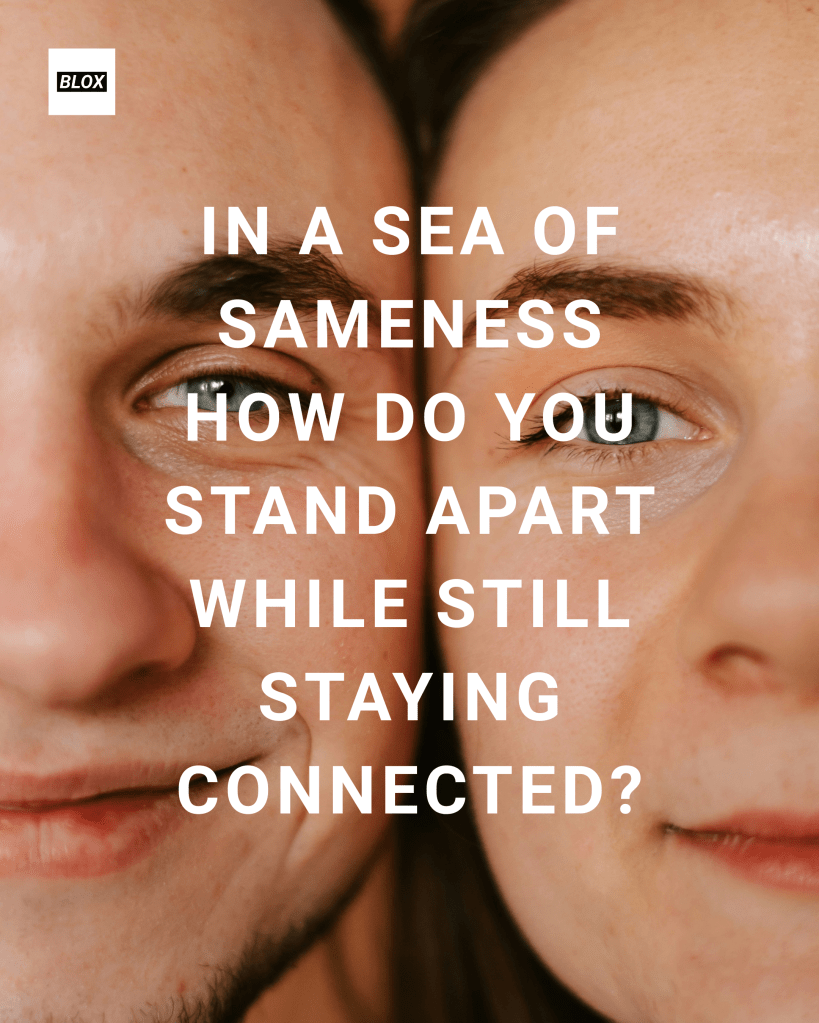
Our first graphic states: “In a sea of sameness, how do you stand apart while still staying connected?” It sounds like a branding question, but it’s actually more of a systems question. Let’s examine this idea.
Sameness comes later. Most industries begin with variation.
Someone develops an original idea. The idea works, so it gets documented. Documentation makes it repeatable. Repetition establishes a pattern. The pattern becomes recognizable. Recognition creates trust. Eventually, the pattern becomes the standard against which everything else is measured. The process looks like this:
Original idea → captured idea → repeatable format → repetition → standard
This trajectory turns an innovation into a convention. Convention simply means that something has become widely accepted. This isn’t necessarily a failure of creativity. It is often the natural consequence of successful systems. The more interesting question is what happens next:
How do you introduce something genuinely different when the system evaluating it is built around convention? How would you define connection in this situation?
We are all connected to this ‘problem’ or ‘challenge’, however you want to feel it…
Why does sameness happen?
So, let’s go back to the beginning and talk about sameness.
Sameness is often a risk-management strategy disguised as best practice. Brands converge because similarity reduces the cognitive and reputational risk of being misunderstood. Difference is expensive to explain. Sameness is comparatively cheap to understand.
A construction company looks like a construction company. A SaaS company looks like a SaaS company. A financial services website immediately signals financial services. But when buyers, executives, procurement teams, investors and algorithms come into the mix, things can quickly change. Experience becomes enrobed in intangibility – values, behaviours, interests, culture, trends, and the list goes on and on. We start to categorize where we fit in. This is still sameness, but now with propensity.
Recent neuroscience research makes the underlying mechanism particularly interesting. A 2026 review in Nature Reviews Neuroscience argues that categorization isn’t simply something the brain does after perceiving information; categorization appears to operate throughout perceptual processing. Humans continuously organize what we encounter into meaningful clusters – sameness differentiated.
In other words, we don’t merely observe the world. We catalogue it. We start making similar things different intentionally. Inevitably, as a way to create more structure and organization.
This creates complexity. For example, we create categories such as:
Industrial.
Technology.
Financial services.
Professional services.
Luxury.
Startup.
Enterprise.
Then we create conventions that communicate membership in those categories.
Certain colours.
Certain terminology.
Certain photography.
Certain website architectures.
Certain value propositions.
Certain ways of presenting expertise.
The category becomes a shorthand for legitimacy.
And eventually businesses aren’t simply documenting what they are.
They’re designing themselves to fit in.
From original idea to accepted standard
Let’s talk about the trajectory again.
An original idea begins as an outlier. Once captured, it becomes transferable. Once transferable, it can be replicated. Once replicated enough times, repetition itself begins to signal correctness.
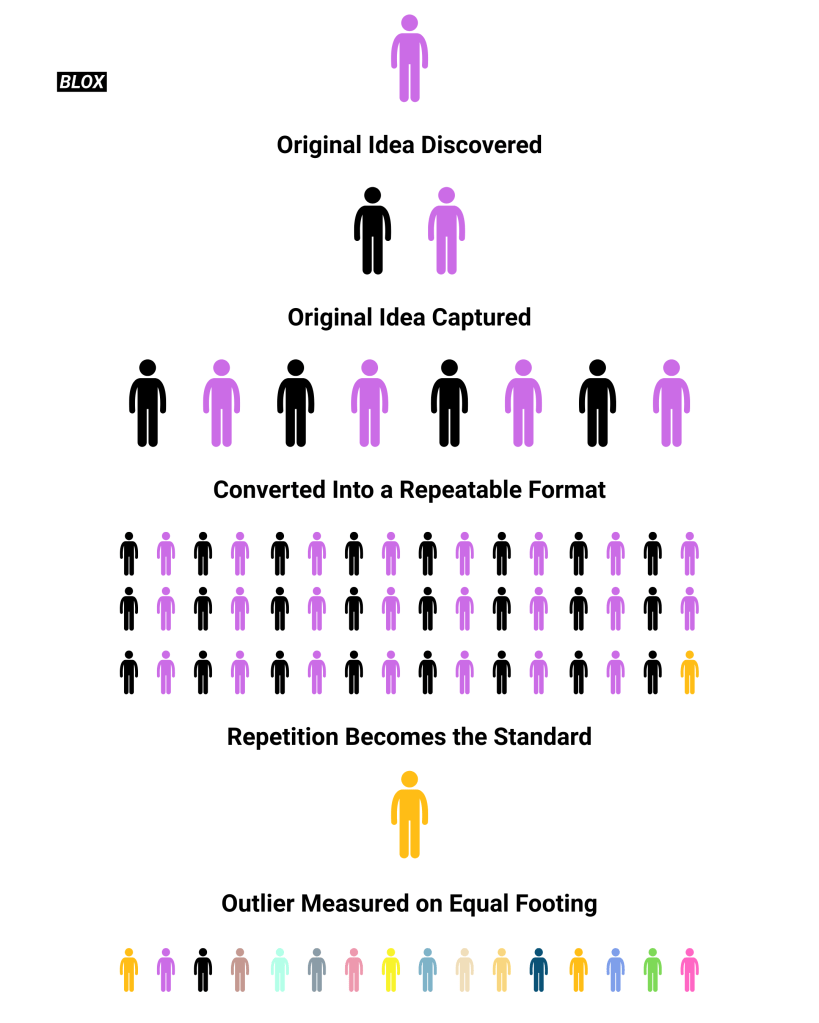
Once the outlier identifies the pattern, a new opportunity arises to stand along the same plane as other outliers that are recognizably different.
This is where standardization becomes complicated. Standards are incredibly useful. They allow organizations to scale quality, create benchmarks, establish expectations and reduce uncertainty. But every measurement system contains assumptions about what deserves to be measured. When something falls outside those assumptions, the system may struggle to evaluate it fairly. The outlier isn’t necessarily worse. It is simply harder to classify. That distinction matters enormously in business. Organizations frequently optimize toward what can be recognized, benchmarked, approved, and explained rather than what could potentially create a degree of separation from the similarity.
The marketing paradox: recognition versus distinction
Marketing lives directly inside this tension. A brand has to resemble its category enough for people to understand what it is. But it also has to create enough difference for people to remember why they should choose it. This is where sameness and differentiation stop being opposites. Some sameness is useful. It provides context. Difference provides meaning.
Research from the Ehrenberg-Bass Institute distinguishes between ordinary brand elements and distinctive assets: colours, typography, logos, characters, sounds and other cues that become strongly and uniquely associated with a particular brand. Their research emphasizes that distinctiveness isn’t simply about making something visually unusual. The asset has to become recognizable as yours.
That distinction is critical.
Being different isn’t the goal. Being recognizably different is.
Kantar’s analysis adds another commercial dimension. Its research across 40,000 brands found a strong relationship between relative uniqueness and consumers’ willingness to pay more. In Canada specifically, Kantar reported in 2025 that brands increasing their “Meaningful Difference” achieved approximately twice the brand-value growth of brands whose Meaningful Difference declined. So the business question isn’t:
How different can we be?
It’s:
How much familiarity does the market need to understand us – and where can difference create disproportionate value?
AI is making this tension more important
There is another force accelerating the sameness trajectory: scale. For example, marketing teams are being asked to produce extraordinary quantities of content. Adobe reported in 2025 that 96% of surveyed marketers had experienced at least a doubling of content demand over the previous two years, while 62% reported demand increasing fivefold or more. 71% expected content demand to increase more than fivefold again by 2027. Generative AI offers an obvious solution. It can help organizations research, write, design, personalize and produce at a speed that would previously have required much larger teams. But speed creates a strategic question.
If organizations use the same tools, trained on overlapping bodies of information, prompted using the same best practices and optimized toward the same platform conventions, what happens to the range of outputs?
Efficiency can scale originality. It can also scale convention. Templates accelerate production because someone has already made hundreds of decisions for us. AI can do something similar. And the easier legitimacy becomes to reproduce, the more valuable genuine identity may become. The competitive advantage won’t necessarily belong to the organization that produces the most. It may belong to the organization with the clearest system for determining what should remain consistent and what should never become generic.
How sameness shows up in three markets
The balance between convention and difference changes depending on the market.
Industrial + Construction: credibility before creativity
Industrial, construction and AEC organizations have legitimate reasons for conservatism. Their buyers often care about technical competence, safety, experience, specifications, reliability and execution. In these environments, familiar signals can reduce perceived risk.
The opportunity isn’t to abandon those credibility-first instincts. It’s to test whether calculated creativity can increase trust rather than threaten it.
That could mean stronger technical storytelling. Better visualization of expertise. More distinctive thought leadership. A clearer digital experience. A brand system competitors don’t immediately resemble. The objective isn’t disruption for disruption’s sake. Meet the industry where it is. Push gently. Don’t ask it to leap.
Legacy businesses: modernize without erasing memory
For established organizations, sameness can represent something very different. It can represent continuity. A logo, colour, phrase, process or visual style may carry decades of accumulated recognition. What looks dated to an internal marketing team may still hold enormous memory value in the market.
Research into distinctive brand assets reinforces the importance of understanding what consumers have actually encoded into long-term memory before discarding familiar brand elements.
Modernization therefore shouldn’t automatically mean replacement. It can mean cataloguing what deserves to survive. What elements are merely old? What elements are genuinely recognizable? What represents the company’s history? What still communicates value? What has become noise? What could be reinterpreted rather than removed?
Legacy businesses don’t need to choose between heritage and relevance. The better challenge is to determine which pieces of the past can become distinctive assets for the future.
Growth-stage companies: speed without identity collapse
Startups face almost the opposite problem. Speed creates convergence. The gradient. The oversized sans-serif headline. The three benefit cards. The social-proof strip. The familiar CTA. The AI-assisted copy.
None of these things are inherently bad. In fact, conventions often exist because they work.
But when every organization borrows the same signals of legitimacy, legitimacy and identity begin to look remarkably similar. For growth-stage companies, the opportunity is therefore to separate operational efficiency from creative conformity. Use templates where templates save time. Use AI where AI creates leverage. Use proven UX patterns where familiarity reduces friction. But identify the places where sameness carries a strategic cost.
Because if every competitor communicates credibility using exactly the same visual and verbal language, distinctiveness itself becomes increasingly scarce. And scarcity creates value.
The answer isn’t differentiation everywhere
This brings us to an important point. A completely differentiated business would probably be exhausting. Imagine a website where navigation worked differently from every other website you’ve visited. A proposal structured unlike any proposal you’ve read. A checkout process you had to learn. New terminology for familiar services. Unexpected interactions everywhere.
Difference creates cognitive cost. That’s why the objective shouldn’t be maximum differentiation. It should be calculated difference. Standardize the things that benefit from familiarity. Differentiate the things that create meaning.
That could be thought of as a simple operating principle:
Familiarity creates access.
Distinctiveness creates recognition.
Difference creates preference.
The strongest organizations understand where each belongs.
From cataloguing sameness to documenting difference
Perhaps this gives us a different way to think about brand systems. Traditionally, organizations document consistency.
Here are our colours.
Here are our fonts.
Here is our logo.
Here is our tone.
Here is our template.
Here is how everything should look.
That documentation matters. Consistent use of distinctive brand assets can improve cohesion and help build mental availability, according to Ehrenberg-Bass research. But what if organizations also documented their difference?
What do we believe that competitors don’t?
What do we understand unusually well?
What processes have we developed ourselves?
What parts of our history could nobody else authentically claim?
Where are we intentionally conventional?
Where are we intentionally unconventional?
Which colours, words, behaviours, experiences and ideas should become uniquely associated with us?
What should AI be allowed to standardize?
And what should it never flatten?
This turns brand governance from a system designed only to enforce consistency into one designed to protect meaningful variation.
The opportunity is a spectrum, not an outlier
This is what the final graphic represents. Once difference can be understood, documented and measured, the outlier no longer needs to sit outside the system. The system itself can become more diverse.
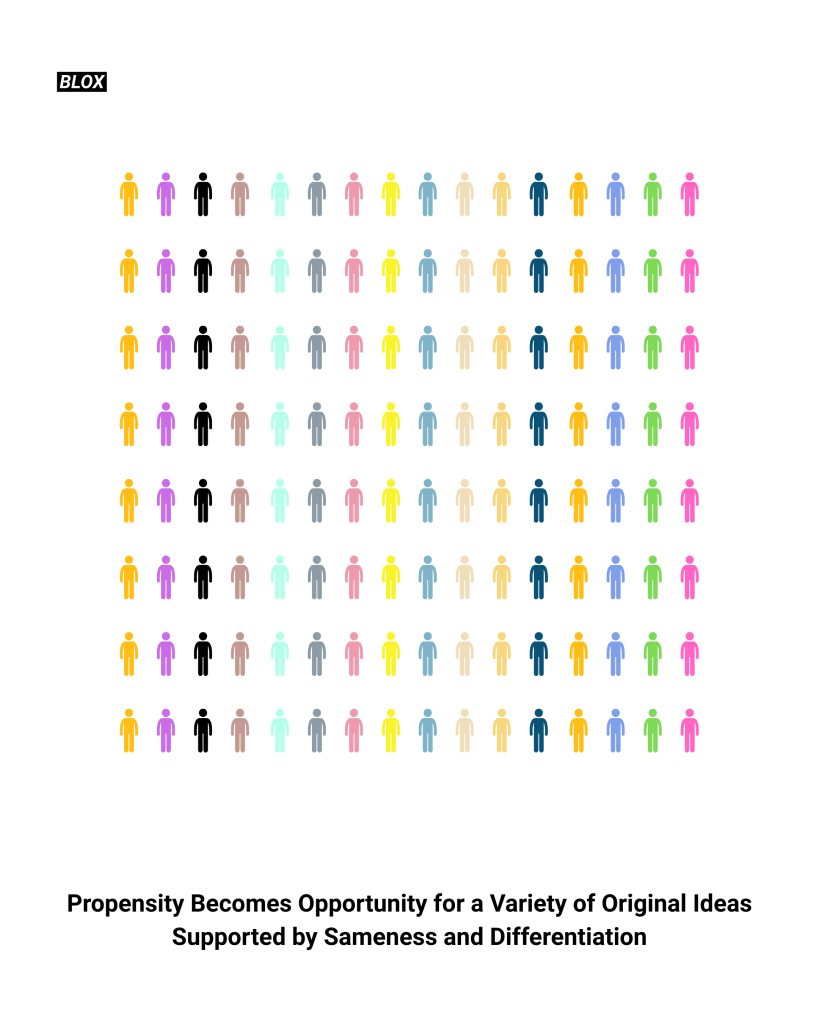
It’s a natural urge or tendency to act or feel in a specific way.
We retain enough common language to understand one another while developing enough specificity to communicate meaningful variation. Markets can work the same way. The goal isn’t to eliminate category conventions. It is to create enough room inside them for organizations to develop identities that are recognizable without becoming interchangeable.
The strategic advantage of calculated difference
Sameness optimizes for speed of recognition – by a buyer, algorithm, procurement team, approval committee, investor or funder. Sometimes that’s exactly what a business needs. But recognition and preference aren’t the same thing. The next generation of strong brands may therefore need to become better at managing the space between them. Not different simply to attract attention. Not conventional simply to avoid risk. But deliberate about both.
Purposeful organizations don’t need to look identical to their competitors to be trusted. They need frameworks that make calculated difference legible rather than risky.
That is the balance. Honour what’s proven. Document what matters. Use familiar structures where they create clarity. And protect enough originality that people still have a reason to choose you. Because in a sea of sameness, standing apart doesn’t have to mean standing alone. It means being different enough to be remembered – and connected enough to be understood.
Frequently Asked Questions
Why do brands in the same industry often look alike?
Brands converge because familiar visual, verbal and structural conventions make them easier for customers and stakeholders to categorize. Similarity can reduce the effort required to understand what a company does and can signal category legitimacy. The risk is that excessive convergence makes competitors increasingly interchangeable.
Is brand consistency the same as brand sameness?
No. Consistency means repeatedly expressing recognizable elements of your own identity. Sameness means increasingly resembling the conventions of everyone else. A strong brand can be highly consistent while remaining highly distinctive.
Why is brand differentiation important?
Differentiation gives customers a reason to prefer one organization over another. Kantar research has linked perceived difference with stronger growth potential and greater willingness to pay, while distinctive brand assets can help people recognize a brand more easily.
Can a brand be too different?
Yes. Difference can create cognitive friction when customers no longer understand what an organization does, how to navigate its experience or how to evaluate its offer. Effective differentiation preserves enough familiar category cues to make the organization understandable while creating meaningful points of distinction.
How does AI affect brand differentiation?
AI can dramatically increase the speed and volume of marketing production. But organizations using similar tools, templates, prompts and conventions may also produce increasingly similar outputs. The strategic opportunity is to use AI for efficiency while maintaining clear human-defined brand principles, proprietary thinking and distinctive assets.
What is calculated difference?
Calculated difference is the deliberate choice to preserve familiar conventions where they improve comprehension or trust while differentiating the elements that influence recognition, meaning and preference. It treats differentiation as a strategic decision rather than a creative exercise.
I hope you enjoyed this post.
Thanks for reading!
Blox