Just a Moment for AI

Take a deep breath and think deeply. AI is becoming the structure of our world, no matter what shape or form that world takes. We are all witnessing it reshape how we think, create, decide, and execute. It’s enabling us to move faster, operate more efficiently, and, in some cases, reach a level of thoroughness that traditional processes struggle to match.

So, let’s start at square one. Why does the philosophical connection matter?

AI’s philosophical connection matters because it defines how we relate to technology – not just how we use it, but our relationship to it. It also challenges the assumption that intelligence is purely human. When a system can generate ideas, synthesize knowledge, and simulate reasoning, it pushes us to ask: What is original thought? Where does meaning actually come from? In that sense, AI becomes a kind of mirror – reflecting patterns, assumptions, and oversights, making our thinking more visible to a trained eye. But it’s not a perfect reflection. What it returns is shaped as much by the system as by us, which can create the illusion of truth when we’re really seeing a constructed projection. Used carelessly, that can blur our sense of authorship and originality. Used well, it can bring us closer to our new reality.

To elaborate.

AI may be blurring the boundary between information and discernment. While it can process, combine, and produce at scale, it lacks intentbelief, and accountability. It also doesn’t pass judgment, exhibit taste, or display empathy. These distinctions form what Blox calls your ‘Competitive Edge’. And note, these distinctions elevate us. They advance our critical thinking abilities. We move from being the primary producers of output to the editors of meaning – deciding what matters, what’s true, and what should be acted on. Most don’t see it this way, but AI gives us secret powers; it’s just a matter of recognizing them and using our self-awareness to do better work – on purpose.

And what about practicality?

In practice, AI reduces friction in how work gets done. It takes on the repetitive, time-consuming parts of work – research, synthesis, drafting, data processing – so people can focus on higher-value thinking. Instead of spending hours gathering and organizing information, you move more quickly to interpretation and decision-making – traits that might differ between man and machine.

And just to be direct about our positioning, we are on the side of humanness – because while AI compresses time, it’s still up to us to decide what that time is worth. Tasks that used to take days – thinking up social media content, writing a report, analyzing trends, building a presentation – can now be done in hours. That doesn’t just make humans faster; it changes how often we can iterate. More cycles, better outcomes. But wait, more work? We need to remember that those outcomes won’t magically explain themselves. That’s why some say AI improves collaboration. Now that we have more time to share, debate, waffle, and construct our ideas, they should carry more weight, and this, in turn, should augment our human capacity to learn.

So…

The distinction is hopefully becoming clear. Used as a shortcut, AI delivers increments. Used as a system, it compounds. Those who apply it sporadically, without understanding how to shape context or guide its output, will plateau. Those who integrate it into how they think and act critically will see exponential returns.

Better thinking. Sharper intuition. More willed execution.

Because when AI handles the production of information, what’s left is what matters most: how you interpret it, how you challenge it, and how you decide what to do with it. Thinking becomes less about generating answers and more about refining them. Intuition strengthens as you recognize patterns faster and question them more deeply. And execution improves because decisions are made with belief, empathy, judgment, accountability, taste, and intent, not just efficiency.

That’s the shift. To be in a mutually beneficial relationship with technology, not taking advantage of it, but giving and taking fairly, like how you would in a good marriage. Let’s look at how AI works with real people doing real life stuff.

Here’s example 1 of a marketing manager’s workflow to write a technical white paper:

Step 1 – Frame the topic and structure

Tools: ChatGPT, Perplexity AI, Claude

  • Pressure-test angles: “What are the most credible narratives in this space?”
  • Pull recent sources, reports, and citations
  • Build a structured outline (sections, arguments, flow)

Benefit: Faster clarity and stronger initial framing

Risk: Over-reliance on generic angles if not guided well, or applying critical thinking

Step 2 – Research synthesis

Tools: Perplexity AI, Elicit

  • Aggregate research papers, industry reports, and data
  • Summarize key findings and extract patterns
  • Cross-check sources manually for credibility

Benefit: Compresses hours of research into minutes

Risk: Missing nuance or misinterpreting source material

Step 3 – First draft development

Tools: ChatGPT

  • Feed structured outline + key points into ChatGPT
  • Generate rough sections (not final copy)
  • Focus on flow, completeness, and logical sequencing

Benefit: Eliminates blank page problem; accelerates momentum

Risk: Voice becomes flat or overly generalized

Step 4 – Refinement and editing

Tools: Grammarly, ChatGPT

  • Review for clarity, grammar, and tone
  • Tighten arguments, simplify language, or reframe sections
  • Manually inject brand voice, opinion, and specificity

Benefit: Higher clarity and readability with less effort

Risk: Over-polishing can remove distinctiveness

Step 5 – Final review and positioning

Tools: Human judgment, taste, and aligning intention (this is the differentiator)

  • Ensure claims are accurate and defensible
  • Align with brand narrative and strategic intent
  • Validate that insights are original enough to be valuable

Benefit: Maintains credibility and authority

Risk: If skipped, the content feels generic and interchangeable

Here’s example 2 of a visual artist’s workflow to understand and apply colour theory:

Step 1 – Research colour theory foundations

Tools: Perplexity AI, Elicit

  • Explore core principles (contrast, harmony, saturation, psychological impact)
  • Surface historical frameworks (Bauhaus, Itten, Albers)
  • Pull references from academic and art theory sources

Benefit: Rapid access to structured knowledge and historical context

Risk: Oversimplification of nuanced theory or missing deeper interpretation

Step 2- Study predecessors and movements

Tools: ChatGPT, Google Arts & Culture

  • Identify key artists and movements (Impressionism, De Stijl, Abstract Expressionism)
  • Analyze how colour was used intentionally across eras
  • Compare approaches (emotional vs. structural vs. symbolic use of colour)

Benefit: Faster pattern recognition across art history

Risk: Flattening distinct movements into generalized summaries

Step 3 – Translate theory into a postmodern application

Tools: ChatGPT

  • Prompt explorations like: “How would Josef Albers approach colour in a digital/postmodern context?”
  • Generate conceptual directions that blend structure with disruption
  • Explore contrast, irony, fragmentation, or reinterpretation of traditional palettes

Benefit: Expands conceptual range and reframes traditional ideas

Risk: Outputs can feel derivative without a strong artistic direction

Step 4 – Visual experimentation and iteration

Tools: Midjourney, Adobe Firefly

  • Generate visual studies based on colour prompts and themes
  • Test combinations, gradients, clashes, and unexpected palettes
  • Use outputs as references or starting points – not final work

Benefit: Rapid iteration and exploration of visual possibilities

Risk: Style homogenization or over-reliance on generated aesthetics

Step 5 – Refinement and artistic integration

Tools: Adobe Photoshop, Procreate

  • Reinterpret AI-generated ideas through your own process
  • Adjust colour relationships, composition, and texture manually
  • Anchor the work in your personal style and ensure it meets your goal

Benefit: Maintains authorship while leveraging AI for exploration

Risk: Losing originality if AI output is used too literally

I hope those examples were helpful.

Just so you know, this article came to light as I was creating a carousel for LinkedIn around three areas where AI is reshaping how work gets done. Let’s wrap up the article and review it here.

1 – Manual Thinking

AI shifts the burden from processing to interpretation. Studies show performance gains of roughly 10–25% in common knowledge tasks like writing, research, and coding when AI is used effectively. More importantly, it reallocates attention: instead of spending time gathering, structuring, and synthesizing information, we can move more quickly to judgment and decision-making, removing the shackles of demand and giving us a sense of freedom. This is where the real leverage sits. Yet many people and organizations are not there – only a small minority describe themselves as fully AI-integrated across workflows, suggesting the gap is not access or even application – it’s a reluctance to embrace what modernization requires.

2 – Creativity Block

When it comes to creativity, AI cannot replace it – it does, however, expand the surface area of possibility. AI is not here to generate the final output. It’s more about supporting iteration: reframing challenges, surfacing alternatives, and reducing the time to production. In practice, this means we can move through more ideas faster with less friction. The implication is subtle but important: creative blocks are no longer just about a lack of ideas, but about a lack of modern systems to support new and modern ideas. With tools like Midjourney and Canva, creators can go from idea to structured design to usable asset in shorter periods. Of course, this questions the entire notion of being creative – artists might want a long and difficult artistic process (I know this, because I have been a practicing artist). What that actually says about us is another topic.

3 – Adapting Systems

Let’s move forward and examine how AI shapes a legacy organization – directly aligning with our third core area: adapting systems. Many companies operate within a “modernization gap,” where fragmented tools, disconnected data, and inconsistent workflows quietly limit their ability to evolve. Across marketing, sales, and customer experience, nearly an entire workday each week is lost to these inefficiencies. Applied strategically, AI becomes that structure we talked about – integrating platforms, standardizing data, and enabling information to move seamlessly across functions. Without that alignment, complexity compounds. With it, AI becomes a coordinating force, helping us activate our Competitive Edge in personal and professional settings.

My final words.

What emerges across all three areas is a pattern. Note: this will be constantly debated. AI does not create capability in isolation – it amplifies the structure that already exists; it makes our existence within the structure more significant. This helps explain the current divide: while roughly three-quarters of us already use AI, many people and organizations do not fully appreciate its implications. The constraint is not technological maturity, but understanding AI’s impact, paired with our empathetic value, so we can leave a strong impression behind and continue moving ahead. And in that, shape the structure we’re all learning to operate within.

First Issue of The Intersection

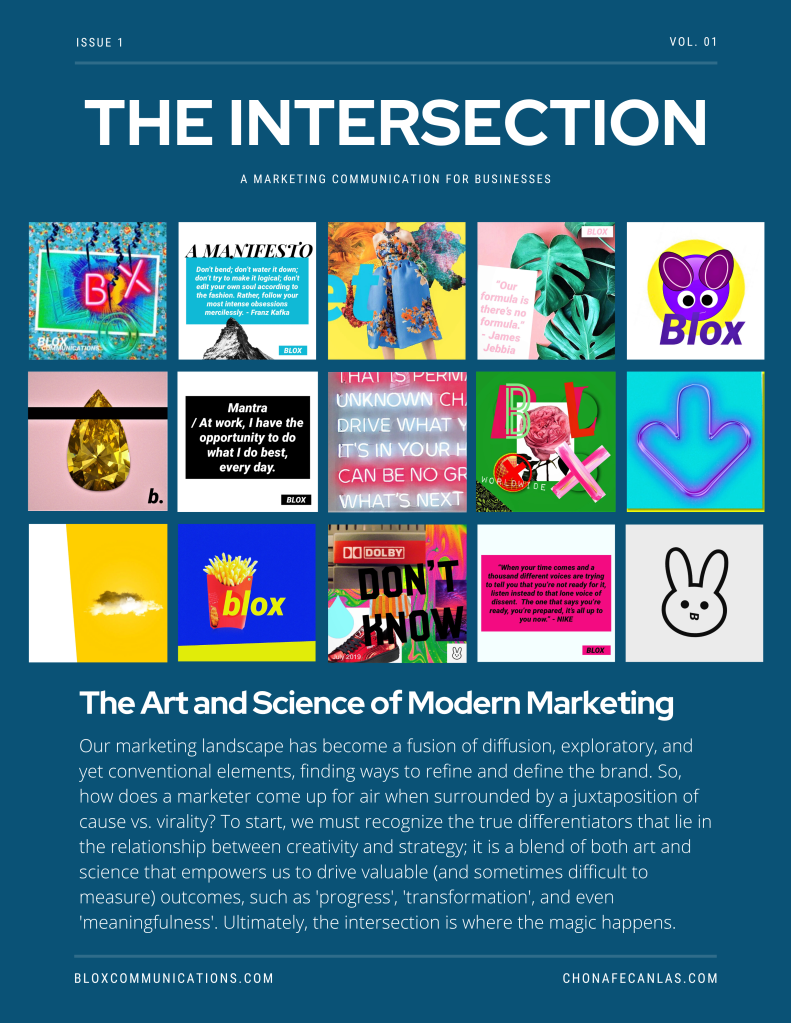
I’ve made some refinements to the original issue, which I previously posted as a plug for a podcast idea (see the updated written version below). If you’re wondering, yes, I still want to start a marketing podcast. I’m still exploring ideas on how to execute all of this. Likely, it will be a monthly contribution, again, following relevant topics around ‘A Marketing Communication for Businesses’.

This serves as inspiration and is also creative fuel for my passion project—Blox. Communications, a marketing consultancy and a project I’m building alongside my professional career as a Marketing Manager. It’s a service-based platform designed to support mid-sized businesses across sectors, including but not limited to manufacturing, distribution, and tech, with bold (a.k.a. creative), strategy-driven marketing solutions that connect, differentiate, and drive results.

If you have a project in mind that sparks your interest or if you’re struggling to find direction for your marketing department, let’s discuss and create a plan tailored to your needs!

The website is being developed, but so far you can take a look here.

And if you’re curious, it has been a long time since I’ve posted. Life has been uber busy, and while I know that is the lamest excuse, believe me, I remain dedicated and committed to my art, writing, and design! Posts to come – promise!

For now, enjoy reading The Intersection, and as always, I am open to hearing your feedback or suggestions. Talk soon.

Hello, 2025!

When the magic happens,
You’re making change happen.

Identity stamped to perfection.

Understanding:

style,
thinking,
love,
goals and aspirations.

There are always ways to re-imagine.

Be who you are.
Strive to be better.

*This is a new day, a new era. My new personal brand stamp marks each letter as if to say, “Hi there!” We need to have a conversation about creativity and art and art and creativity and that relationship specifically.

Welcome, 2025. You are going to be amazing.

Lessons from Art to Marketing

Creativity—an elusive concept for all.

Hard to identify and more challenging to explain.

Cambridge Dictionary describes it as:

imagination
vision
inventiveness
ingenuity

and

originality

Artists and marketers know.

Creativity is necessary. It may not have always been that way, but today, it matters immensely.

Whether you’re an artist painting on a canvas (Are your colours ‘original’? Do they spark emotions we are starting to understand?) or a marketer crafting campaigns (Is your work pivotal? Does it imbue change?)—creativity is the spark that turns ordinary moments into extraordinary breakthroughs.

It’s the difference between refining and redefining.

It is a flash of brilliance.

A slow-burning fire built on curiosity and persistence.

The truth is that creativity thrives at the intersection of structure and imagination.

It’s where the messy “what ifs” meet the grounded “how-tos.” And at this junction lies the power to unlock potential within teams, organizations, and leaders. Oh, and of course, within yourself.

So, creativity isn’t just about expression; it’s about connection—linking ideas, people, and strategies in ways that inspire growth and, more importantly, progress.

It’s about being part of a larger community where each participant has recognized their unique capabilities. We have taken an intellectual oath that includes emotion and experience to persist and sway. To churn ambition into reality, to light the fire beneath, spark bold ideas and fuel new mindsets.

Lean into these queries the next time you feel stuck or uninspired. Funnily enough, doubt can take you there.

The magic happens.

Rebranding: A Strategic Initiative with Far-reaching Implications for Sustainability and Growth

It’s been a slice since I’ve been on here. It’s because I have recently (well, about five months ago now) started a new job! I’m so excited. It has been the opportunity of a lifetime, and I am learning so much about a new industry and finding myself passionate about the projects I’ve been undertaking. Who is the new company? Delta Water Products! The head office is locally based in Chilliwack and has 14 branches across Western Canada and the Pacific Northwest. I’ve been hired as the new Marketing Manager, and my very first task was to take on the company’s rebranding as it became the parent name to several sub-brands, which required a complete revitalization of the brand.

Now, it’s essential to remember that rebranding is not a mere cosmetic change like a new logo or catchy tagline; it’s a strategic initiative that can redefine a company’s identity, reposition it in the market, and set the stage for long-term success. As businesses evolve, rebranding can be crucial in aligning a company’s image with its vision, values, and the market’s ever-changing demands. Understanding this strategic nature of rebranding can empower those involved to make informed decisions about their company’s future. Let’s delve in to understand better what a rebrand is.

What is Rebranding?

Rebranding is the process of changing an organization’s corporate image. It involves updating or completely overhauling the brand’s name, logo, visual identity, messaging, and sometimes its core values and mission. The goal is to create a new identity that resonates with customers, differentiates the company from its competitors, and reflects its current or future ambitions.

For many companies, rebranding becomes necessary after mergers or acquisitions, market shifts, changes in customer preferences, or a desire to enter new markets. It’s a way of breathing new life into a brand and ensuring it remains relevant and competitive.

What Makes a Successful Rebrand?

A successful rebrand is one that not only captures the essence of what a company stands for but also resonates with its target audience. Here are some key elements that contribute to a successful rebrand:

  1. Clear Purpose and Vision: A rebrand should be driven by clearly understanding the company’s goals. Whether it’s to attract a new customer base, reflect a merger, or reposition the brand in the market, the purpose behind the rebrand should guide every decision.
  2. Consistency Across All Touchpoints: Rebranding isn’t just about changing a logo. It’s about creating a consistent brand experience across all customer touchpoints—from the website and social media to packaging and customer service. Consistency helps build trust and recognition among customers.
  3. Stakeholder Involvement: A rebrand should involve input from critical stakeholders, including employees, customers, and partners. Their insights can provide valuable perspectives on what the brand represents and how it should evolve.
  4. Authenticity: The new brand identity should reflect the company’s values and heritage. A successful rebrand doesn’t mean abandoning what made the brand strong in the first place; it’s about building on that foundation.
  5. Effective Communication: It is crucial to communicate the reasons behind the rebrand and what it means for customers. Transparency helps in gaining customer buy-in and ensures a smooth transition.

Rebranding for Sustainability and Longevity

A well-executed rebrand can significantly contribute to the sustainability and longevity of a company. Here’s how:

  1. Adapting to Market Changes: As markets evolve, so do customer needs and expectations. Rebranding allows a company to adapt to these changes, ensuring it remains relevant and competitive.
  2. Expanding Market Reach: Through rebranding, a company can reposition itself to attract new customer segments or enter new markets. This expansion can lead to increased market share and growth.
  3. Strengthening Brand Equity: A robust and consistent brand builds equity over time. Rebranding can refresh and reinvigorate a brand, increasing its perceived value and enhancing customer loyalty.
  4. Reflecting Growth and Evolution: Companies grow, and their brands should evolve to reflect that growth. Rebranding allows a company to communicate its progress, innovations, and future direction.
  5. Building a Unified Brand Identity: In the case of mergers or acquisitions, rebranding can unify different entities under a single, cohesive brand. This simplifies the brand architecture and helps create a more substantial, recognizable presence in the market.

Case in Point: Delta Water Products Group

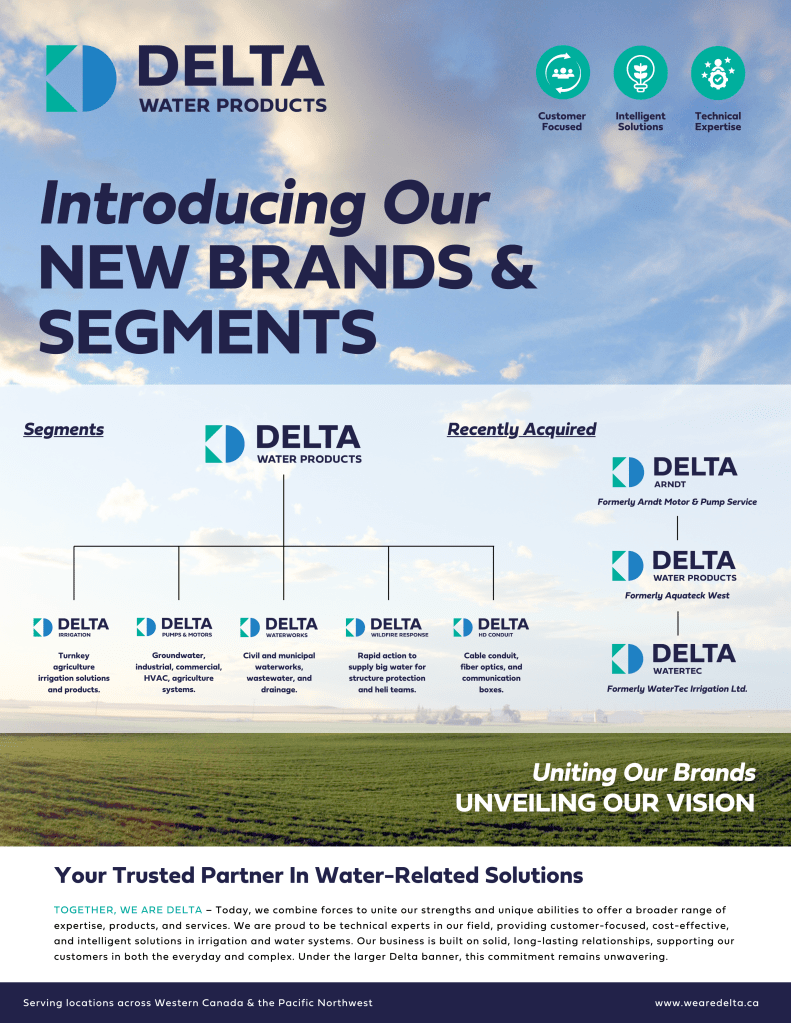
A perfect example of rebranding in action is the recent transformation of several well-established brands under the new banner of Delta Water Products Group. With the acquisition of WaterTec Irrigation Ltd., Arndt Motor & Pump Service, and Aquateck West, rebranding and aligning these brands with Delta Water Products and Delta Irrigation was strategic.

This rebrand was not just about a name change. It was about unifying these brands’ strengths and unique abilities to offer a broader range of expertise, products, and services. By becoming Delta Water Products Group, the company has expanded its geographic coverage across Western Canada and the Pacific Northwest and diversified its product segments, including Irrigation (Turnkey agriculture irrigation solutions and products), Pumps & Motors (Groundwater, industrial, commercial, HVAC, agriculture systems), Waterworks (Civil and municipal waterworks, wastewater, and drainage), Wildfire Response (Rapid action to supply big water for structure protection and heli teams), and HD Conduit (Cable conduit, fibre optics, and communication boxes).

This rebranding effort underscores Delta Water Products Group’s commitment to sustainability and longevity. By consolidating under a single, cohesive brand, the company has strengthened its market position, making it more agile and better equipped to meet the needs of its customers today and in the future.

I hope this all makes sense to you! Just keep in mind – rebranding is a powerful tool that, when executed thoughtfully, can increase a company’s relevance, market share, and longevity. It’s more than just a visual overhaul; it’s about aligning the brand with the company’s current and future goals. For companies like mine, rebranding has provided a renewed sense of purpose, a more robust market presence, and a clear path forward in an ever-evolving industry.

We took many steps to execute the rebrand, including building a new landing page, updating email signatures, and releasing brand announcement letters. My next big project is building one unified website to consolidate the brands and represent our group. I’ve shared a couple of different brand announcements I made below so you can understand my approach and the new branding. If you have any questions, feel free to contact me anytime!

The Innovator’s Dilemma

🚀 Embrace Innovation + Disruption = A Lesson for Every Marketer

I downloaded a new app called Headway. It’s a great way to learn about new books, and I recommend it to anyone. Here are some of my learnings over the weekend.

Topic: The Innovator’s Dilemma (By Clayton Christensen)

The main idea is that creating a new market poses less risk than entering an established market. It is also more rewarding. Nonetheless, small new markets can barely satisfy the required growth requirements of larger businesses.

In other words, businesses may overlook game-changing opportunities because their model is primarily to maintain the status quo. 🛳️ To lead the pack, marketers must be forward-thinking, disruption-leaning changemakers.

Here are a couple of definitions to start –

Innovation: In marketing, this is the fusion of creativity and strategy. Innovation is our ability to craft compelling narratives and experiences that captivate audiences, redefine brands, and transcend conventional boundaries.

Disruption: Closely connected to the above, disruption in marketing is the radical departure from norms, leveraging innovative approaches to challenge conventions and reshape audience/buyer behaviour on a larger scale.

So, what’s the takeaway for us marketers? Here are a few key points to keep in mind:

🔍 Stay vigilant: Keep your eyes peeled for emerging trends and technologies, even if your first inclination is to tell yourself it’s too small or too niche of an idea. Do you want to cross over strategy between industries? Why not see how it fits? Run some experiments to test the waters – but before you launch anything, earn buy-in from your team. Your role will be to convince them with supporting data.

💡 Think like a startup: Embrace agility and experimentation. Don’t get too comfortable with your current strategies. See the value for your audience. How does that influence business outcomes? And if there is a misalignment, you might focus too much on activities and output. Your strategy must respond to change, not be static or a quest for perfection.

🗣️ Listen to your audience/buyers, but watch the market too: While meeting current needs is significant, don’t ignore opportunities outside your existing customer base. Seek out different and diverse points of view. Your creative director friend? He might have some powerful assertions worth exploring. Always carry paper and a pen as it provides immediate focus and stimulation – good stuff for your head.

Be proactive: Don’t wait for disruption to hit you—seek ways to innovate and stay ahead of the curve. And you can do it by yourself! Self-learning can help learners become more autonomous, organized, self-disciplined, and able to communicate. Just remember – cross-collaboration over silos and hierarchies.

What are your thoughts on innovation and disruption in marketing?

Never Miss Twice

Marketers plan. And planning takes work. But the involved behaviours and habits around planning take the cake. For me, establishing these behaviours and habits involve practice (continually trying to figure out the best outcome), a never-ending cycle of trial and error, and ultimately, gridlocked, unnerving will and determination.

In the process, we can lose sight of our destination. But to get there, we first must understand the journey. That path may not always be clear, but if the correct approach is adopted and adhered to, it will make things easier! James Clear talks about a rule that relates to this – never missing twice:

“The first mistake is never the one that ruins you. It is the spiral of repeated mistakes that follows. Missing once is an accident. Missing twice is the start of a new habit.”

Never missing twice is as sensible a rule as it can get. It acknowledges that to achieve personal or professional excellence, we should hold high standards and a high compliance rate. The importance is to allow for some human failure, to be reasonable, and self-compassionate to hold yourself accountable. But never miss twice. Plan for your success. Get back on track after the first misstep. Keep moving forward, learning, growing, and, most of all, welcome change, as it’s often the precursor for attaining better results.

The Rule of Reciprocation

Next up – Dr. Robert Cialdini‘s Rule of Reciprocation!

Revelation. I’ve taken up something I’m sure a million (or more) of you do. I’m back to listening to ebooks while driving to work. Haha – and you thought it would be something more complicated! I did it before but found I was getting bored of it. I’m unsure if it’s the drone of narration or my susceptibility to zoning in and out. Probably a mixture of both. Alas, as part of my year of sharing insights, I thought it would make sense to dedicate myself to it again. 

So, today, I want to talk about reciprocity in marketing. From a psychological standpoint, this rule is simple. What you give is what you get. We tend to feel obligated to return a favour or gesture after receiving something from someone else. If I come back from the cafe with a donut for you, you will likely buy me a baked good the next time you’re picking up a coffee. 😉 

In marketing, this sense of indebtedness in our actions, or more specifically, messaging, can steer our audience to feel more motivated or compelled to make a decision that will impact their buying trajectory. For example, as part of our ABM strategy, I put together a booklet and sample kit for prospective customers. The act of sending and receiving the package in the mail is not only thoughtful but leverages something of value, something tactile and beautiful, something helpful and intriguing that, in turn, can help the receiving party better understand where our brand comes from and ultimately, our passion and intention of supporting the design and construction community through not only inspiring architecture but inspiration, in and of itself!

Creating this cycle of giving and receiving strengthens social connections and encourages cooperative behaviour among individuals and groups within communities, small and big. I see it as small steps of action becoming big sips of gratitude and many more meaningful opportunities in the future!

Have you taken a reciprocal step? In what way did it change the trajectory of your day? Your goals? Your journey as a marketer?

A brief Forbes article by Jeff Bradford sums it up pretty sweet – https://bit.ly/3NVpYUd

Not done yet! Reciprocity has even been known to foster creativity and innovation, such as this Adobe example in a short Medium article – https://bit.ly/48McaDl

2024 – The Year of Insights

I want to make 2024 the year to share some insights. I have time! You have time! We all have time! While perfecting pour-overs, tackling big hills on runs, or when driving into work – these are all great opportunities to listen and learn something valuable, even if just one small concept, it could turn into a big change-maker!

First up is the Cube of Creativity by marketing strategist Andrew Davis. This framework can help marketers leverage their creative process to promote innovation and encourage better outcomes.

To apply this shift in mindset, we need to be open to embracing constraints, defined by the four sides of a cube –

1 – Eliminate the Unnecessary
2 – Define a Single, Measurable Outcome
3 – Add Unreasonable Creative Constraints
4 – Raise the Stakes

To learn more, check out this episode of the Social Media Marketing Podcast with Michael (Mike) Stelzner – https://bit.ly/3TV2D8T

You can also find more details here – https://bit.ly/3TRFJiF

Hope everyone is off to a productive and fulfilling new year!

Critical Mass – Studying Team Endurance

When Friday Turns to Saturday…

Member A – Marketing is a constantly evolving landscape. 

Member B – Ideas ignite and fizzle away.

Member C – A structured and creative ebb and flow transpires.

Member D – New campaigns take flight. 

.

.

.

.

.

.

Evolution.

We seek out different and diverse points of view, embrace and respond to change, and plan only to a level sufficient to ensure effective prioritization and execution. We find ourselves encountering a phenomenon called—CRITICAL MASS.

Akin to when celestial planets align, critical mass is that single yet multifarious moment when our efforts transcend the ordinary and catapult into the extraordinary. It’s a transformative point when our brand’s message resonates with such force that it achieves unstoppable momentum, similar to a cascading waterfall or an awe-inspiring avalanche.

Achieving critical mass can ignite a spark in the collective consciousness of a team, sparking a wildfire of enthusiasm that spreads contagiously through diligent becomings – social networks, word-of-mouth, and media channels. One clever idea can transform into an iconic cultural touchstone, etching your brand’s identity into the minds of engaged onlookers everywhere.

When an idea reaches critical mass, it propels forward and impacts a team’s ability to meet goals.

Here are some ways your team can make that impact based on some common marketing objectives – 

Boost Brand Awareness

As your name, products, and services become more recognized, brand awareness will naturally increase. When your brand reaches a certain level of visibility, popularity, or adoption, it triggers a self-sustaining momentum (critical mass), fostering a positive feedback loop that fuels growth and solidifies your brand’s position in the market.

Obtain New Clients

Your team can focus on targeted campaigns to showcase your USP (unique selling proposition) and differentiators while also highlighting your clients’ success stories and effectively communicating the value of your product to attract a steady stream of interest (demand generation), then ultimately converting that interest into actual sales and new clients (client acquisition).

Strengthen Relationships with Existing Clients

You can contribute to this effort by implementing a preferred client program, personalizing your internal and external communication via channels like social media, email, and content, and creating a detailed plan and strategy around launching new products that address client challenges, needs and pain points. 

Increase Sales

As your market presence and brand awareness expand, so does sales potential. A larger customer base combined with the effective execution of a strategy will lead to more opportunities. Your marketing team can collaborate closely with your sales team to generate and nurture high-quality leads, provide sales enablement materials, and optimize the customer journey to convert prospects into loyal clients.

So, what do you think?

Critical mass is a powerful catalyst for any growing team. By reaching this point of substantial growth and influence, your team’s efforts – recognizing ‘critical mass’ as it occurs and creating models to emulate its course – become pivotal in driving continued success. 

Inspiration can be a behemoth, and it is waiting for y’all!