Brand Strategy

Hi gang!

I was excited about creating these designs. The work was produced using Canva and took about 30 hours (including printing and assembling) to complete. I left out the personal part of my proposal, but I hope you can derive a positive sentiment from the style + tone I chose to go after!

This portion of the proposal defines a brand strategy in three parts – the social media aspect (WHAT), art direction aspect (HOW) and digital specialty aspect (WHY). At best, these aspects are shared and applied to a project equanimously in order create a sweet spot, ‘the magic’ or WHERE and WHEN true potential can emerge.

This whole concept is derived from Simon Sinek’s Golden Circle Theory which purports that great organizations create their foundation by addressing WHY they exist, HOW they go about their mission, and then finally, WHAT they do.

In my model, social media is used as a product or service we sell, however this can be changed to web development, SEO, email marketing etc.

The HOW is the people who are involved in the project. It is what sets us apart from the competition. It is what makes us unique and indispensable.

Lastly, WHY is the ultimate outcome. Very few organizations know WHY they do what they do. Why is not about making money. That’s a result. Why is a purpose, cause or belief. It’s the very reason your organization exists.

In synergy, any set of core values can be realized. In my model, I value belief, faith, trust and love. As a brand strategist, my ultimate outcome paints a beautiful picture for both the seller and buyer. The PICTURE is the agency differentiating itself from competitors. WHERE and WHEN this occurs impacts results – profitability, scalability and customer experience.

Have a look at this brief slideshow and let me know what you think –

This slideshow requires JavaScript.

Remember, there is always room for further or greater interpretation. This is the sweetness of advertising. Branding is the #1 method we can use to portray our message, whether that message be creative, technical or both, a brand is responsible for defining who we are and what we do!

Talk soon!

ChonaBLOX Graphics

Hey everyone!

What a whirlwind of week it’s been!

Between studying like a madwoman and trying to maintain a consistent posting schedule, I’ve designed some quick, quirky graphics for various topics up on The ChonaBLOX Blog.

Right now, they are being shared across multiple platforms (remember, have you had your FILPTS today?) and I will present them in one swift punch once my colour scheme (rainbow, of course) has had its say.

I suppose it would be my most current body of work, should any amazing agencies in the air desire a digital marketer with an artistic penchant to boot!

For now, here’s a sample. A graphic designed today for my latest #girlstories post – her name is SABRINA and she is a…GHOST!

Check out her story as it relates to two other Elevententeen characters, Judge Judy (I know, and yes, on purpose) and Alice from Wonderland.

new #girlstories sabrina (1)

And last thing, two very important marketing terms that I’ve come across lately and seem to apply to my work – top of mind and evergreen. Here are a couple of simple definitions.

First, per Wikipedia –

In marketing, top-of-mind awareness (TOMA) refers to a brand or specific product being first in customers’ minds when thinking of a particular industry or category. … At the market level, top-of-mind awareness is more often defined as the “most remembered” or “most recalled” brand names.

And second –

Evergreen content is content that is always relevant – much like the way evergreen trees retain their leaves all year around. Interesting and relevant content that does not become dated is necessary in order to be found online by search engines (The Balance Careers).

As we enter the beginning of Q4 or reach the end of the year, I want to consider these definitions as they relate to my brand and marketing strategy. How have these terms applied to your business? Do you think they are relevant and does applying these concepts to your work produce less disparity between yourself and your audience? Let’s have a brainstorm!

Cheers y’all!

PS – Halloween is just around the corner, what are your plans?

PPS – FILPTS is a BLOX acronym standing for Facebook, Instagram, LinkedIn, Pinterest, Twitter & Snapchat.

PPPS – I gotta up my Snapchat game! Any cool tips or tricks my friends?

#girlstories

Hey gang!

I forgot to post my ad for #girlstories, which launched a month or two ago.

The purpose of this campaign is to empower women from different demographics and psychographics to tell their personal stories using creativity to dispel fear, judgement, and other negative attributes that we may associate with categorization.

Wikipedia describes categorization as:

…something that humans and other organisms do: “doing the right thing with the right kind of thing.” The doing can be nonverbal or verbal. For humans, both concrete objects and abstract ideas are recognized, differentiated, and understood through categorization.

I’m learning about Facebook Ads right now and it just seems fitting to mention this topic today! I love being analytical, because I don’t have to worry about ‘categorization’, it’s just an ‘interest’ hey!

It’s as simple as this:

doing the right thing –> creating campaigns

with the right kind of thing –> Facebook advertising

Facebook’s mission for 2019 is Embrace Automation. Perhaps a further step towards developing AI…

“Using Dynamic Ads, advertisers can upload an entire product catalog and set their campaign time, and let Facebook do the rest. Working in conjunction with the Facebook Pixel, Facebook will automatically show the right products to users who have visited your website previously.” –  Ignite Visibility

It doesn’t sound so simple, but it can be!

If we take this notion and apply it to a creative + technical writing style (see my first paragraph), we can attempt to mimic the theory and eliminate a need for keywords, bringing us one step closer to attributing right-brained thinking to adaptive modes of learning.

Check out this interesting article, A Glance at the Past & Future of Keyword Research on Semper Plugins.

In place of keywords, we can utilize Facebook Ad concepts like targeting, audiences and insights.

But, who is the pixel? Or, shall I say: who is Pixel? 😉

Okay, that’s my concept exploration for the day! Back to the matter at hand…

When crafting my ideas, I stay true to (what I believe is) the genuine nature of short story telling: condensed length + resisting the sense of obligation to apply edits to the original draft.

Okay, but I still run a wee minor check before I post – always!

This speaks to the campaign’s purpose – revealing our true self (it ends up being paradoxical at times – think: can we express truth condensed?) while maintaining the raw and gritty nature of our human existence.

At the end of the hour, we remain women (and men), powerful regardless of what we know, how we advertise ourselves and why we do it!

#girlstories Girl Stories is a series of creative, short stories focused on empowering creativity in women

These stories will be posted at least once per month. I hope you enjoy them and if you have any ideas for new character names, I’m all ears!

The Development of Trogg

Trogg a new potential character from Elevententeen

Consonance

IMG_2928

Hi everyone!

We do what we do! But without our mind getting in the way?

I sometimes find myself questioning my work. I ask myself – is it too ‘complicated’ for the ‘average’? Does it come off as ‘fluffy’ or ‘dense’? These words mean too many things, but we get used to one meaning, and that is not right.

And when our minds enter ‘the complex’, we should stop and perform self-talk. People avoid self-talk for fear that it gives others the impression that we’re ‘crazy’. I mean, my mouth moves when I’m thinking too hard! So what! Okay, it might just look ‘odd’. But nowadays, self-talk should be used as a positive, gentle form of therapy to get us back on track to believing in the idea of original intention. Google explores this concept readily, when it comes to understanding how people surf the internet. That being said, why is it today, that we feel an attachment to guilt, pity or shame when it comes to feeling a different way about something? Well, it could be ‘different’ things – an idea of interdependence, requirement or necessity.

When I came across the word consonance, I felt blessed and it quickly resonated with my current circumstance, because it challenges the notion of sleep (figure it out). Like take a break here and there, not everyone hates you, if anything shout it off the tallest rooftop – you are loved everywhere! Just go in with that attitude anyway, smile until it hurts. Find the humour in everything and go ‘nuts’, it’s not going to kill you to have fun! Here’s a bit on consonance as it relates to working and the whole job interview process thingamajigger.

Scott Olster, Ideas Editor at LinkedIn, wrote a brief article around “the idea of business trends, perspectives, and hot topics you need to know to work smarter”. He says –

Success can easily end up feeling hollow when it’s defined and measured by other people’s standards. For our work to have lasting personal value, author Laura Gassner Otting writes that we need to focus on developing what she refers to as consonance.

Laura is a writer for Harvard Business Review and she defines consonance as –

“Consonance is not just purpose writ large (and lofty). It’s your purpose, freely and clearly defined by you, and put into action through awareness of and alignment with your life’s plan. Consonance is when what you do matches who you are (or who you want to be).”

As I enter the interview zone, I will remember alignment with your life’s plans as another tip that will help me remember why this is taking so long. I’m dying here guys!

Hello. Thank you for the opportunity, now I have something to say…

Do you relate to this? What is the interview process like for you? Easy? Intense? How do you prepare?

Blogging Graphic Design Process

Hi everyone!

Using simple applications to turn out wicked images is fun. Sort of like the gamification of graphic design (what blogging is like to me). Gaming is portable these days, right? Here’s an interesting article on the history of gaming, maybe you can check for me!

The History Of Gaming: An Evolving Community by Riad Chikhani

Back to the matter at hand…

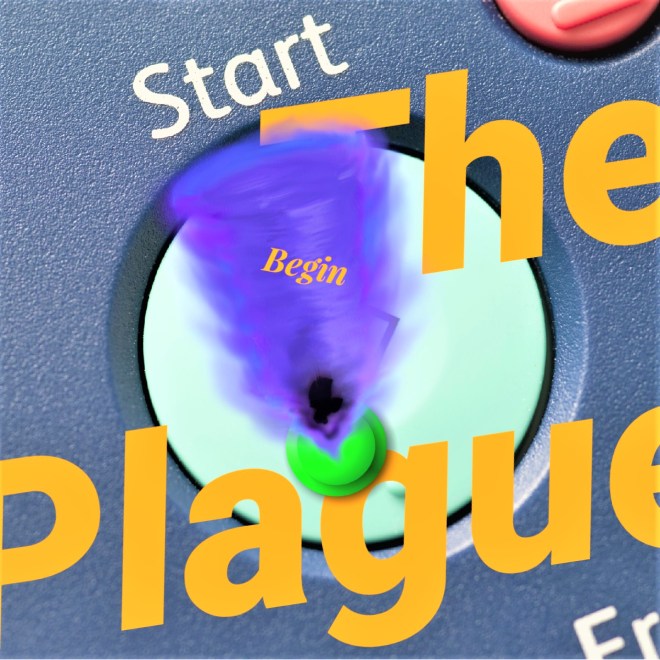
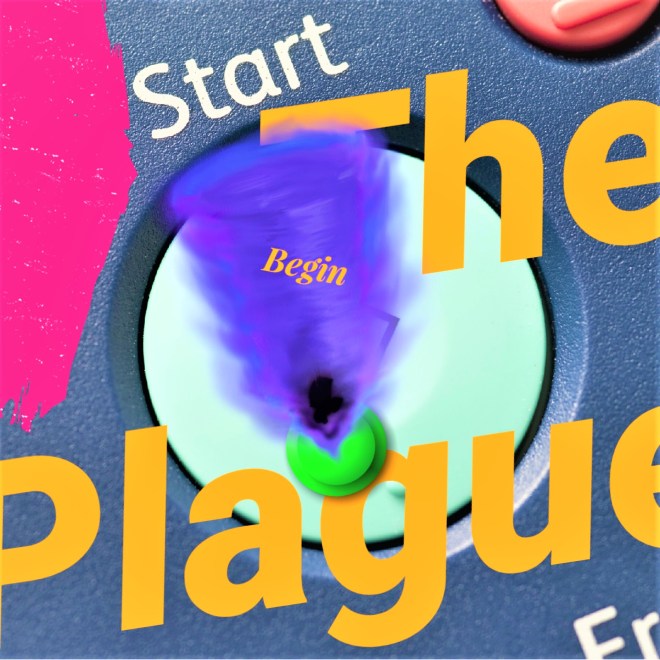
Here are 3 versions of an image I developed for a post (Start). I’ll try to share my process with you (unedited) about how it came together in a time frame of about 15 minutes.

Step 1 – Select a major topic from blog content. (the plague)

Step 2 – Decide if primary message will focus on an image or text. (text)

Step 3 – Decide on a colour palette. (complementary colours blue and orange)

Step 4 – For this image, I decided on text, so the next step was to figure out wording. Wording should be based on the blog’s content, and is usually more effective if it provides the viewer with a direct parallel or bold contrast to the primary message. (the plague)

Step 5 – Pair text with secondary element – image or text. For example, the post’s title is ‘Start’, so I looked for an image of a ‘start button’. (image)

Step 6 – Publish the featured image. Go back to the website to see if it’s effective. In most cases, the image will be cropped, so you may have to edit to ensure the desired elements you want to showcase show up in the frame. (edit to fix)

Step 7 – For this image, I didn’t like the way it was cropped. So, I asked myself – to add or remove? In this case, I decided to add another element in the centre area where visual weight was lacking. (edit for composition)

Step 8 – Again, return to your website and check to see if the image is effective. Still in this case, there was a lack of balance in the top left side corner. I decided to add a pop of colour to provide an additional element of contrast. (edit for graphic design elements)

Step 9 – Check the image on your website. If it works, you will be aesthetically pleased with its presentation or you have found a balance between image – text – colour. (satisfaction)

Step 10 – Double-check to see if there were any cropping issues, spelling or grammar mistakes. Ensure each element of the design is balanced and harmonious. And, you’re finished! (completion)

collage-60.jpg

collage (61)

collage (62)

What’s your graphic design process like? Do you create your own images for your blog? If you could write 10 steps to finalizing an image for a post, what would it entail?

Logo Design

Hi everyone! Here are a couple of funky collages containing recent logo work designed for Blox (Blox. Communications requires a corporate image, so more on that later).

The Blox logo is a study on minuscule composition, where the subject matter is paradoxically enlarged in comparison to the traditional meanings we normatively attach to logos. Each logo is a project in itself, undertaken with massive charisma as the final piece must speak to the idea of liberty in design and the humour found in the seriousness of brand identification.

A logo thus indicates fun. Why does it have to be the same every time? Can our audience begin to understand the concept of change? And can this change be something ethereal and definitive, because gosh darn, it compels you to say, “I don’t understand?”

So then, we must connect our audience to basic things that work underneath context to bear a logo with simplistic meaning. Visual design elements are a foundation to understanding the essence of a statement. The viewer will say, “Oh, that green and that red are complimentary. This works for me.” Or, “That paint pouring down resembles the shape of that banana. Why is there a banana in this?” WHY is there a banana in this logo? Peel. Peel away the layers, to find a tasty meaning. “The peony, is it for me?” Well, doesn’t that make you feel nice? 

We must find ways to evolve harmlessly. It doesn’t hurt anyone to have fun. But it hurts to see thoughtless design. But, who am I to judge? The show must go on (onto the next logo) and the work will still appear on a van. Have a look and edit it in your mind. Make it better. Make it run and most importantly, try to consider a logo as a gift from the world of design. 

Which is your favorite? What type of imagery would you like to see? Colours?


collage (13)

collage (9)

Brand Names

Hi everyone! Branding is about consistency. Consistency in the words and language used to describe what you sell and do. Plus, if we can make personal connections to our messaging (visual communication), our audience will see better (think Visual Transparency).

Okay, let’s ride.

If your brand delivers quality products and/or services, creates exceptional digital exposure and aligns with your customers’ values, then we will begin to associate your brand with positivity (reciprocal awareness, ideology, experience, emotion etc.).

Wow, this website shows their products in a sensible order / the product descriptions are detailed and personalized / this makes me think of the wool bucket hats my Grandmother made / I want to contact the store right now to see if they have the hats in stock. And so on and so forth. The buyer’s process is attentive. What we need to ask is – is the seller’s process absolute?

Timing differs from various perspectives. In marketing sales, process and planning may not always be aligned. We need to find ways to guarantee customer conversion, but how can this be done?

Like the beautiful calico print top you wore when you were three or like the rain splattered window you peered out of on your way home from piano lessons, our audience develops brand identity in the same way we develop thought processes. Hup 2 3 4, hup 2 3. I would even argue that the buyer’s process is creative and the seller’s process is technical.

Can we then leverage creativity in a technical way to ensure customer conversion? Perhaps a topic for Kevin David!

For example, we (Sellers & Buyers) make the same, dedicated connections when observing a special life experience. Then, this can be observed through products and services. We recall brand names and in the long-term, we remember who you are for what you can bring to the table. Then, the name you have chosen to attach to your products and/or services will become synonymous and eventually engrained in time.

Time is of the essence and proves that business can have longevity! Seems really obvious, but it isn’t.

This is the importance of material and conceptual brand development (transparency) — when our audience can automatically associate a brand name with positive things, they become our friends for life! And that’s the brand speaking. This is the beginning of things of ‘internet of things’ (IOT) or one aspect of artificial intelligence (AI) – visual communication, visual transparency and straight-up old transparency.

Post brought to you by the McDonald’s and Tim Hortons billboards on McBride Ave (heading north). 

🙂

Sensory Marketing

Hi everyone! Do you think about what you’re doing when you dive into a pool? Most of us are probably counting down or counting in (up people). Let’s explore sensory marketing!

Per @AlisteMarketing, sensory marketing is a method of selling products. It is a form of marketing that influences our perception of brands using multi-sensory experiences to establish positive emotional connections. 

For example, in web development and social media management you can combine the IDEA of audial, visual and tactile cues (think of ‘3D forms’ that impart tangibility and distinctive qualities to your content and design) to produce a highly memorable experience. This will help build anticipation of the service and/or product you are representing.

I say idea because the future of branding will remove all literal association. It won’t be required in our digital age. With the concept and on the other end, a way to serve it up, born is a style of marketing that encroaches art. This won’t be fear-based and cannot be avoided by the mainstream. Marketers will simply use the most base and recognized forms of digitization to attract a target audience.

So to expand, our senses make it REAL. As in, AI. A sense is a cue to uncover a more elaborate idea. For example, I smell cinnamon.  I am now picturing Cinnabon. Drive by. What’s more powerful? Seeing a Cinnabon sign or smelling their cinnamon? Our senses tell us what we want and what we don’t need.

Again, this is attached to our personal experience. What we didn’t have growing up. What we had too much of as a child. The ultimate irony with sensory marketing is that it removes attachment to the branding experience, but we still invest in the product! This is ubiquity — there; not based on want, but desire.

Bottoms up!