9 – Coming Down

I’m so tired, Daisy thought. You’re always tired, retorted Cherry. She was just sitting there, twiddling her thumbs, looking at her green shoes. She turned her head right, was there something there? She suddenly felt uncomfortable. Someone was watching them. They didn’t know who.

It’s time to pack, dear. The routine was the same every June. Alice from Wonderland would arrive to take Daisy home. Daisy couldn’t do it without help. It was a sad time for her. She was remembering the death of her mom, those last few cigarettes she had outside with her dad, in the snow. She was really angry Being because of Ben. He ruined her life, led her astray. She was an addict when she was with him.

Forget thinking about it, darling. Alice stroked Cherry’s hair, handing her a cheese and ham biscuit. This is ridiculous. I’m practically choking on this bread, it’s getting lodged in my throat! I can’t take it anymore! By then, their tears were flowing, ruining everything including a pink dress and a gigantic muumuu.

All of the pupils present today were busy writing down their answers. Not me. I’m just going to sit it. Read his brain. Oh shit, he’s looking. The girls looked away, frantically grabbing their miniature Navajo backpacks, matching, gifts from the Philippines and their Auntie Stella.

Daisy? Can you contribute something to this discussion we’re having? Her teacher was frustrated, but tried his best to be kind and patient. Daisy twitched her mouth. No, I don’t think I can. They could feel every single eye in the room blink. Then, 999,999 heads turned to look at her. What were they expecting? She wasn’t going to put on a show. And especially not in this muumuu. Do you have anything to say, young miss? Neither had enough bitcoins to argue. Clearing her throat, Miss Daisy stood up. Cherry budged in front, knocking her sister to the floor. I bought these with my own cash! Dreams, actually. It was Toys clearly. Can any one of you in the room debate that? We highly think naught. And with haste, they flipped their skirts and left the room.

Flying through the wind, Cherry grabbed her big sister’s hand. They were going to be just fine.

Consonance

IMG_2928

Hi everyone!

We do what we do! But without our mind getting in the way?

I sometimes find myself questioning my work. I ask myself – is it too ‘complicated’ for the ‘average’? Does it come off as ‘fluffy’ or ‘dense’? These words mean too many things, but we get used to one meaning, and that is not right.

And when our minds enter ‘the complex’, we should stop and perform self-talk. People avoid self-talk for fear that it gives others the impression that we’re ‘crazy’. I mean, my mouth moves when I’m thinking too hard! So what! Okay, it might just look ‘odd’. But nowadays, self-talk should be used as a positive, gentle form of therapy to get us back on track to believing in the idea of original intention. Google explores this concept readily, when it comes to understanding how people surf the internet. That being said, why is it today, that we feel an attachment to guilt, pity or shame when it comes to feeling a different way about something? Well, it could be ‘different’ things – an idea of interdependence, requirement or necessity.

When I came across the word consonance, I felt blessed and it quickly resonated with my current circumstance, because it challenges the notion of sleep (figure it out). Like take a break here and there, not everyone hates you, if anything shout it off the tallest rooftop – you are loved everywhere! Just go in with that attitude anyway, smile until it hurts. Find the humour in everything and go ‘nuts’, it’s not going to kill you to have fun! Here’s a bit on consonance as it relates to working and the whole job interview process thingamajigger.

Scott Olster, Ideas Editor at LinkedIn, wrote a brief article around “the idea of business trends, perspectives, and hot topics you need to know to work smarter”. He says –

Success can easily end up feeling hollow when it’s defined and measured by other people’s standards. For our work to have lasting personal value, author Laura Gassner Otting writes that we need to focus on developing what she refers to as consonance.

Laura is a writer for Harvard Business Review and she defines consonance as –

“Consonance is not just purpose writ large (and lofty). It’s your purpose, freely and clearly defined by you, and put into action through awareness of and alignment with your life’s plan. Consonance is when what you do matches who you are (or who you want to be).”

As I enter the interview zone, I will remember alignment with your life’s plans as another tip that will help me remember why this is taking so long. I’m dying here guys!

Hello. Thank you for the opportunity, now I have something to say…

Do you relate to this? What is the interview process like for you? Easy? Intense? How do you prepare?

Blogging Graphic Design Process

Hi everyone!

Using simple applications to turn out wicked images is fun. Sort of like the gamification of graphic design (what blogging is like to me). Gaming is portable these days, right? Here’s an interesting article on the history of gaming, maybe you can check for me!

The History Of Gaming: An Evolving Community by Riad Chikhani

Back to the matter at hand…

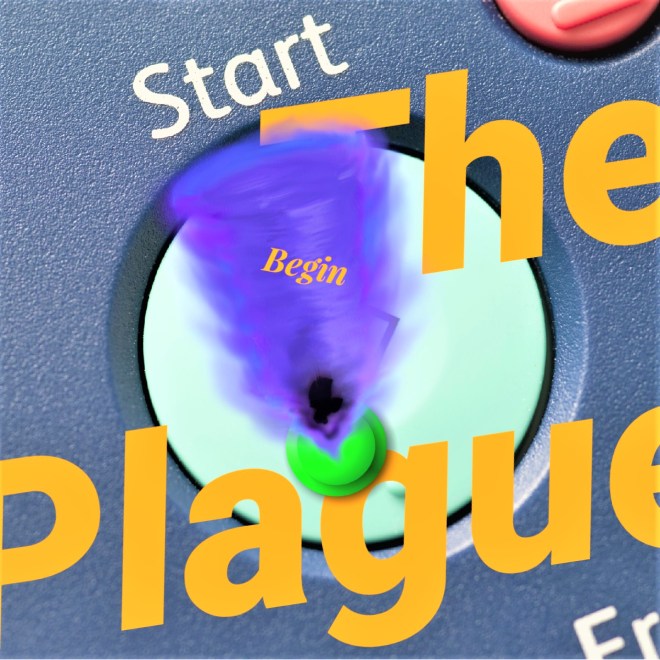
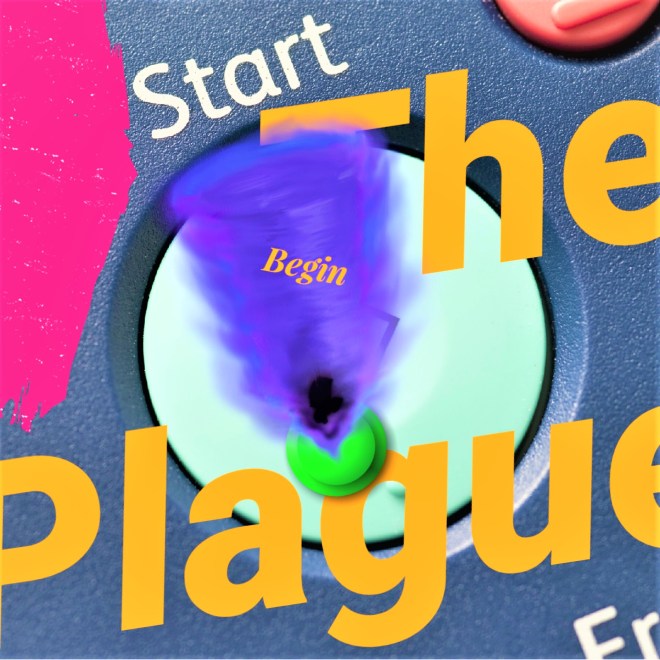
Here are 3 versions of an image I developed for a post (Start). I’ll try to share my process with you (unedited) about how it came together in a time frame of about 15 minutes.

Step 1 – Select a major topic from blog content. (the plague)

Step 2 – Decide if primary message will focus on an image or text. (text)

Step 3 – Decide on a colour palette. (complementary colours blue and orange)

Step 4 – For this image, I decided on text, so the next step was to figure out wording. Wording should be based on the blog’s content, and is usually more effective if it provides the viewer with a direct parallel or bold contrast to the primary message. (the plague)

Step 5 – Pair text with secondary element – image or text. For example, the post’s title is ‘Start’, so I looked for an image of a ‘start button’. (image)

Step 6 – Publish the featured image. Go back to the website to see if it’s effective. In most cases, the image will be cropped, so you may have to edit to ensure the desired elements you want to showcase show up in the frame. (edit to fix)

Step 7 – For this image, I didn’t like the way it was cropped. So, I asked myself – to add or remove? In this case, I decided to add another element in the centre area where visual weight was lacking. (edit for composition)

Step 8 – Again, return to your website and check to see if the image is effective. Still in this case, there was a lack of balance in the top left side corner. I decided to add a pop of colour to provide an additional element of contrast. (edit for graphic design elements)

Step 9 – Check the image on your website. If it works, you will be aesthetically pleased with its presentation or you have found a balance between image – text – colour. (satisfaction)

Step 10 – Double-check to see if there were any cropping issues, spelling or grammar mistakes. Ensure each element of the design is balanced and harmonious. And, you’re finished! (completion)

collage-60.jpg

collage (61)

collage (62)

What’s your graphic design process like? Do you create your own images for your blog? If you could write 10 steps to finalizing an image for a post, what would it entail?

Meaningfulness

Editing could quite possibly be the treachery of writing! Overly edited content may tell readers, “This is not false.” On the other side, the raw construction of content is meaningful, but we should argue that the deliberate deconstruction of content to reveal a greater point of view (proper editing) more readily achieves the goals of an SEO/l or a communications strategy – to uphold popularity, relevance, authority and credibility and to distribute a message that is transparent, accurate and responsible.

C122F4BD-D35D-4EF5-AAFA-0AFAF1447EFD

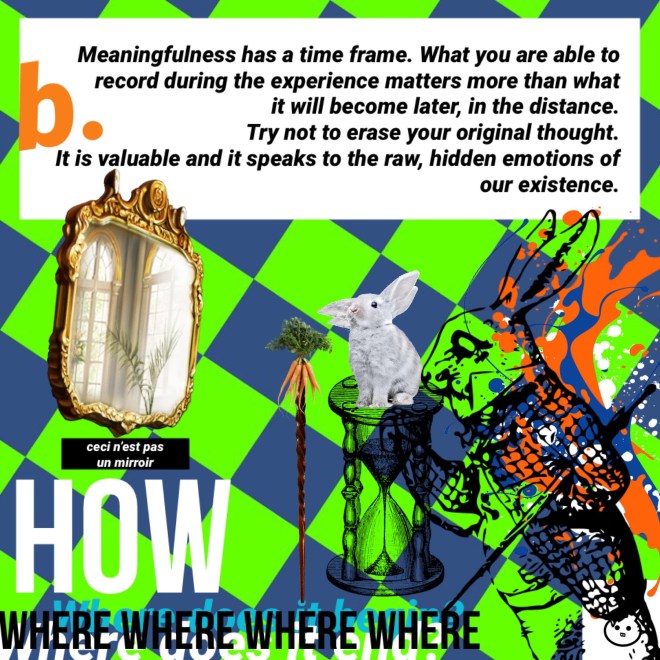
This piece is inspired by a very popular surrealist painting, Ceci n’est pas une pipe by René Magritte. Ironically, my image overloads the viewer with elaborate messages (a commentary on keywords perhaps), whereas Magritte’s painting is a basic review of signified and signifier. Here’s some additional information taken from Wikipedia

The Treachery of Images (French: La Trahison des images) is a 1929 painting by surrealist painter René Magritte.

The painting shows a pipe. Below it, Magritte painted, “Ceci n’est pas une pipe“, French for “This is not a pipe”.

The famous pipe. How people reproached me for it! And yet, could you stuff my pipe? No, it’s just a representation, is it not? So if I had written on my picture “This is a pipe”, I’d have been lying! (Magritte)

Do you enjoy the process of editing? How do you know when to stop and is this action directly related to the meaningfulness of a  message, because content becomes inherently closer to ‘an answer’ or ‘a reality’? Which one for you?

Influence

Hi everyone!

We want to fit into the human experience, but in today’s digital condition, it can all seem very confusing. Let’s explore the idea of illusion and HOW it relates to social media marketing.

An illusion is a misrepresentation of a “real” sensory stimulus – that is, an interpretation that contradicts objective “reality” as defined by general agreement. For example: reach, likes, your interaction with a mirror or the selfie.

The psychological concept of illusion is defined as a process involving an interaction of logical and empirical considerations. Common usage suggests that an illusion is a discrepancy between one’s awareness and some stimulus.

Are you able to identify some LABELS OF ILLUSION used in social media today? Do the labels impart a lesser or greater influence in terms of how we see ourselves and others?

Case Study

Label:

She is in a bikini, showing the world her body. She is smiling, so she is happy with her appearance and comfortable in her own skin.

Hypothesis:

Influence, as opposed to reach, can extend beyond numbers/demographics and descriptors/psychographics.

Explanation:

Within our cultural/societal context, the labels identified in pink can impart a greater influence on ourselves and others. (Note: influence does not always have a positive effect/affect.) HOW? Cultural appropriation (in visual arts, to appropriate means to properly adopt, borrow, or recycle) effects/affects everyone using the same medium. Marshall Mcluhan, considered by many to be the first father and leading prophet of the electronic age (leaderu.com) argued that, “The medium is the message.” Therefore, the more people exploring similar labels influence more people and the message itself becomes more significant or important. WHY? Cultural integrity says that everybody is included and can be a part of the message. Support is shown by repeating labels within both our cultural/societal context and the content of our individual situations (message). (Note: again, support can have a positive or negative effect/affect.) The more we relate to one another, the greater influence can be.

Exploration:

What we want to know is – HOW then, can we substantiate, quantify (excellence) or qualify (perfection) the labels that we see across channels and platforms? You’ve probably come across messages proclaiming, “She just looks that way online, but in real life, she is miserable.” Or captions that comment, “That is just a flattering angle, I’m posing.” And, “She used filters to slim her waistline and to make it seem like she is wearing makeup.”

Within our cultural/societal context, the labels identified in red impart an even greater influence on ourselves and others. HOW? Cultural integrity causes a competitive sentiment which promotes unique content and more importantly, individuality. This brings us back to asking WHY? And, we can answer in the same way as above — cultural appropriation says that everybody can be included and is a part of the message. Support is shown by repeating labels (or opposing labels) within both our cultural/societal context and the content of our individual situations (message). The more we relate or contend with one another, the greater influence will be.

So, how can we discern true ownership in a digital condition riddled with illusion? 

Cultural appropriation: to explore further

Cultural integrity: to explore further

Effect: to explore further

Affect: to explore further

Strong values and ideas in branding are important. This is cultural appropriation + cultural integrity. Everyone can play a role because as a whole, we are impressing cultural/societal change and development for ourselves and for others. No matter WHAT the message is, it is being shared and released within a free, digital democracy and thus, the content we create and HOW it is transmuted becomes a message in and of itself.

Influence is an original, unbiased and rare phenomenon. It can create a streamlined effect in messaging (communication), which affects WHY we think.

The questions become:

WHY do we choose to direct the flow of creation, messaging and communication (our omnichannel experience)? To change the human experience? To change negative thought processes? As an outlet to comprehend the difference between analog and digital meaning? To explore our digital condition? To belong to a revolution? To simply participate?

To expand:

Use Digital Presence – A Business Model (exploring left and right-brained equalization through messaging/communication management)

Conclusion (for now):

Blox. Communications is always looking for ways to impact the greater picture. We are a POWER OF INFLUENCE and we want to ask: HOW can we influence positive change in the human experience psyche using a digital mind frame? Can our channels become more transparent if a few simple rules (i.e. questioning ASMR) or set practices (use of the selfie to elevate self-esteem, rather than self-image) were put into place? Can our platforms be used for something other than self-promotion? This competitive nature that we rarely talk about, it is happening and what is it serving us? Do we need to adopt digital minimalism? Studies show anxiety among youths has skyrocketed and Generation Z is suffering the consequence with increased cases of depression, attention deficit hyperactivity disorder (ADHD), impulsive disorder, problems with mental functioning, paranoia, and loneliness (adaa.org). Needless to say, our society is up to speed. We know this is going on, but WHAT are we going to do to change it?

Worry is a false attribute. That is the argument – that our involvement in the digital condition is impacting the human experience, our psyche, modes of thinking and ways of communicating messages. We can choose to negate the entire experience, or we can believe that change is already happening. And, for the better.

We don’t need physical collaboration. It occurs spontaneously through the power and magic of digital media. We are all potentially working together, depending on how you choose to see it.  Your perception is bold enough to see outside of regular composition. You can see more than the truth that the regular world presents to us. You see an ideal, an ideal that is off the grid and too good to conceive. So, it is a matter of comprehension. HOW will we bring the world together in our new digital condition? Can we teach youth HOW to go beyond apparent teachings? Can humankind collectively push the boundaries of medicine and science (through art and language), so that our human experience can be brought into a new time frame that will change the very aspects of our health and wellness?

Continue to imbue your force upon other forces. In this great way, wild things will occur. Changes guys, changes!

This journal (thesis development) is TBC. If you have any inquiries, please reach out – info@chonsfecanlas.com.

Logo Design

Hi everyone! Here are a couple of funky collages containing recent logo work designed for Blox (Blox. Communications requires a corporate image, so more on that later).

The Blox logo is a study on minuscule composition, where the subject matter is paradoxically enlarged in comparison to the traditional meanings we normatively attach to logos. Each logo is a project in itself, undertaken with massive charisma as the final piece must speak to the idea of liberty in design and the humour found in the seriousness of brand identification.

A logo thus indicates fun. Why does it have to be the same every time? Can our audience begin to understand the concept of change? And can this change be something ethereal and definitive, because gosh darn, it compels you to say, “I don’t understand?”

So then, we must connect our audience to basic things that work underneath context to bear a logo with simplistic meaning. Visual design elements are a foundation to understanding the essence of a statement. The viewer will say, “Oh, that green and that red are complimentary. This works for me.” Or, “That paint pouring down resembles the shape of that banana. Why is there a banana in this?” WHY is there a banana in this logo? Peel. Peel away the layers, to find a tasty meaning. “The peony, is it for me?” Well, doesn’t that make you feel nice? 

We must find ways to evolve harmlessly. It doesn’t hurt anyone to have fun. But it hurts to see thoughtless design. But, who am I to judge? The show must go on (onto the next logo) and the work will still appear on a van. Have a look and edit it in your mind. Make it better. Make it run and most importantly, try to consider a logo as a gift from the world of design. 

Which is your favorite? What type of imagery would you like to see? Colours?


collage (13)

collage (9)

Brand Names

Hi everyone! Branding is about consistency. Consistency in the words and language used to describe what you sell and do. Plus, if we can make personal connections to our messaging (visual communication), our audience will see better (think Visual Transparency).

Okay, let’s ride.

If your brand delivers quality products and/or services, creates exceptional digital exposure and aligns with your customers’ values, then we will begin to associate your brand with positivity (reciprocal awareness, ideology, experience, emotion etc.).

Wow, this website shows their products in a sensible order / the product descriptions are detailed and personalized / this makes me think of the wool bucket hats my Grandmother made / I want to contact the store right now to see if they have the hats in stock. And so on and so forth. The buyer’s process is attentive. What we need to ask is – is the seller’s process absolute?

Timing differs from various perspectives. In marketing sales, process and planning may not always be aligned. We need to find ways to guarantee customer conversion, but how can this be done?

Like the beautiful calico print top you wore when you were three or like the rain splattered window you peered out of on your way home from piano lessons, our audience develops brand identity in the same way we develop thought processes. Hup 2 3 4, hup 2 3. I would even argue that the buyer’s process is creative and the seller’s process is technical.

Can we then leverage creativity in a technical way to ensure customer conversion? Perhaps a topic for Kevin David!

For example, we (Sellers & Buyers) make the same, dedicated connections when observing a special life experience. Then, this can be observed through products and services. We recall brand names and in the long-term, we remember who you are for what you can bring to the table. Then, the name you have chosen to attach to your products and/or services will become synonymous and eventually engrained in time.

Time is of the essence and proves that business can have longevity! Seems really obvious, but it isn’t.

This is the importance of material and conceptual brand development (transparency) — when our audience can automatically associate a brand name with positive things, they become our friends for life! And that’s the brand speaking. This is the beginning of things of ‘internet of things’ (IOT) or one aspect of artificial intelligence (AI) – visual communication, visual transparency and straight-up old transparency.

Post brought to you by the McDonald’s and Tim Hortons billboards on McBride Ave (heading north). 

🙂

Sensory Marketing

Hi everyone! Do you think about what you’re doing when you dive into a pool? Most of us are probably counting down or counting in (up people). Let’s explore sensory marketing!

Per @AlisteMarketing, sensory marketing is a method of selling products. It is a form of marketing that influences our perception of brands using multi-sensory experiences to establish positive emotional connections. 

For example, in web development and social media management you can combine the IDEA of audial, visual and tactile cues (think of ‘3D forms’ that impart tangibility and distinctive qualities to your content and design) to produce a highly memorable experience. This will help build anticipation of the service and/or product you are representing.

I say idea because the future of branding will remove all literal association. It won’t be required in our digital age. With the concept and on the other end, a way to serve it up, born is a style of marketing that encroaches art. This won’t be fear-based and cannot be avoided by the mainstream. Marketers will simply use the most base and recognized forms of digitization to attract a target audience.

So to expand, our senses make it REAL. As in, AI. A sense is a cue to uncover a more elaborate idea. For example, I smell cinnamon.  I am now picturing Cinnabon. Drive by. What’s more powerful? Seeing a Cinnabon sign or smelling their cinnamon? Our senses tell us what we want and what we don’t need.

Again, this is attached to our personal experience. What we didn’t have growing up. What we had too much of as a child. The ultimate irony with sensory marketing is that it removes attachment to the branding experience, but we still invest in the product! This is ubiquity — there; not based on want, but desire.

Bottoms up!

Definitions

Hi everyone! Coming up with a unique definition can be tough. In order to understand Daisy’s story, we need to understand the conceptual terms that are presented. Can you help me define these ideas more accurately?

A Day –

Alive – a subsidized program enabling all citizens of mankind to partake in new technologies. The only side step is that it can be forced, unwelcomed and misunderstood to the point where confusion may set in counterparts. Return to Artha for renewed vitality

A Moment – You’re driving, the radio is on, a song plays and your entire Being is rushed with feeling. The feelings are so intense that you quiver and cry. You must get back to to Artha or suffer the consequences of emotionality

A Tree –

Always-always – A cutting edge technology in fabric that allows the human brain to decide between wool or cotton. A necessary sensory experience due to global warming

Animal characters – Filburt (beaver), Stan (antilope), Shady and Slime (frogs), the falcon,

Artha – Relatable to ego; meaning, sense, goal, purpose or essence; a place

Baby Bear – Baby Romel (in spirit)

Banana split second – That indulgent minute when you awake and everything feels perfect

Being – Relatable to id; associated with fire and the power of transformation; a lustrous gem

Bling –

Blueberry – A retro blue Ty bear stuffie, sewn together with black thread; his beady eyes are made of wind-blown agate, a mystical find these days in Chon

Daisy – Our existential hero

Dream – Ignorance; created by Alice for Daisy

Each Other -Chona (Each) and Romel (Other); the reason for everything; relational goal

Food – cherry scone, hot drink of lemonade, ham and cheese biscuit, ham and cheese sandwich, ham and cheese omelette, French macarons, sandwich, fruit salad, barbecued pork chop muffins, star anise, sweet lemons, grass seed, bread, Earl Grey, 3% milk, taro cream buns, Nanö, Dreamsicles, bright green granny smith apple, gum, solid steel jelly beans,

Free –

Gods – Alice from Wonderland, Judge Judy, Linz, Indigo (Paradise Colours)

Human characters – Daisy, Cherry

Life –

Locations – Chon, Elevententeen, Life Space, Nike outlet

Manipura – Relatable to superego; the totality of currency, the conscience plus the ideal self; an animal

Others –

Outsiders –

Seventeen – Dilettante, youngest version of Chona

Space – Where Daisy lives at times

Spaces – Diet, exercise, sex, sleep

Spiritual characters – A Day, A Tree, The Need, The Pause

States – Manipura, Artha, Being

Theories – Fever,

Toys –

Tree characters – Jared, Paul

Wide Awake –