Supporting Businesses Using Social Media Strategy – A Quick 5 Step Review

My work strategies always begin with my mission statement (or simple variations of it) – Simpler is Larger.

In other words, we must create work that is easy to understand, so that businesses can afford more time and apply more effort toward ‘larger’ things. 

Read this quick review on supporting businesses using social media strategy.

b. (1)

1

When choosing clients, consider engaging with businesses that are focused on change or influence. Clients should be dedicated toward defining or refining their digital marketing plan.

  • An example of change could be increasing purchases of an item that has just entered the market and the business’ product list.
  • An example of influence could be supporting a new real estate development that gives back to Indigenous groups.

2

We should launch campaigns that matter to the community and foster promotions that persuade target audiences of the relative merits of a product, service, brand or issue”. Think objective and the answers to it. Will the audience (buyer) believe in what they see? Does it make sense? Does it make the business more approachable? Will the work and project parameters make us (seller) happy and productive?

  • An example of a campaign would be to recognize employees within a large organization. This matters because each employee plays a specific part in helping the company succeed. The employees represent community, because they live where they work and work where they live. Think local (global further down the line), sustainable, viable and profitable.
  • An example of a promotion would be to develop quick, one-minute videos showing customers a range of products and how they could be used at home. Imagine a household cleaning products line or sleek and modern furniture for the bedroom, then promote the best-selling features of the products in an environment where buyers dwell. Think top of mind, clear, fast and evergreen.
  • At the end of the campaign/promotion cycle, offer an appealing call to action like, “Our products are made with environmentally friendly, cruelty-free ingredients! Click here to see PROOF and we’ll send you a FREE antibacterial cloth!” Or, offer a discount on stale inventory like, “Receive a FREE eco-friendly table lamp with any purchase of a nightstand!” Think longevity, adaptability, convenience and action.

3

The next step is establishing or fine-tuning the objectives for presentation. We need to understand the business’ identity (more to do with the company itself) and image (more to do with their brand) to develop an effective expression of their work.

  • Some examples of identity aspects would be things like catch phrases (trendy sayings), slogans (company mottos), keywords (descriptions), tone (for example academic or casual), values, a mission statement and a vision. Identity aspects can be imbued in the work and are most likely to be effective in a post’s caption or ad copy.
  • Some examples of image aspects would be things like branded colour scheme (best to stick to one or two), a logo (optional), a tag (optional), branded typeface (best to stick to one or two) and style (for example, sleek and modern). Image aspects can change, it’s important to be flexible.

3

Next, true potential will be revealed via design elements, bringing everything together for the audience to capture. The best design elements to consider would be things like source (where is the content coming from – stock imagery or work from an artist), medium (what forms do they want to use – photography, graphic design, text-based, video etc.), composition (how will images be composed), pattern (what pattern will the posts follow) and grid utilization (applying creativity to posting layouts).

4

The main goal of a social media strategy is to achieve balance + harmony with the work itself and to find the ‘sweet spot’/the magic for HOW the work is done. You will know your goal has been met when 1 – both the Seller & Buyer are satisfied with the results; 2 – an efficient workflow has been put into place; and 3 – you have a good idea of HOW to put everything together for publishing. And with the right timing/scheduling and succinctly, yet artfully composed caption/copy, clients’ social media platforms will sing! Think always compete with the best.

5

Remember, if our work is easily understood and done, then the client’s business can consider a greater capacity (which in turn opens up new avenues for us!). Have metrics set up to evaluate the work. If businesses are wondering HOW to put together the required metadata (aspects and elements) / to successfully scale relevant data (the large scale attributes like brand image and company identity) / which in turn impacts the fluency and efficacy of their overarching campaigns and promotions / we can provide a concept kit in a simple and easy to read format.

If you’re enjoying this new listicle style I’ve been using lately, please let me know. I would be happy to produce more work this way.

Cool guys, have an amazing day!

5 Ways Social Media is Changing the Way We Communicate

Hey everyone! 

Let’s jump right into it. 

We all know things are different. We rarely use our phones to place calls anymore. Progressively, we are relying on different social media platforms to reach out – to friends, family, co-workers and customers. We can interact with more people at once. No need to place a phone call (unless you want to close a deal); we can send a snap using Snapchat, add tags to Instagram Stories or relay continuous messages via applications like Facebook Messenger. And think, we are doing this while doing the same thing with others. All at once. In synergy, together. Thing are really changing!

The following listicle written for Jelly Marketing, touches on this new ‘permanent impermanence’ or our ability to communicate in infinite ways via digital platforms, a.k.a. social media. Social media is here to stay. Read on to find out HOW social media maximizes communicative potential!

1 Creating New Sets of Social Skills

One of the most amazing ways communication has changed via social media, is in its integration of new sets of social skills or groups of attributes more focused on visual communication. The people we are interacting with are more inclined to be engaged, because they are constantly absorbing positive social imagery – videos, gifs, stickers, emojis and even colourful applications in the form of digital writing instruments like pencils and paintbrushes. Communication has become fun! It’s almost as if this function of elements has paved a way for our social skills to light up a space. Try using Canva to bring light to your brand, for example. In this space, our feelings and emotions are heightened, so as a result we are more likely to engage in this new way, time and time again. In our current adaptive environment, this may contribute toward new forms of success.

New York Behavioral Health emphasizes this idea stating –

“Our ability to process emotional cues is associated with personal, social and academic success (Knapp & Hall, 2010).”

2 Leading with Identity

Social media has provided us with ways to express ourselves, something that is more difficult to do in a short face-to-face encounter or during a mobile phone call. We can use all the different platforms to form our image & identity, then we can choose the ways we want to share this information with others. And the greatest thing about social media is that again, it is a 2-way communication channel, so we can interact with other individuals who have similar interests or attributes. This may increase our levels of self-image or esteem. Of course, there are many discussions that would argue against this, but the point of the matter is – it’s your identity and YOU can choose. We can start to pick apart our best features and develop them further using social media aspects like, a profile picture or Facebook cover photo. Even curating a group of boards showcasing who you are and what you like on Pinterest can help develop your identity!

Dr. Uğur Gündüz is an Associate Professor at Istanbul University for the Faculty of Communication and he wrote a research article published in 2017 for the Mediterranean Journal of Social Sciences on The Effect of Social Media on Identity Construction (www.degruyter.com).

Here is an excerpt relating to my idea of leading with identity –

Social media enables identity expression, exploration, and experimentation; something natural for the human experience. It is the agencies in real life, which provide a source of names for different sectors, that inspire the internet communities and the interactions they make within themselves.

3 Adaptive Learning

The ways that we communicate via social media are vast. It is not only a means to communicate with other people in new and creative ways or for establishing a specific digital identity. It is a structural tool that can be used to learn, teach and educate ourselves and others by employing incentive and authoritative techniques. Take for example, Instagram. Today’s Social Media Coordinators put together detailed strategies while skillfully composing content + format. We are learning to use the left side of our brain by applying grids, patterns, permutations and combinations. On the other end of things, we are training the right side of our brain by developing context and adding visuality to the mix.

The future of Generation Z will rely on social media to communicate findings and research relating to topics that are impacting the world. A couple of examples are the state of the science behind climate change or evaluating mental health based on technological consumption. According to a recent study, more and more teachers and professors are incorporating social media into their classrooms to engage students and support their educational development, whether online or in person (Ashford University).

4 Critical Mass

In marketing, critical mass is the idea that one, small movement in the form of an idea or expression can expand the sheer power and capacity of digital media. This can work in two ways, one – it helps users become aware of today’s most pertinent topics, current events, trends and critical intelligence that affect the way we communicate and do work. We don’t need to rely on a newspaper, we can obtain various points of view on the same topic from several different sources. Then, we can cross-postulate for our own purposes or to share with others across platforms like a blog or company e-newsletter. We can even use the least amount of words to create sustainable influence and significant reach (Twitter). Sharing information has never been so easy! We need to take advantage of critical mass in that sense. The second way is – contributing toward HOW businesses communicate. This impacts brand awareness, brand loyalty and even methods for prospecting and retaining clients. Sellers and buyers can flaunt their understanding of today’s fluctuating market (not just stocks and bonds stuff) without having to depend on outside sources, if they are connected to social media. It’s a two way street and we’re giving each other high fives!

Merriam-Webster points out that, “Once these elements reach the size that enables a company to operate efficiently, it is said that a company has reached its critical mass. Critical mass is the point at which a company becomes profitable.”

In this case, the elements are social platforms which provide new hubs of information that can make or break a company’s profitability. Social media has truly become a vital and crucial form of business development. Businesses cannot thrive without it. We communicate and work with it. Period.

Check out this article for more information – Social Media: The World’s Newest Source of Profit

5 Communicating Your Vision

In an era prior to social media, how did we figure out or map our goals? Probably with a vision board, a thought bubble written down on paper or by simply sitting down, daydreaming about what we could accomplish. This has changed so much today. Now, we can objectify our goals and visions using platforms like LinkedIn. Here, you have ample space in the About section to describe your ideas. It becomes a part of your LinkedIn profile, so other people, including employers, can see what you’re all about. But what’s even better is, you can use this section to produce timely updates relating to your journey. Others are watching and they can see the progression.

Instagram alone has become an indispensable tool for business owners. Through thoughtful curation and strategy, businesses can be portrayed in a respectable light that touches on what they offer, how they care about their customers, and in other words, what they do best. Think – campaigns that reflect a company’s core values, promotional posts that keep customers interested in products and services or spotlights on employees and company best practices, so customers can really know what they’re putting their money toward.

The hope for today is that we may collaboratively succeed using our most innovative tools (social media) and techniques (social media strategy), to communicate with others from all facets of life.

Jelly Marketing is an award-winning Digital Marketing & PR firm providing digital ads, social media, SEO, & public relations services to brands in Vancouver and the Fraser Valley. Their case studies explore various client objectives and the innovative + mainstream ways we can produce results by catering toward communicating vision. Have a look!

That’s it for today and remember everyone, always think of PRAC and are you living it today – Popularity, Relevance, Authority & Credibility.

The power is in us to incite wonder and change!

Talk soon!

What is Marketing?

Hey gang!

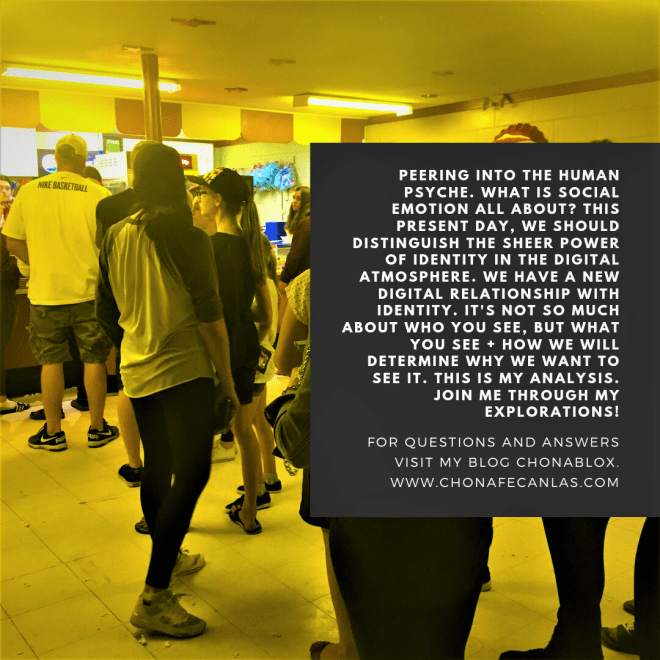
This content was developed prior to leaving VanWhistle Media. I wrote it in my small, orange notebook. I was thumbing through that today, putting some definitions together for my Definitions post. It’s amazing how you can return to something, months later and it has become more relevant than it was when it was originally written! The photo was taken at the Starlight Drive-In Theatre in Enderby, BC.

Social Emotion - Peering Into The Human Psyche

What do YOU think?

If you would like to see the Abstract for this post, shoot me an email anytime – info@chonafecanlas.com.

Cheers guys!

Launching #bloxbooks Sept. 17/19

Hey gang!

I’m starting a new regular topic called #bloxbooks.

It will showcase any recent books I’ve read and extracted elements that I believe are relevant to changing career paths or approaching life in a more creative + technical way.

My first book for this campaign is, Emergent Strategy by Adrienne Maree Brown.

Photo of book Emergent Strategy by Adrienne Maree Brown

The quote below is actually taken from the author’s blog. I find it ultra relevant as I search for the right company culture to work with.

Company culture is the personality of a company. It defines the environment in which employees work. Company culture includes a variety of elements, including work environment, company mission, value, ethics, expectations, and goals. – Definition from www.thebalancecareers.com

Brown’s post resonates with me, because it is primarily focused on trust and in my interpretation, what we should experience as Sellers & Buyers in the marketing, advertising and public relations industry.

Have a read and please let me know what you think!

trust the people who move towards you and already feel like home.

trust the people to let you rest.

trust the people to do everything better than you could have imagined.

trust the people and they become trustworthy.

trust that the people are doing their work to trust themselves.

trust that each breach of trust can deepen trust or clarify boundaries.

trust the people who revel in pleasure after hard work.

trust the people who let children teach/remind us how to emote, be still, and laugh.

trust the people who see and hold your heart.

trust the people who listen to the whales.

trust the people and you will become trustworthy.

trust the people and show them your love.

trust the people.

My favorite is: Trust the people who listen to the whales.

Psychology Today says, “Creativity comes through personal ecstatic experience, play, and a kind of osmosis: “Research conducted at the University of Kansas concludes that people from all walks of life show startling cognitive improvement — for instance, a 50 percent boost in creativity — after living for a few days steeped in nature.”

Do YOU believe in this? Why don’t we try?!

Organize a nature retreat for your team, or implement weekly yoga classes set outdoors. I remember when things got tough at my previous corporate job, I would schedule 5K runs at lunch to clear my brain and reset my mind to returning to a high performance environment (my job was that demanding).

I can usually say, if my body demands more exercise, it may be a sign of burnout, so it is imperative to carve out physical, mental and spiritual time to take care of yourself.

Do you feel this way when you’re overworked? Books can help, no?

The power is in us to incite wonder and change! 

Talk soon!

Redux – A Work in Progress

(Title inspiration: Reduxwood West)

Hi everyone!

You can find the original blog post under the name A Work in Progress (you can also find it under Technical Work on my homepage).

Since determining that my actual most fit vocation is art/creative direction (yay!), I had to update the original post for transparency and accuracy. I guess the act of doing that is responsible!

Another thing to clarify – saying ‘customized content solutions’ is just a more ambiguous way of saying art/creative direction. And, saying ‘define or refine your brand’ is my way of slowly dissecting the meaning of Digital Presence and how it can impact a business’ success. Is it not crazy to think only half a year ago I didn’t respect my artistry (and 20+ years of it)?! INSANE!

Imagine this graphic in a movie’s title credit (inspired by Star Wars).

Blox is an artistic identity that was developed in the early 2000s. Since then, it has become a moniker for Chona's creative and technical work embodying explorations of (a concept she developed called) Digital Pre


Passion & Efficiency

a.k.a. passion & efficiency (2)

9 – Coming Down

I’m so tired, Daisy thought. You’re always tired, retorted Cherry. She was just sitting there, twiddling her thumbs, looking at her green shoes. She turned her head right, was there something there? She suddenly felt uncomfortable. Someone was watching them. They didn’t know who.

It’s time to pack, dear. The routine was the same every June. Alice from Wonderland would arrive to take Daisy home. Daisy couldn’t do it without help. It was a sad time for her. She was remembering the death of her mom, those last few cigarettes she had outside with her dad, in the snow. She was really angry Being because of Ben. He ruined her life, led her astray. She was an addict when she was with him.

Forget thinking about it, darling. Alice stroked Cherry’s hair, handing her a cheese and ham biscuit. This is ridiculous. I’m practically choking on this bread, it’s getting lodged in my throat! I can’t take it anymore! By then, their tears were flowing, ruining everything including a pink dress and a gigantic muumuu.

All of the pupils present today were busy writing down their answers. Not me. I’m just going to sit it. Read his brain. Oh shit, he’s looking. The girls looked away, frantically grabbing their miniature Navajo backpacks, matching, gifts from the Philippines and their Auntie Stella.

Daisy? Can you contribute something to this discussion we’re having? Her teacher was frustrated, but tried his best to be kind and patient. Daisy twitched her mouth. No, I don’t think I can. They could feel every single eye in the room blink. Then, 999,999 heads turned to look at her. What were they expecting? She wasn’t going to put on a show. And especially not in this muumuu. Do you have anything to say, young miss? Neither had enough bitcoins to argue. Clearing her throat, Miss Daisy stood up. Cherry budged in front, knocking her sister to the floor. I bought these with my own cash! Dreams, actually. It was Toys clearly. Can any one of you in the room debate that? We highly think naught. And with haste, they flipped their skirts and left the room.

Flying through the wind, Cherry grabbed her big sister’s hand. They were going to be just fine.

Transparency


Abstract – that / this / things / work / jeans / hat

Hi everyone! Ready for some conceptual development? Let’s go!

Transparency is our ability to see through the madness. If you walk alongside an ad, a banner or a billboard, you are shuffling ahead, trying to get by the crowds surrounding your body and your spirit. This leaves you with little to no time to stop, to take a breath and to analyze what you see. But if you do have a moment, take it. Stop, breathe, then look. Let’s analyze this image as you would see it, if for example, you were walking through Burrard skytrain station (Vancouver, BC) trying to catch your ride home.

It’s so bold, you have to stop. Even if for 1 second. You’re wondering about the colours, the use of red + blue & light purple. Why would they do this? But look – a rabbit. It’s in the centre of the circle. I suppose we are trying to catch it, but it is getting away. That’s interesting! Softly positioned underneath, we see some text – A Technical Creative Company. Hmm. I guess this business is in the business of creating technical and creative things. And that is enough to think. A slight nod of his head, then he walks away.

From Wikipedia –

Hidden Markov Model (HMM) is a statistical Markov model in which the system being modeled is assumed to be a Markov process with unobservable (i.e. hidden) states.

In simpler Markov models (like a Markov chain), the state is directly visible to the observer, and therefore the state transition probabilities are the only parameters, while in the hidden Markov model, the state is not directly visible, but the output (in the form of data or “token” in the following), dependent on the state, is visible. Each state has a probability distribution over the possible output tokens. Therefore, the sequence of tokens generated by an HMM gives some information about the sequence of states; this is also known as pattern theory, a topic of grammar induction.

The adjective hidden refers to the state sequence through which the model passes, not to the parameters of the model; the model is still referred to as a hidden Markov model even if these parameters are known exactly.

Hidden Markov models are especially known for their application in reinforcement learning and temporal pattern recognition such as speechhandwritinggesture recognition,[7] part-of-speech tagging, musical score following,[8] partial discharges[9] and bioinformatics.[10]

Transparency. It is hard to see the writing, but I suppose this is a play on words. Let’s take a step aside to identify another idea that could possibly contribute to our exploration of transparency.

Shakespeare wrote –

All the world’s a stage, and all the men and women merely players: they have their exits and their entrances; and one man in his time plays many parts, his acts being seven ages.

As an exercise for my readers, let’s remove ‘seven ages’ and replace it with ‘seven goals’, which we can create to incorporate more visuality into our practice. If you are a business owner, define these seven goals around the fields of branding, marketing and sales. And in case you were wondering about the word visuality, https://www.merriam-webster.com describes it as –

Definition of visuality

1the quality or state of being visual or visible VISIBILITY
2a mental image or picture VIEWGLIMPSE

So, seven goals to incorporate more visuality into my business (acting as a business owner for Blox. Communications) –

(Goals should relate to the quality or state of being visible, as in advertising/PR and should relate to a mental image or picture, as in HOW our customers perceive our business and our products/services.)

  1. Define 1 main logo and 1 main tag;
  2. Consistently promote ChonaBLOX. blog (with URL) across all social media platforms (Facebook, Instagram, LinkedIn, Pinterest, Twitter);
  3. Come up with a consistent slogan for each identity (BLOX, ChonaBLOX. and Blox. Communications);
  4. Ensure each project/document aligns with established goal attributes – transparency, accuracy and responsibility;
  5. Speak and write using vivid and bold description;
  6. Speak and write following a linear and logical pattern;
  7. Establish brand identity using colour + text as a visual tool across all platforms.

Can you come up with something like this for your own business? For myself, transparency is creating an abstract concept, breaking it down for my reader, so that they can begin to understand the ways we see and interpret visual and/or written data, using innovative + mainstream techniques. This is a skill and it must be honed. If you are trying to establish or refine your brand, your marketing strategy or your sales approach, comprehension of innovative + mainstream ideas is imperative, especially in a visual state. Do you agree with this?

Back to our analysis…

(Ask yourself, can we jump from paragraph to paragraph? Does it distort the message?)

And it relates to the two images, because the first one is bold and the second one is more transparent. However, messaging does not exist along the same plane. Which image has more popularity? More relevance? More authority? More credibility? (These are SEO metrics to keep in mind.) The man, who I forgot to mention, wears a khaki-coloured trench coat and matching hat. He takes 5 steps back to re-read the word ‘transparency’. He quickly glances further back at the bolder image, then walks forward 8 steps to be faced directly with the more transparent image.

We have engaged our viewer. Transparency is a particular context that comments on HOW things work. Transparency, which lexico.com defines as – an image, text, or positive transparent photograph printed on transparent plastic or glass – is able to be viewed using a projector. Just as a frosted window engages its audience to peer in closer, these images encourage the same experience. Perhaps if the man looks closer, deeper, further into, he will begin to question HOW the messaging is working, while still taking in a normative meaning that most average ads, banners or billboards intend.

And visually speaking, the projector has imprinted the image in our minds, in our short and long term memory. In our digital collaborative state, the aim is to be able to study another’s work and run a real-time comparison to understand how someone else’s chosen elements could apply to and improve our chosen modes of communication. Again and again, we see that the stage is experiential and we must involve ourselves with interest and intention to reap any benefits for our business and our customers.

Members of the advertising discipline are playing many intentional ‘games’ that are designed to engage, enrapture and captivate a specific, targeted audience. Would you want your audience to be enthralled? Are there any downsides to this type of engagement? Is the experience itself enough?

Start

Hi everyone! This is a story about taking naps. What would you do if you could start your nap over again?

Day by day, she fought to stay awake. At night, facing the wall, she could see her breath come back, stirring her into place. Her gaze could only see an odd, black shadow.

The plague.

Napping feverishly on an ex-boyfriend’s mattress, my breath came to me, rousing my face. There was no odd black shadow, only the installation piece (University of Calgary, Faculty of Art, 2001) I completed about a red cross and red intersecting paint brushes. Over time, the red morphed into a black matte surface, replacing the glowing red symbols with something different…

The sound.

I gasped for air, clutching my heart staring into Kevin’s barren closet. I saw myself as a ‘doctor’, healing the world from every known pain of mankind. In that moment, my heart sung and I cried. I felt adorned, yet I was confused as to how this could have happened. How could this be a reality that I, Chona Fe, changed the world? Healed it, in fact. How could I be the charging force that put everything into place?

The only other time this happened, I was napping, this time at my aunt’s house in one of the empty rooms. (Note: Filipino homes always have empty rooms; they’re probably accommodating ghosts.) All of the 90s furniture, including a stark, reflective black master’s bedroom set, had no meaning or design in that place. That place where I slumbered and was suddenly awoken again. I think I was 13, sitting up abruptly on the right side of the bed, staring at myself. Yelling. Screaming at the top of my lungs.

Stop!

I wasn’t looking at a reflection of ours.

The reflection.

My brother (Alan Abad) and cousins (Ryan and Vanessa Skinner), ran home from the playground in the centre of the crescent (71 Maryvale Cr. N.E., Calgary, AB). They heard me scream. They were horrified to think something horrible had happened. But nothing did. I was alive. I wasn’t attacked or eaten by monsters. Vanessa grabbed my shoulders, shaking vigorously and I blinked slowly three times, “What. The. I…don’t know what just happened, but I think…I died and saw…a different person…in…” I couldn’t even continue. It was that bad.

Scared?