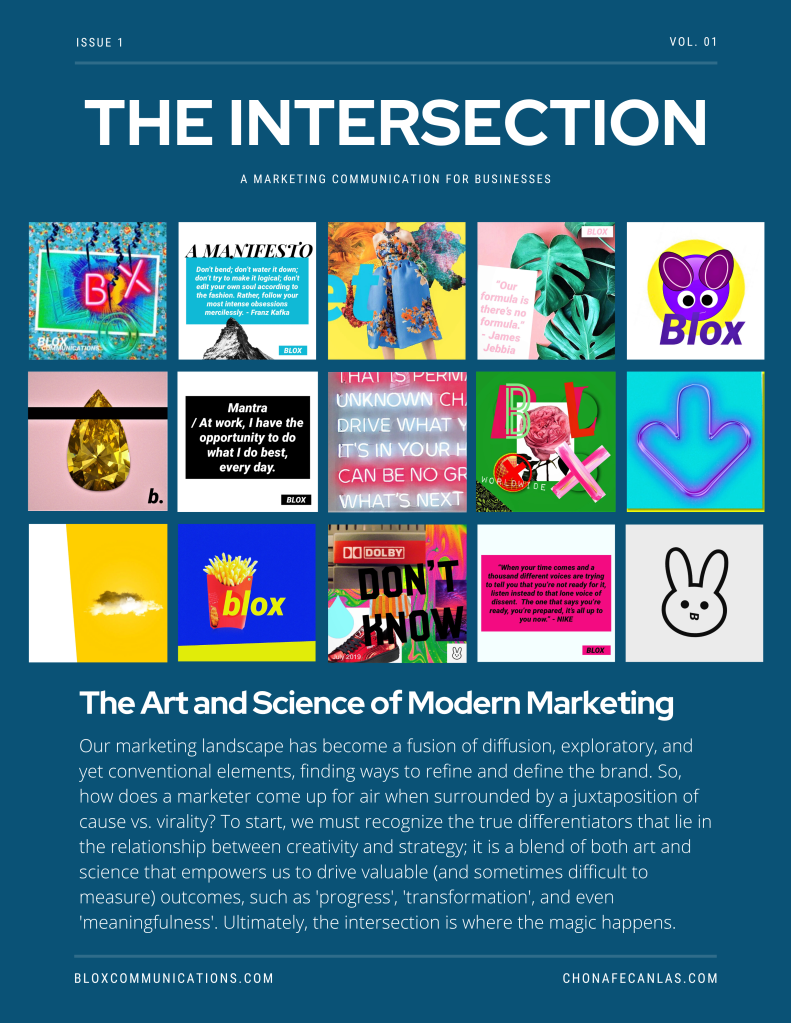
First Issue of The Intersection

I’ve made some refinements to the original issue, which I previously posted as a plug for a podcast idea (see the updated written version below). If you’re wondering, yes, I still want to start a marketing podcast. I’m still exploring ideas on how to execute all of this. Likely, it will be a monthly contribution, again, following relevant topics around ‘A Marketing Communication for Businesses’.

This serves as inspiration and is also creative fuel for my passion project—Blox. Communications, a marketing consultancy and a project I’m building alongside my professional career as a Marketing Manager. It’s a service-based platform designed to support mid-sized businesses across sectors, including but not limited to manufacturing, distribution, and tech, with bold (a.k.a. creative), strategy-driven marketing solutions that connect, differentiate, and drive results.

If you have a project in mind that sparks your interest or if you’re struggling to find direction for your marketing department, let’s discuss and create a plan tailored to your needs!

The website is being developed, but so far you can take a look here.

And if you’re curious, it has been a long time since I’ve posted. Life has been uber busy, and while I know that is the lamest excuse, believe me, I remain dedicated and committed to my art, writing, and design! Posts to come – promise!

For now, enjoy reading The Intersection, and as always, I am open to hearing your feedback or suggestions. Talk soon.

The Intersection Podcast – Vol. 1

I would love to share my thoughts and ideas through different formats this year. I created a sort of newsletter and thought to read it aloud and say, ‘This is my first podcast.’ It’s just an idea that could turn into something real, depending on this marketing journey of mine. I hope you enjoy it, and feel free to provide any feedback—I appreciate it!

The Rule of Reciprocation

Next up – Dr. Robert Cialdini‘s Rule of Reciprocation!

Revelation. I’ve taken up something I’m sure a million (or more) of you do. I’m back to listening to ebooks while driving to work. Haha – and you thought it would be something more complicated! I did it before but found I was getting bored of it. I’m unsure if it’s the drone of narration or my susceptibility to zoning in and out. Probably a mixture of both. Alas, as part of my year of sharing insights, I thought it would make sense to dedicate myself to it again. 

So, today, I want to talk about reciprocity in marketing. From a psychological standpoint, this rule is simple. What you give is what you get. We tend to feel obligated to return a favour or gesture after receiving something from someone else. If I come back from the cafe with a donut for you, you will likely buy me a baked good the next time you’re picking up a coffee. 😉 

In marketing, this sense of indebtedness in our actions, or more specifically, messaging, can steer our audience to feel more motivated or compelled to make a decision that will impact their buying trajectory. For example, as part of our ABM strategy, I put together a booklet and sample kit for prospective customers. The act of sending and receiving the package in the mail is not only thoughtful but leverages something of value, something tactile and beautiful, something helpful and intriguing that, in turn, can help the receiving party better understand where our brand comes from and ultimately, our passion and intention of supporting the design and construction community through not only inspiring architecture but inspiration, in and of itself!

Creating this cycle of giving and receiving strengthens social connections and encourages cooperative behaviour among individuals and groups within communities, small and big. I see it as small steps of action becoming big sips of gratitude and many more meaningful opportunities in the future!

Have you taken a reciprocal step? In what way did it change the trajectory of your day? Your goals? Your journey as a marketer?

A brief Forbes article by Jeff Bradford sums it up pretty sweet – https://bit.ly/3NVpYUd

Not done yet! Reciprocity has even been known to foster creativity and innovation, such as this Adobe example in a short Medium article – https://bit.ly/48McaDl

2024 – The Year of Insights

I want to make 2024 the year to share some insights. I have time! You have time! We all have time! While perfecting pour-overs, tackling big hills on runs, or when driving into work – these are all great opportunities to listen and learn something valuable, even if just one small concept, it could turn into a big change-maker!

First up is the Cube of Creativity by marketing strategist Andrew Davis. This framework can help marketers leverage their creative process to promote innovation and encourage better outcomes.

To apply this shift in mindset, we need to be open to embracing constraints, defined by the four sides of a cube –

1 – Eliminate the Unnecessary
2 – Define a Single, Measurable Outcome
3 – Add Unreasonable Creative Constraints
4 – Raise the Stakes

To learn more, check out this episode of the Social Media Marketing Podcast with Michael (Mike) Stelzner – https://bit.ly/3TV2D8T

You can also find more details here – https://bit.ly/3TRFJiF

Hope everyone is off to a productive and fulfilling new year!

What Is a Fighter Brand?

Fight.

Fight for what’s right.

Fight for it’s worth.

A fighter brand is when a company introduces a new, lower-priced product or brand to compete directly with its own existing products or with those of its competitors.

The purpose of a fighter brand is to target price-sensitive consumers who may otherwise choose a competitor’s cheaper alternatives, thereby protecting the company’s market share and overall brand image.

Pros

Market Segmentation: A fighter brand allows you to target different market segments simultaneously. It enables you to cater to both price-conscious consumers and those who are willing to pay a premium for your main brand, thus widening the client base.

Competitive Advantage: By offering a lower-priced option, you can directly challenge your competitors on price. It can capture clients who prioritize cost savings without undermining the reputation or sales of your higher-priced main brand.

Risk Mitigation: In the face of tough economic conditions or fluctuations in consumer preferences, the fighter brand can act as a buffer for your overall performance. If consumers tighten their budgets, they may switch to the more affordable fighter brand, maintaining sales for you.

Brand Loyalty: Clients who begin their journey with the fighter brand may eventually move up to your main brand if they have a positive experience. It can create brand loyalty within the client base, potentially increasing long-term client retention.

Cons

Cannibalization: One of the significant risks associated with fighter brands is the potential for cannibalization of sales. If the fighter brand draws clients away from your main brand without attracting new clients, overall revenue could suffer.

Brand Dilution: Introducing a lower-priced brand may lead to a perception of reduced product quality or brand dilution. If not managed carefully, it can negatively impact the image of your main brand, especially if clients associate the fighter brand with inferiority.

Marketing Costs: Successfully launching and maintaining a fighter brand requires investment in marketing and advertising. If the returns on this investment are not significant, it could strain your financial resources.

Logistical Complexity: Operating multiple brands can add complexity to your supply chain, distribution, and inventory management processes. It requires careful coordination and management.

Impact on a Growing Company:

For a growing company, introducing a fighter brand could have several implications:

Competitive Edge: In a competitive market, launching a fighter brand could help you gain a competitive edge by offering a more affordable alternative to your existing products and those of your competitors. This could attract budget-conscious clients and win market share.

Revenue Stability: Economic downturns or fluctuations in any industry can affect purchasing behavior. The fighter brand could help maintain revenue stability during challenging times by capturing price-sensitive clients.

Customer Acquisition and Loyalty: The fighter brand can act as a stepping stone for clients who are initially hesitant to invest in your main brand’s premium products. If they have a positive experience with the fighter brand, they may become loyal clients and eventually upgrade to the main brand.

Product Diversification: Introducing a fighter brand allows you to diversify your product portfolio and address the needs of a broader client base. This diversification can reduce reliance on a single product line and expand market reach.

Challenges in Brand Management: You must carefully manage your marketing and positioning of the fighter brand to avoid brand dilution and cannibalization. Clear differentiation between the fighter brand and the main brand is essential to maintain their distinct identities.

Operational Considerations: The introduction of a new brand may require adjustments to your processes, supply chain, and distribution channels. Proper planning is necessary to handle the increased logistical complexity.

In summary, a fighter brand can be a valuable strategy for a growing company. One main benefit of developing a fighter brand is that clients who initially purchase from the fighter brand might be enticed to upgrade entirely to or add-on different products and services as their needs and budgets evolve. This can foster long-term client loyalty (a longer term marketing strategy). To solidify a fighter brand’s market position, you would need to develop a clear communication strategy to explain the relationship between the main brand and the fighter brand to avoid confusion among clients.

I’m going to share more explorations on brand types in coming posts, so stay tuned!

Saccharine

Critical Mass – Studying Team Endurance

When Friday Turns to Saturday…

Member A – Marketing is a constantly evolving landscape. 

Member B – Ideas ignite and fizzle away.

Member C – A structured and creative ebb and flow transpires.

Member D – New campaigns take flight. 

.

.

.

.

.

.

Evolution.

We seek out different and diverse points of view, embrace and respond to change, and plan only to a level sufficient to ensure effective prioritization and execution. We find ourselves encountering a phenomenon called—CRITICAL MASS.

Akin to when celestial planets align, critical mass is that single yet multifarious moment when our efforts transcend the ordinary and catapult into the extraordinary. It’s a transformative point when our brand’s message resonates with such force that it achieves unstoppable momentum, similar to a cascading waterfall or an awe-inspiring avalanche.

Achieving critical mass can ignite a spark in the collective consciousness of a team, sparking a wildfire of enthusiasm that spreads contagiously through diligent becomings – social networks, word-of-mouth, and media channels. One clever idea can transform into an iconic cultural touchstone, etching your brand’s identity into the minds of engaged onlookers everywhere.

When an idea reaches critical mass, it propels forward and impacts a team’s ability to meet goals.

Here are some ways your team can make that impact based on some common marketing objectives – 

Boost Brand Awareness

As your name, products, and services become more recognized, brand awareness will naturally increase. When your brand reaches a certain level of visibility, popularity, or adoption, it triggers a self-sustaining momentum (critical mass), fostering a positive feedback loop that fuels growth and solidifies your brand’s position in the market.

Obtain New Clients

Your team can focus on targeted campaigns to showcase your USP (unique selling proposition) and differentiators while also highlighting your clients’ success stories and effectively communicating the value of your product to attract a steady stream of interest (demand generation), then ultimately converting that interest into actual sales and new clients (client acquisition).

Strengthen Relationships with Existing Clients

You can contribute to this effort by implementing a preferred client program, personalizing your internal and external communication via channels like social media, email, and content, and creating a detailed plan and strategy around launching new products that address client challenges, needs and pain points. 

Increase Sales

As your market presence and brand awareness expand, so does sales potential. A larger customer base combined with the effective execution of a strategy will lead to more opportunities. Your marketing team can collaborate closely with your sales team to generate and nurture high-quality leads, provide sales enablement materials, and optimize the customer journey to convert prospects into loyal clients.

So, what do you think?

Critical mass is a powerful catalyst for any growing team. By reaching this point of substantial growth and influence, your team’s efforts – recognizing ‘critical mass’ as it occurs and creating models to emulate its course – become pivotal in driving continued success. 

Inspiration can be a behemoth, and it is waiting for y’all!

Usurp Your Words – Define Your USP by Finding an Emotional Connection

Your USP or Unique Selling Proposition is what differentiates your business from others in the marketplace. It’s also the reason why clients should choose you over a competitor. A USP informs every business modality—brand management, slogans, developing and describing new products and services, and how you interact with clients. A strong USP will put your clients’ needs front and center. 

One technique you can follow to create impactful USPs is What’s In It For Me? (WIIFM). Here’s a bit about it:

The problem with promoting product features is that it does not always create an emotional connection with the consumer.

Without an emotional connection, chances of completing a transaction, whether a sale or simply a positive exchange (think: being swayed by an advertisement), reduce significantly. By answering the WIIFM question from the perspective of your target audience, you can start to understand their needs and develop clear and concise messaging around how your business can help them achieve their goals.

The central theme of your message should be the benefits offered. You shouldn’t confuse benefits with features (as in, you should describe the benefits they bring versus just listing features). Focus on the impact your clients will experience and the resulting emotional outcome. 

Your WIIFM answer is what your clients look for when encountering you, your product, and the message you want to transmit. As a final point, you shouldn’t assume that because you understand it, everyone else does too. Develop an engaging, compelling, and accurate brand voice for your company that speaks to a vital concept (for example, for me at Longboard, it’s Inspiring Architecture). 

What are your ideas about creating and promoting an effective USP? Here are some examples of USPs I wrote for my company. What are your thoughts? I would love to hear them; reach out to me anytime!

Why I Love Asynchronous Communication (a.k.a. Emails)

I love to write, and emails are a breath of fresh air.

No editing.
No fancy words.
No issues over length.
No need for profundity.

It has been almost five years since I left Bell Mobility to pursue a career in marketing, and one thing that has drastically changed is how often I communicate via email.

I miss the simplicity of it all.
I miss reaching out to my clients daily.
I miss the back-and-forth motion that builds connection.

At Bell, I had so many great relationships; I used email to build better ones along the way. It was just so damn efficient. Templates allowed the writing to take shape quickly. In mere minutes, I was sending off concise and compelling messages. Over and over again. Each email was re-read once, at most twice, and then sent so I could continue to the next case. It was a beautiful workflow, and it was all supported by Salesforce.

The strategy behind it? Starting, stopping, continuing. Perpetually. The true definition of email really—asynchronous. This is also marketing. For a later topic!

And by the way, I am trying to write more like Seth Godin. Also, finding my way back to my university days. My favourite professor and mentor, Paul Woodrow, graded an essay I wrote on the fallacies of Coca-Cola, commenting in tiny writing and bright green ink, “Swift and punchy, Chona!”

So begets my email manifesto –

I will always try to write swift and punchy. 

If I can remember to, that is.

Alas, I have a pop quiz for y’all.

I want you to decide which entry below is authentic, meaning not edited. And which one is “fake”, as in completely and utterly revised from its original style + tone.

How can you tell?
What gives it away?
Which is written better?

Ah, so many questions to ponder, but if only we had more time.

Off to bed, now, enjoy the exercise!

Entry 1

For all my years as a Corporate Account Manager at Bell, some of my fondest memories included writing emails. I loved how fluid and uncomplicated it was to craft messages on the spot without spending copious amounts of time editing. I would not mind working on some ideas to “wow” our current and prospective customers with something easy to read, memorable, and impactful!

Entry 2

I spent many years as a Corporate Account Manager at Bell, crafting friendly and professional emails. I thought it was so exciting (yup, I love communication!) to be able to write something on the spot that didn’t require any editing. It’s an art form really. Would love to work on some ideas to incorporate more emails into how we communicate with our customers.