Launching #bloxbooks Sept. 17/19

Hey gang!

I’m starting a new regular topic called #bloxbooks.

It will showcase any recent books I’ve read and extracted elements that I believe are relevant to changing career paths or approaching life in a more creative + technical way.

My first book for this campaign is, Emergent Strategy by Adrienne Maree Brown.

Photo of book Emergent Strategy by Adrienne Maree Brown

The quote below is actually taken from the author’s blog. I find it ultra relevant as I search for the right company culture to work with.

Company culture is the personality of a company. It defines the environment in which employees work. Company culture includes a variety of elements, including work environment, company mission, value, ethics, expectations, and goals. – Definition from www.thebalancecareers.com

Brown’s post resonates with me, because it is primarily focused on trust and in my interpretation, what we should experience as Sellers & Buyers in the marketing, advertising and public relations industry.

Have a read and please let me know what you think!

trust the people who move towards you and already feel like home.

trust the people to let you rest.

trust the people to do everything better than you could have imagined.

trust the people and they become trustworthy.

trust that the people are doing their work to trust themselves.

trust that each breach of trust can deepen trust or clarify boundaries.

trust the people who revel in pleasure after hard work.

trust the people who let children teach/remind us how to emote, be still, and laugh.

trust the people who see and hold your heart.

trust the people who listen to the whales.

trust the people and you will become trustworthy.

trust the people and show them your love.

trust the people.

My favorite is: Trust the people who listen to the whales.

Psychology Today says, “Creativity comes through personal ecstatic experience, play, and a kind of osmosis: “Research conducted at the University of Kansas concludes that people from all walks of life show startling cognitive improvement — for instance, a 50 percent boost in creativity — after living for a few days steeped in nature.”

Do YOU believe in this? Why don’t we try?!

Organize a nature retreat for your team, or implement weekly yoga classes set outdoors. I remember when things got tough at my previous corporate job, I would schedule 5K runs at lunch to clear my brain and reset my mind to returning to a high performance environment (my job was that demanding).

I can usually say, if my body demands more exercise, it may be a sign of burnout, so it is imperative to carve out physical, mental and spiritual time to take care of yourself.

Do you feel this way when you’re overworked? Books can help, no?

The power is in us to incite wonder and change! 

Talk soon!

Redux – A Work in Progress

(Title inspiration: Reduxwood West)

Hi everyone!

You can find the original blog post under the name A Work in Progress (you can also find it under Technical Work on my homepage).

Since determining that my actual most fit vocation is art/creative direction (yay!), I had to update the original post for transparency and accuracy. I guess the act of doing that is responsible!

Another thing to clarify – saying ‘customized content solutions’ is just a more ambiguous way of saying art/creative direction. And, saying ‘define or refine your brand’ is my way of slowly dissecting the meaning of Digital Presence and how it can impact a business’ success. Is it not crazy to think only half a year ago I didn’t respect my artistry (and 20+ years of it)?! INSANE!

Imagine this graphic in a movie’s title credit (inspired by Star Wars).

Blox is an artistic identity that was developed in the early 2000s. Since then, it has become a moniker for Chona's creative and technical work embodying explorations of (a concept she developed called) Digital Pre


Tweedle Seller & Buyer Lookin’ Right

5F3E09B7-5BCD-42CA-B42F-CDFF95AA6189

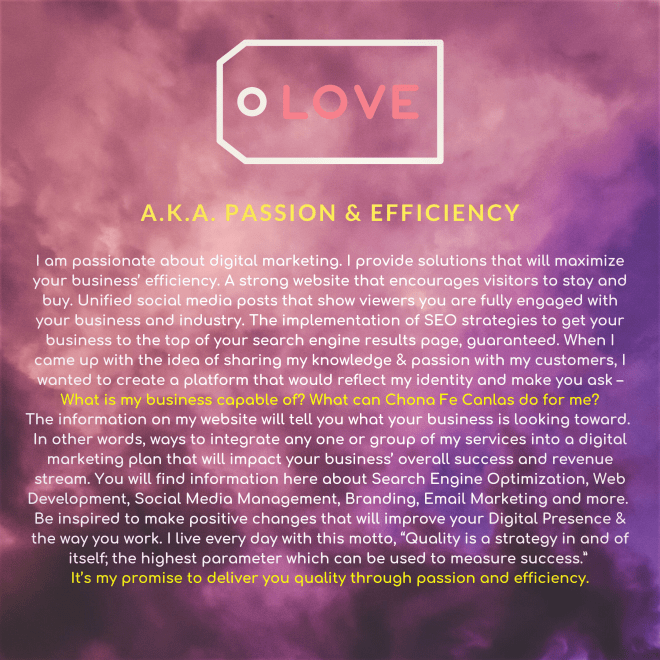
Passion & Efficiency

a.k.a. passion & efficiency (2)

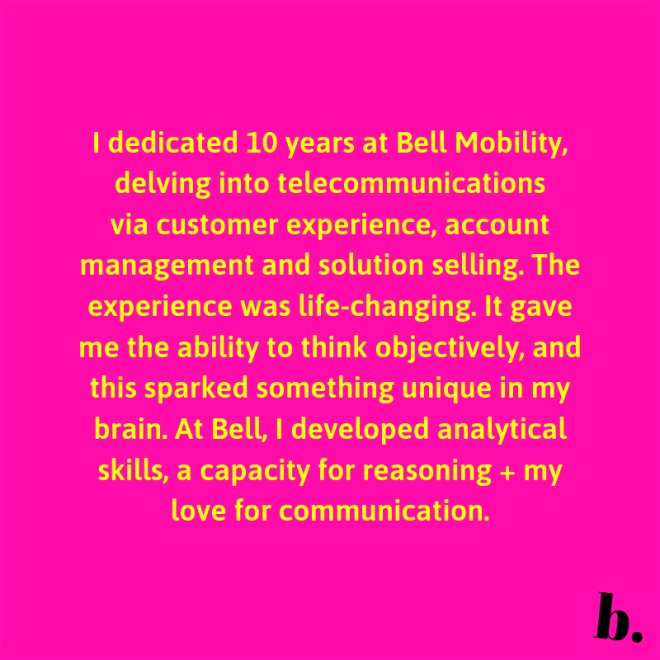
Past Experience

I dedicated 10 years at Bell Mobility, delving into telecommunications via customer experience, account management and solution selling. The entire experience was life-changing. It gave me the ability to think (2)

Copy of Untitled Design (1)

SEO

Hi everyone!

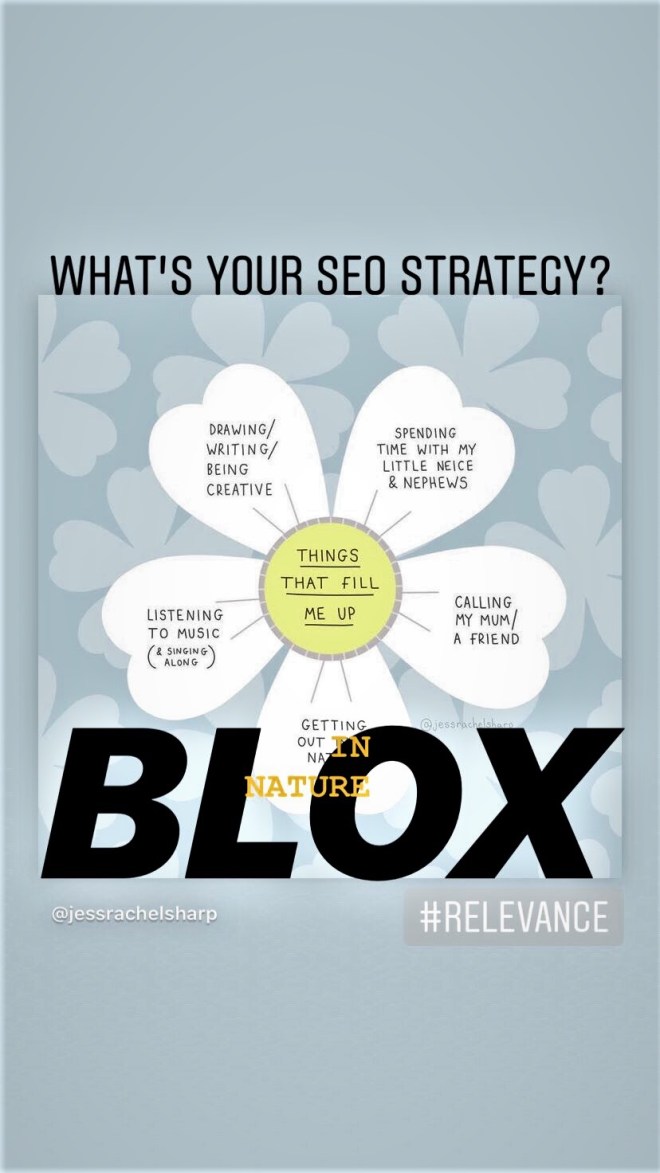
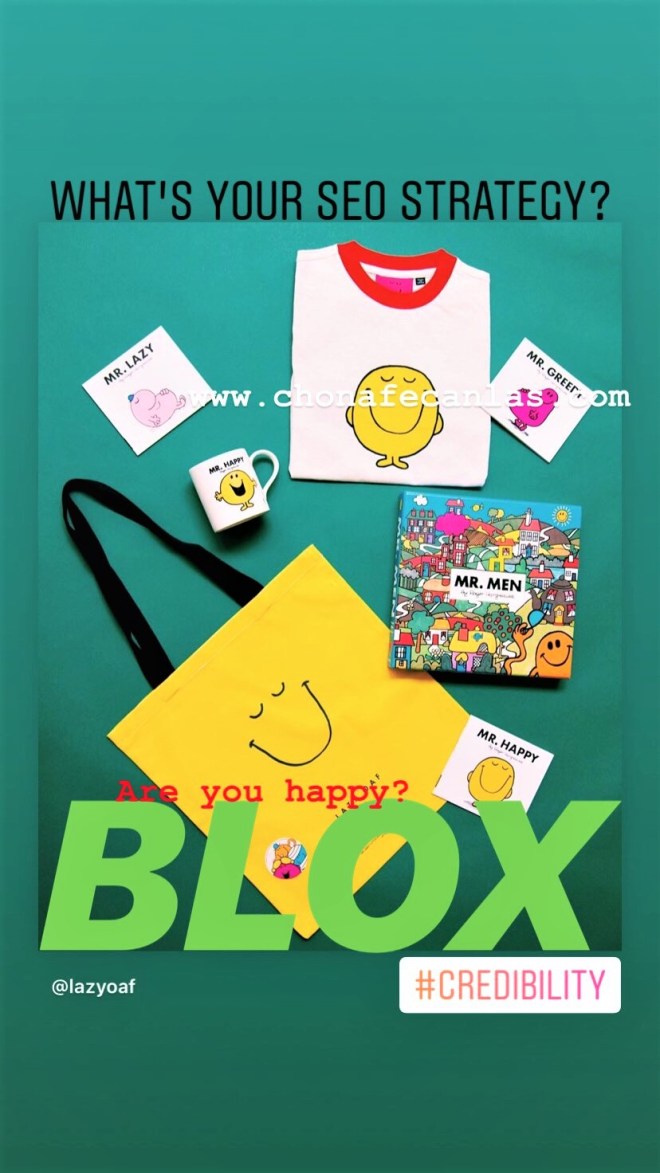
Just a short burst of info here. What are you drawn to? Do the colours play a significant role in your interpretation? What connections can you make with the chosen imagery attached to each hashtag?

A perfect brainstorming exercise for design newbies – make a list under each hashtag including transferable elements (actual aspects and items like a brand name or object) and attributes (descriptions and words) for each. Aim for 50 answers, then narrow down to your top 10 answers, then again to your top 3, then top 1. What conclusion can you draw from this experiment?

Always remember the acronym PRAC – Popularity, Relevance, Authority & Credibility. This will help you target your audience and ensure that your content is set up to improve your overall search engine rankings.

Yes, yes…SEO is a lot more complex than a simple acronym, but sometimes starting off with something more general helps to develop your digital marketing strategy or plan more succinctly down the road.

I will get into this topic (SEO) further in the  future!

8516971dc8824311b90739d6057393fc_Moment

3BC9F832-AADE-448A-A8C6-FBD0EEE0A5CE

FA7C92B5-50E1-40FE-A711-714E4251A799.jpg

B63AA3B1-EB38-4600-A85B-35C7CC4B6A72.jpg

Visual Transparency

Hi everyone!

Today’s topic is SMART Goals.

A brief definition of each objective and an example of how each objective can be applied to achieve an effective creative technical writing style.

Here, I am writing about visual transparency as it relates to an image I designed for Blocks, my first and ongoing social media management strategy. Blocks aims to explore left and right-brained thinking and our ability to control destiny (or in simpler terms, improve issues of self-image or esteem.) Note: Initially, I was going to include the image in this post, but the relevance of my imagery is too swift. I will always include my most recent works to keep you up-to-date with my current visual style and tone.

As an extra creative exercise, try to imagine a fruit to attach to each objective. How does it relate to the SMART goal and our definition of visual transparency? Could you affix these tasty symbols to a billboard? What would be the significance? How effective would say, a giant teal apple be at communicating a specific message?

I will post the fruits on my next post tomorrow!

BEGIN

HEADING: The heading is the text indicating the nature of the article below it. The large type front page headline did not come into use until the late 19th century when increased competition between newspapers led to the use of attention-getting headlines. (Wikipedia)

WILL IT ENTICE YOU IN A GLANCE?

SUBHEADING: For documents longer than 3 or 4 paragraphs, subheadings are an important usability and accessibility strategy to help readers both determine the overall outline of the document and to navigate to specific information on the page.

VISUAL TRANSPARENCY AS A COMMUNICATIONS STRATEGY

SPECIFIC: Goals that are specific have a significantly greater chance of being accomplished. It should be well-defined, clear, and unambiguous. Essentially a definition of your idea that allows your audience to understand your topic more accurately. (CFI)

Visual transparency, from an artist’s standpoint, is a form of contextual openness that allows viewers to become engaged on a more subconscious or subliminal level.

MEASURABLE: Goals that are measurable have criteria for measuring progress. Criteria can be in line with your vision, mission, values etc. The point is to measure your progress somehow, for example, how would you measure engagement or participation? Is the action itself significant enough? In writing, a statement of intent is a great way to achieve a sense of measurability. (CFI)

As a writer and digital specialist, the goal is to be transparent, accurate and responsible. As an artist, I simply want to be engaged with my work and for my viewers to participate. Note: professional transparency has more to do with how others perceive you and what your actions say about your brand.

ATTAINABLE: Goals that are attainable help you figure out ways you can realize an objective and work towards it. The achievability of the goal should be stretched to make you feel challenged, but defined well enough that you can actually achieve it. It would be a good time to insert your call to action here. (CFI)

With all of the outlets available, viewers can participate using whichever preferred medium they desire. And they don’t need to be 100% engaged for it to matter. For example, your interaction with a billboard might only last 5 seconds, so the argument could be that visual transparency is actually quite critical.

RELEVANT: Goals that are relevant must be realistic given the available resources and your timeline. What would be the innovative or mainstream approach? What are pertinent examples you can showcase? What will be the outcome? Ideal or realistic? Your exploration should be relevant to your life’s or work’s purpose. (CFI)

This is who we are today. We embrace a fast and furious approach to everything and criticize the results. From placing mobile food orders to providing subscribers with a mere minute to execute a successful Instagram (video) campaign – the faster we engage our viewers while applying visual transparency, the more likely we can succeed in delivering our message.

TIME-BOUND: Goals that are time-bound must have a sense of a start and finish date. What is it like today, what will it be like in the future? If the goal is not time constrained, there will be no sense of urgency or motivation to achieve the goal. What is causing the urgency for action? Are we in a position to answer or question? (CFI)

Perhaps one day it will be different, but for now artists and marketers must adapt to these swift modes of communication. Visual transparency will become the norm, then who knows what will be next…

END

Does using the SMART goal technique help you? I believe that it is a great stepping stone towards achieving a more clear and linear style of communication. Test it out!

Meanwhile, dear Alice is still falling…

down?

below?

towards?

76c60b704f37267d3082e8effe39302d

Meaningfulness

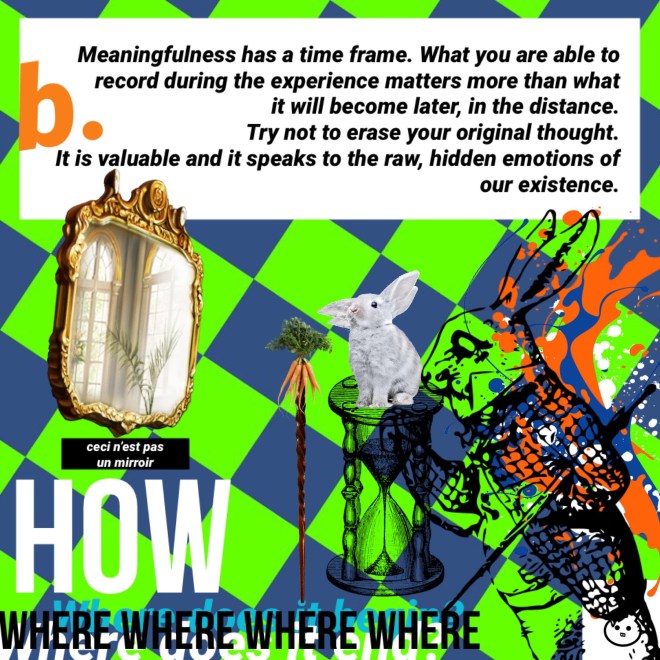
Editing could quite possibly be the treachery of writing! Overly edited content may tell readers, “This is not false.” On the other side, the raw construction of content is meaningful, but we should argue that the deliberate deconstruction of content to reveal a greater point of view (proper editing) more readily achieves the goals of an SEO/l or a communications strategy – to uphold popularity, relevance, authority and credibility and to distribute a message that is transparent, accurate and responsible.

C122F4BD-D35D-4EF5-AAFA-0AFAF1447EFD

This piece is inspired by a very popular surrealist painting, Ceci n’est pas une pipe by René Magritte. Ironically, my image overloads the viewer with elaborate messages (a commentary on keywords perhaps), whereas Magritte’s painting is a basic review of signified and signifier. Here’s some additional information taken from Wikipedia

The Treachery of Images (French: La Trahison des images) is a 1929 painting by surrealist painter René Magritte.

The painting shows a pipe. Below it, Magritte painted, “Ceci n’est pas une pipe“, French for “This is not a pipe”.

The famous pipe. How people reproached me for it! And yet, could you stuff my pipe? No, it’s just a representation, is it not? So if I had written on my picture “This is a pipe”, I’d have been lying! (Magritte)

Do you enjoy the process of editing? How do you know when to stop and is this action directly related to the meaningfulness of a  message, because content becomes inherently closer to ‘an answer’ or ‘a reality’? Which one for you?

Transparency


Abstract – that / this / things / work / jeans / hat

Hi everyone! Ready for some conceptual development? Let’s go!

Transparency is our ability to see through the madness. If you walk alongside an ad, a banner or a billboard, you are shuffling ahead, trying to get by the crowds surrounding your body and your spirit. This leaves you with little to no time to stop, to take a breath and to analyze what you see. But if you do have a moment, take it. Stop, breathe, then look. Let’s analyze this image as you would see it, if for example, you were walking through Burrard skytrain station (Vancouver, BC) trying to catch your ride home.

It’s so bold, you have to stop. Even if for 1 second. You’re wondering about the colours, the use of red + blue & light purple. Why would they do this? But look – a rabbit. It’s in the centre of the circle. I suppose we are trying to catch it, but it is getting away. That’s interesting! Softly positioned underneath, we see some text – A Technical Creative Company. Hmm. I guess this business is in the business of creating technical and creative things. And that is enough to think. A slight nod of his head, then he walks away.

From Wikipedia –

Hidden Markov Model (HMM) is a statistical Markov model in which the system being modeled is assumed to be a Markov process with unobservable (i.e. hidden) states.

In simpler Markov models (like a Markov chain), the state is directly visible to the observer, and therefore the state transition probabilities are the only parameters, while in the hidden Markov model, the state is not directly visible, but the output (in the form of data or “token” in the following), dependent on the state, is visible. Each state has a probability distribution over the possible output tokens. Therefore, the sequence of tokens generated by an HMM gives some information about the sequence of states; this is also known as pattern theory, a topic of grammar induction.

The adjective hidden refers to the state sequence through which the model passes, not to the parameters of the model; the model is still referred to as a hidden Markov model even if these parameters are known exactly.

Hidden Markov models are especially known for their application in reinforcement learning and temporal pattern recognition such as speechhandwritinggesture recognition,[7] part-of-speech tagging, musical score following,[8] partial discharges[9] and bioinformatics.[10]

Transparency. It is hard to see the writing, but I suppose this is a play on words. Let’s take a step aside to identify another idea that could possibly contribute to our exploration of transparency.

Shakespeare wrote –

All the world’s a stage, and all the men and women merely players: they have their exits and their entrances; and one man in his time plays many parts, his acts being seven ages.

As an exercise for my readers, let’s remove ‘seven ages’ and replace it with ‘seven goals’, which we can create to incorporate more visuality into our practice. If you are a business owner, define these seven goals around the fields of branding, marketing and sales. And in case you were wondering about the word visuality, https://www.merriam-webster.com describes it as –

Definition of visuality

1the quality or state of being visual or visible VISIBILITY
2a mental image or picture VIEWGLIMPSE

So, seven goals to incorporate more visuality into my business (acting as a business owner for Blox. Communications) –

(Goals should relate to the quality or state of being visible, as in advertising/PR and should relate to a mental image or picture, as in HOW our customers perceive our business and our products/services.)

  1. Define 1 main logo and 1 main tag;
  2. Consistently promote ChonaBLOX. blog (with URL) across all social media platforms (Facebook, Instagram, LinkedIn, Pinterest, Twitter);
  3. Come up with a consistent slogan for each identity (BLOX, ChonaBLOX. and Blox. Communications);
  4. Ensure each project/document aligns with established goal attributes – transparency, accuracy and responsibility;
  5. Speak and write using vivid and bold description;
  6. Speak and write following a linear and logical pattern;
  7. Establish brand identity using colour + text as a visual tool across all platforms.

Can you come up with something like this for your own business? For myself, transparency is creating an abstract concept, breaking it down for my reader, so that they can begin to understand the ways we see and interpret visual and/or written data, using innovative + mainstream techniques. This is a skill and it must be honed. If you are trying to establish or refine your brand, your marketing strategy or your sales approach, comprehension of innovative + mainstream ideas is imperative, especially in a visual state. Do you agree with this?

Back to our analysis…

(Ask yourself, can we jump from paragraph to paragraph? Does it distort the message?)

And it relates to the two images, because the first one is bold and the second one is more transparent. However, messaging does not exist along the same plane. Which image has more popularity? More relevance? More authority? More credibility? (These are SEO metrics to keep in mind.) The man, who I forgot to mention, wears a khaki-coloured trench coat and matching hat. He takes 5 steps back to re-read the word ‘transparency’. He quickly glances further back at the bolder image, then walks forward 8 steps to be faced directly with the more transparent image.

We have engaged our viewer. Transparency is a particular context that comments on HOW things work. Transparency, which lexico.com defines as – an image, text, or positive transparent photograph printed on transparent plastic or glass – is able to be viewed using a projector. Just as a frosted window engages its audience to peer in closer, these images encourage the same experience. Perhaps if the man looks closer, deeper, further into, he will begin to question HOW the messaging is working, while still taking in a normative meaning that most average ads, banners or billboards intend.

And visually speaking, the projector has imprinted the image in our minds, in our short and long term memory. In our digital collaborative state, the aim is to be able to study another’s work and run a real-time comparison to understand how someone else’s chosen elements could apply to and improve our chosen modes of communication. Again and again, we see that the stage is experiential and we must involve ourselves with interest and intention to reap any benefits for our business and our customers.

Members of the advertising discipline are playing many intentional ‘games’ that are designed to engage, enrapture and captivate a specific, targeted audience. Would you want your audience to be enthralled? Are there any downsides to this type of engagement? Is the experience itself enough?

Welcome

Hi everyone!

What type of woman would you hire to help brand your business? What marketing skills should she hold? What type of sales personality will she have? Is she strong, independent and willing to change in order to meet and exceed current industry objectives?

collage (48)